
1. Nga korero haumaru
This Neoteck Clamp Meter is designed and manufactured to meet CAT III 600V safety standards, providing superior defense against high-voltage transients. Always adhere to the following safety precautions to prevent electric shock or personal injury.
- Kaua apply more than the rated voltage, kua tohuhia ki te mita, i waenga i nga pito, i waenga ranei i tetahi tauranga me te whenua whenua.
- Kia tino tupato i te wa e mahi ana me te voltagkei runga ake i te 30V AC RMS, te tihi 42V, te 60V DC ranei. Ko enei voltaghe morearea ohorere.
- I nga wa katoa use the meter with the correct function and range selected.
- Tirotiro test leads for damaged insulation or exposed metal before use. Replace if damaged.
- Whakaritea the battery cover is securely closed before operating the meter.
- Kaua operate the meter if it appears damaged or is not functioning properly.
- Parenga taumaha: The meter features intelligent anti-burnout and overload protection across all ranges.

Whakaahua: Roto view of the Neoteck Clamp Meter, highlighting double safety protection and overload protection features. The device complies with CAT III 600V security level standards.
2. Hua Neke Atuview
The Neoteck Clamp Meter MY2610D is a versatile digital multimeter designed for comprehensive electrical troubleshooting in home, automotive, industrial, and HVAC applications. It offers True RMS measurements for accurate readings on non-sinusoidal waveforms.
Āhuatanga matua:
- 800A AC/DC Current: Measures high current with a 26mm high-capacity jaw.
- RMS Pono: Provides accurate measurements for AC/DC voltage, resistance, capacitance, frequency, and duty cycle.
- Te Kitenga NCV: Kore-Whakapā Voltage detection for live wire checking.
- Diode and Continuity Test: Essential for circuit diagnostics.
- Ine inenga: Includes a K-type thermocouple.
- Āhuatanga ratarata-kaiwhakamahi: Data hold, bright backlight, flashlight, and 15-minute auto power-off.
Ihirangi mōkī:
- 1 x Neoteck Clamp Meter MY2610D
- 1 x Takirua o nga Arahi Whakamatau
- 1 x Herahiko Momo-K
- 1 x Pair of Alligator Clips
- 1 x Kaihurihuri
- 3 x AAA Pūhiko
- 1 x Putea Rokiroki
- 1 x Manual Kaiwhakamahi (tenei tuhinga)

Image: Labeled diagram of the Neoteck Clamp Meter, showing its various components and controls.

Image: The complete professional kit for the Neoteck Clamp Meter, ready for immediate use.
3. Tatūnga
3.1 Tāuta Pūhiko
- Locate the battery compartment on the rear of the meter.
- Use the provided screwdriver to open the battery cover.
- Insert the 3 AAA batteries, observing correct polarity.
- Katia kia mau te taupoki pākahiko.
3.2 Te hono i nga kaiarahi Whakamātautau
Mo te voltage, resistance, capacitance, diode, and continuity measurements, insert the test leads into the appropriate input terminals:
- Whakauruhia te mata whakamatautau pango ki roto i te COM (common) terminal.
- Whakauruhia te mata whakamatautau whero ki roto i te WHAKATOHU kāpeka.
4. Nga Tohutohu Whakahaere
Turn the rotary range selector to the desired measurement function. Use the 'SEL' button to switch between sub-functions (e.g., AC/DC voltage, te ātete/tonu/diode).
4.1 AC/DC Inenga o naianei (Clamp)
Whakamahia te clamp jaw for non-contact current measurement.
- Turn the rotary selector to the 800A AC/DC or 60A AC/DC tūnga.
- Patohia te keu kauae ki te whakatuwhera i te clamp.
- Tāpirihia anake kotahi kaiārahi i roto i te clamp jaw. Measuring multiple wires will distort results.
- Pānuihia te uara o nāianei i runga i te whakaaturanga LCD.

Whakaahua: Te whareamp meter in use, measuring current on a single electrical wire. The 26mm jaw allows for direct cable measurement without cutting.
4.2 AC/DC Voltage Inenga
Connect test leads as described in Section 3.2.
- Turn the rotary selector to the V~ (Rohe ACtage) ranei V- (DC Voltage) tūnga.
- Touch the test probes to the circuit points where voltage me ine.
- Pānuihia te voltage uara i runga i te whakaaturanga LCD.
Video: Demonstration of the Neoteck Clamp Meter measuring alternating current (AC) and direct current (DC) voltage, as well as using the NCV function. The video shows the meter's LCD backlight in action and how to measure current on a single wire.
4.3 Resistance, Capacitance, Diode, and Continuity
Connect test leads as described in Section 3.2.
- Turn the rotary selector to the Ω/Cap/Diode/Continuity tūnga.
- Press the 'SEL' button to cycle through Resistance (Ω), Capacitance (Cap), Diode, and Continuity functions.
- For Resistance: Connect probes across the component.
- For Capacitance: Connect probes across the capacitor.
- For Diode: Connect probes across the diode.
- For Continuity: Connect probes across the circuit. An audible beep indicates continuity.

Whakaahua: Te whareamp meter performing various measurements including resistance, diode test, capacitance, and continuity on a test circuit board.
4.4 NCV (Kore-Whakapā Voltage) Function
This function detects AC voltage kore e pa ki te tinana.
- Turn the rotary selector to the NCV tūnga.
- Move the NCV sensor probe near the conductor or outlet.
- An audible and visual alarm will indicate the presence of AC voltage (90V ki te 1000V).
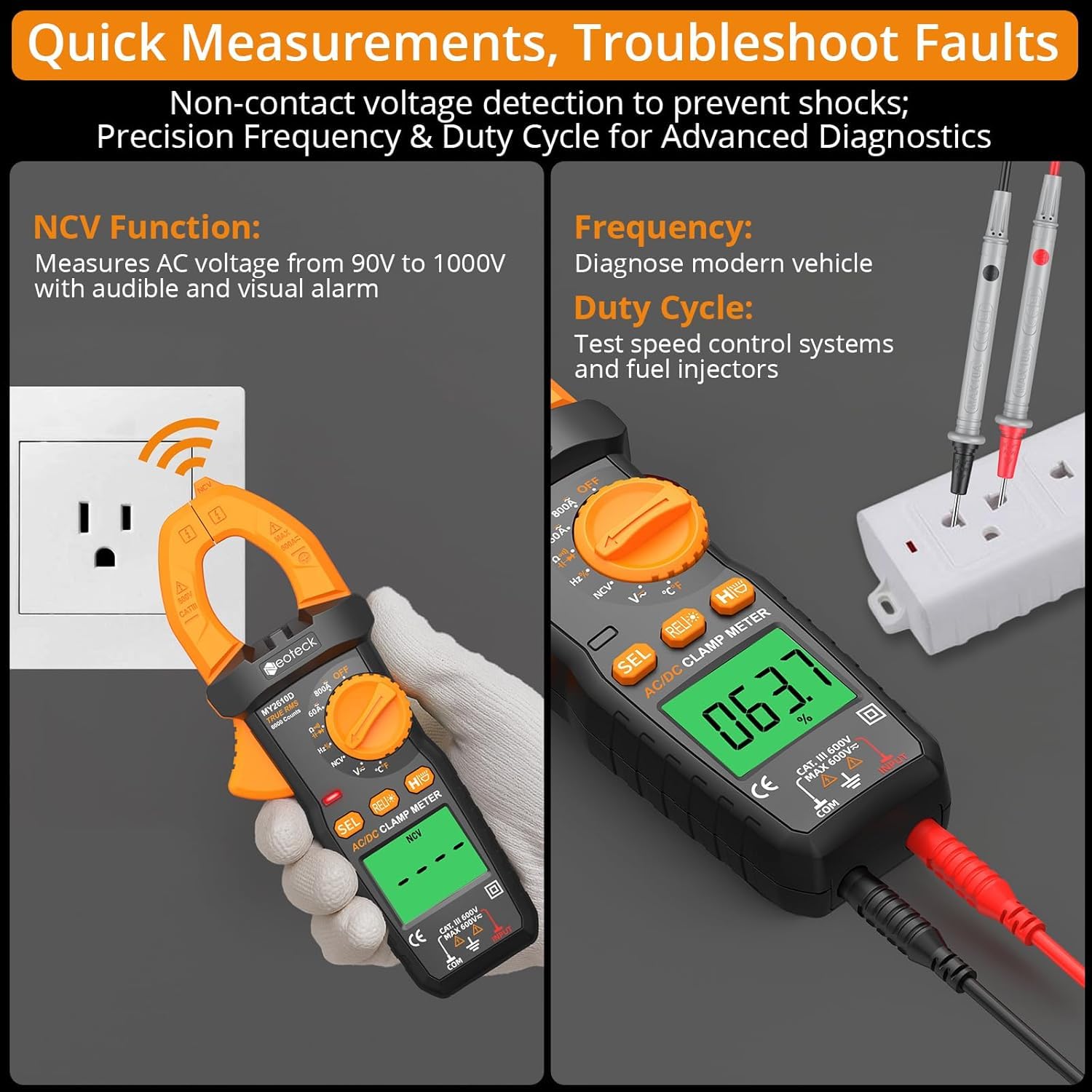
Image: The NCV function in use, detecting AC voltage near an electrical outlet. Also shown is the meter measuring frequency and duty cycle.
4.5 Nga Mahi taapiri
- Data Hold (HOLD button): Ka whakatio i te panui o naianei kei te whakaaturanga. Patohia ano kia tukuna.
- Backlight (Backlight button): Illuminates the LCD display for use in dim lighting. Automatically turns off after 30 seconds.
- Flashlight (Flashlight button): E whakarato ana i te māramatanga mō te wāhi mahi.
- Whakaweto Aunoa: The meter automatically powers off after 15 minutes of inactivity to conserve battery life.

Image: Visual representation of the meter's thoughtful designs, including overload protection, auto-off feature, data hold, and integrated flashlight with LCD backlight.
5. Tiaki
5.1 Te horoi
Wipe the meter with a dry, soft cloth. Do not use abrasives or solvents.
5.2 Whakakapinga Pūhiko
When the battery indicator appears on the display, replace the batteries as described in Section 3.1.
5.3 Rokiroki
If the meter is not used for an extended period, remove the batteries to prevent leakage. Store the meter in its protective pouch in a cool, dry place.
6. Te Raru
- Kāore he whakaaturanga, he whakaaturanga ngoikore rānei: Tirohia te whakaurunga o te pākahiko me te whakakapi i nga pākahiko mehemea e tika ana.
- Ngā pānui hē: Ensure test leads are properly connected and the correct function/range is selected. Verify ambient temperature is within 0-40°C for accurate current readings.
- Continuity function delay: Some delay may occur. Ensure a solid connection for consistent beeping.
- NCV not detecting: Ensure the NCV sensor is close to the live conductor and within the specified voltage range (90V-1000V AC).
Mena kei te haere tonu nga raru, whakapā atu ki te tautoko a te kaihoko.
7. Whakatakotoranga
| Whakatakotoranga | Uara |
|---|---|
| Waitohu | Te Ruku |
| Tauira | MY2610D |
| Puna Mana | Whakahikohia te Pūhiko (3x AAA) |
| Kāhua | Orange, 800A AC/DC Current |
| Tae | Karaka |
| Taumaha Tūemi | 191 Karamu |
| Mahinga Mahi Ititage | 0.6 Volts (DC) |
| Te Whakatauranga Te Pawera o runga | 1000 Degrees Celsius (for K-type thermocouple) |
| Momo Ine | Imita maha |
| Te Ahu o te Tuemi | 7.28 x 2.76 x 1.38 inihi |
| Safety Specification Met | CAT III 600V |
| Whakatuwheratanga Kauae | 26mm |
| Kaute Whakaatu | 6000 Tatau |
8. Raihana me te Tautoko
The Neoteck Clamp Meter MY2610D comes with an 18-marama whakamana mai i te ra o te hokonga. Ka kapi tenei whakamana i nga hapa o te hangahanga me nga mahi kino i raro i te whakamahinga noa.
For technical support, warranty claims, or any questions regarding the product, please contact Neoteck customer service through the retailer where the product was purchased or visit the official Neoteck webpae mo nga korero whakapā.
Tena koa pupuri i to tohu hoko mo te ratonga whakamana.