
1. Kupu Whakataki
Thank you for choosing the Dierya x TMKB M1 Wireless Gaming Mouse. This manual provides detailed instructions on how to set up, operate, and maintain your new gaming mouse. The M1 mouse offers versatile connectivity, high-precision tracking, and customizable features to enhance your gaming and productivity experience.
2. Hua Neke Atuview
2.1 Nga Waahanga me nga Mana Whakahaere
Familiarize yourself with the various buttons and features of your Dierya M1 mouse:
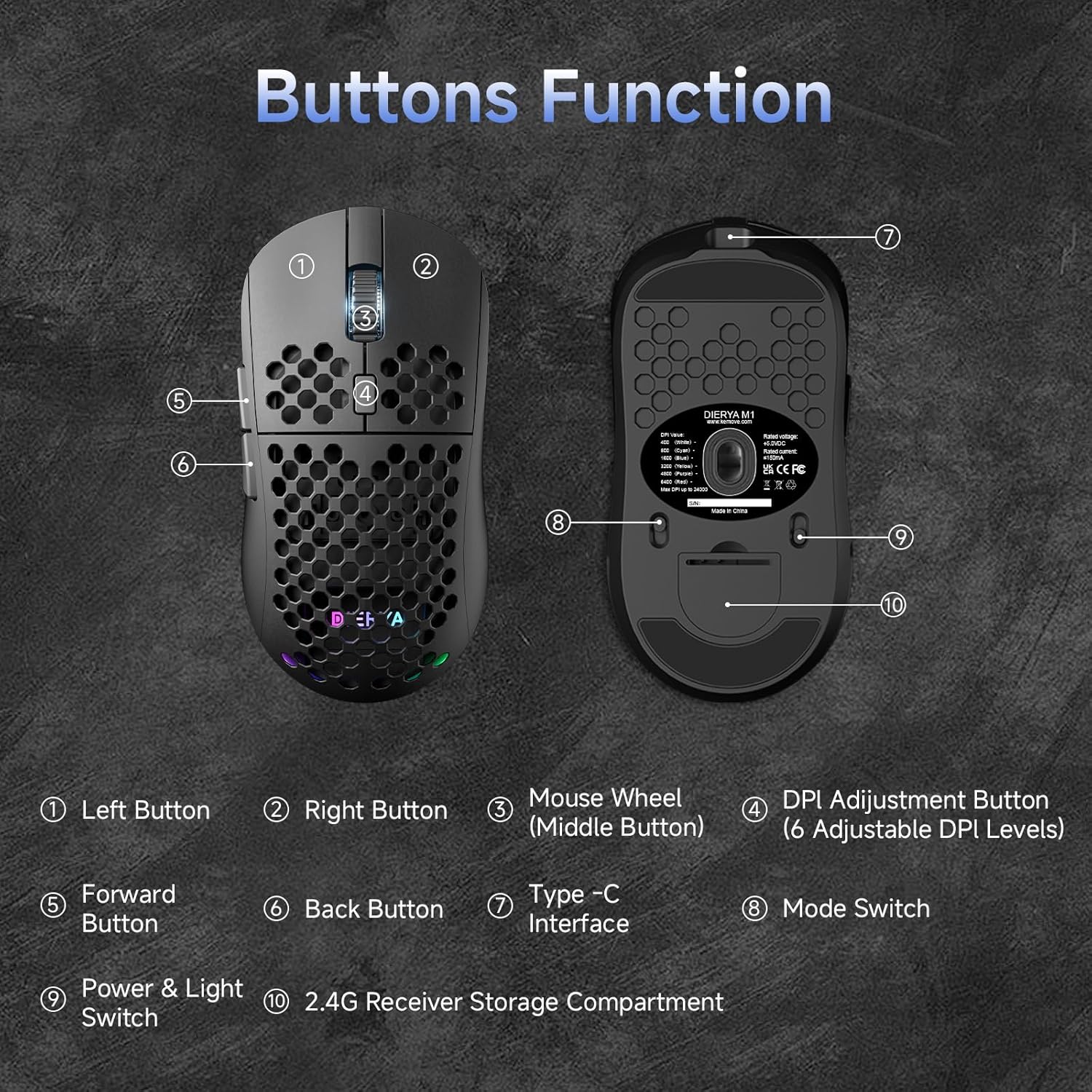
This diagram illustrates the various components of the Dierya M1 wireless gaming mouse. It highlights the Pātene Mauī (1), Pātene Matau (2), Mouse Wheel (Middle Button) (3), DPI Adjustment Button (4) with 6 adjustable DPI levels, Forward Button (5), Back Button (6), Type-C Interface (7) for charging and wired connection, Whakawhiti Aratau (8) for selecting connection type, Power & Light Switch (9), me te 2.4G Receiver Storage Compartment (10) located on the underside.
2.2 Nga waahanga matua
- 24,000 DPI Pūoko Optical: Adjustable DPI range from 200 to 24,000, with 6 preset levels (400-6400 DPI).
- Tūhononga Aratau Toru: Supports ultra-fast 2.4GHz wireless, energy-efficient Bluetooth 5.2, and stable USB-C wired connections.
- Roa te Ora o te Pūhiko: 1000mAh battery provides up to 180 hours in ECO mode or 48 hours with RGB lighting, with 1-hour fast charging.
- Hoahoa Māmā me te Ergonomic: Weighs only 90g with a honeycomb shell for breathability and a symmetrical design (125x63x41 mm).
- Pātene Whakahōtaka: 6 customizable buttons via the M1 Driver software (Windows only).
- Rarama RGB Hihiko: 13 integrated RGB lighting effects with 16.8 million customizable colors.
- Mahinga Nui: 125-1000 Hz polling rate, 300 IPS tracking speed, and 35G acceleration.
- Whakawhiti Roa: Equipped with Huano switches rated for 20 million clicks and 100% PTFE feet for smooth gliding.
3. Tatūnga
3.1 Te Whakataki i te Kiore
Before first use, it is recommended to fully charge the mouse. Connect the provided USB-C cable to the Type-C Interface (7) on the mouse and the other end to a USB power source (e.g., computer USB port, USB wall adapter).
- The mouse charges in approximately 1 hour.
- The scroll wheel LED will indicate charging status (e.g., red for charging, green for fully charged).
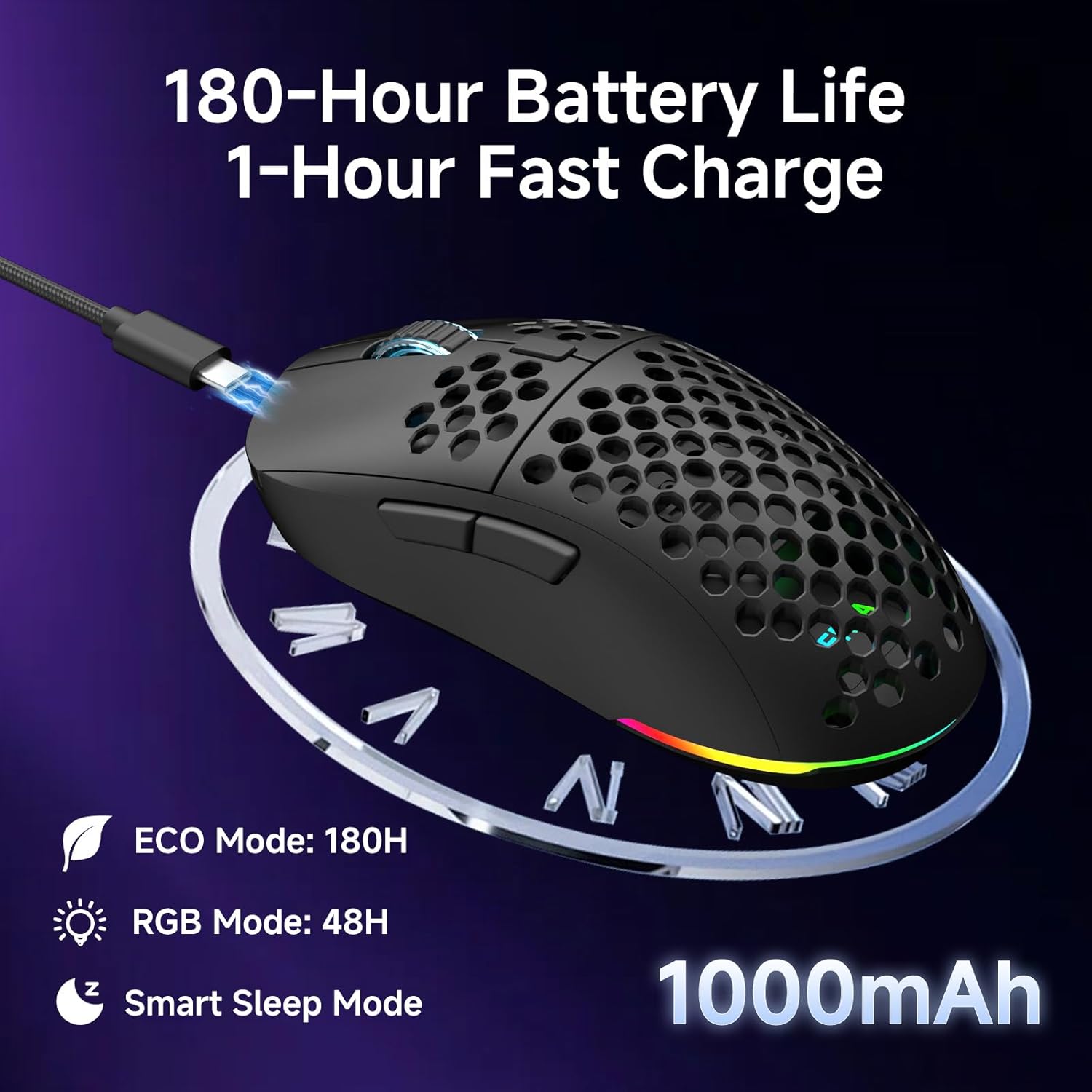
The Dierya M1 mouse features a 1000mAh battery, providing up to 180 hours of use in ECO mode or 48 hours with RGB lighting enabled. It supports fast charging, reaching full capacity in approximately 1 hour via the included USB-C cable. The mouse also includes a smart sleep mode to conserve power during inactivity.
3.2 Te hono i te Kiore
The Dierya M1 mouse offers three connection modes: 2.4GHz Wireless, Bluetooth 5.2, and USB-C Wired.

The Dierya M1 mouse supports three flexible connection modes: Bluetooth 5.2 for energy-efficient pairing with up to two devices, 2.4GHz Wireless via a USB dongle for ultra-fast response, and a stable USB-C Wired connection for charging and direct use. Each mode offers a different polling rate, with 2.4GHz and wired modes providing 1000Hz, and Bluetooth offering 125Hz.
3.2.1 2.4GHz Hononga Ahokore
- Locate the 2.4G receiver in the storage compartment (10) on the underside of the mouse.
- Plug the 2.4G receiver into an available USB port on your computer.
- Set the Mode Switch (8) on the underside of the mouse to the '2.4G' position.
- The mouse should connect automatically. The polling rate for this mode is 1000 Hz.
3.2.2 Hononga Nihokikorangi 5.2
- Set the Mode Switch (8) on the underside of the mouse to the 'BT' position.
- I runga i to rorohiko, i to taputapu ranei, whakatuwhera i nga tautuhinga Nihokikorangi ka rapu mo nga taputapu hou.
- Select 'Dierya M1' from the list of available devices to pair.
- The mouse supports Bluetooth 5.2 and has a polling rate of 125 Hz in this mode.
3.2.3 Hononga Waea USB-C
- Connect the USB-C cable to the Type-C Interface (7) on the mouse.
- Hono atu te pito o te taura USB-C ki tetahi tauranga USB e waatea ana i runga i to rorohiko.
- The mouse will automatically switch to wired mode and begin charging. The polling rate for this mode is 1000 Hz.
4. Nga Tohutohu Whakahaere
4.1 Whakatikatika DPI
The Dierya M1 mouse features a dedicated DPI Adjustment Button (4) to cycle through preset DPI levels. The scroll wheel LED color indicates the current DPI setting.
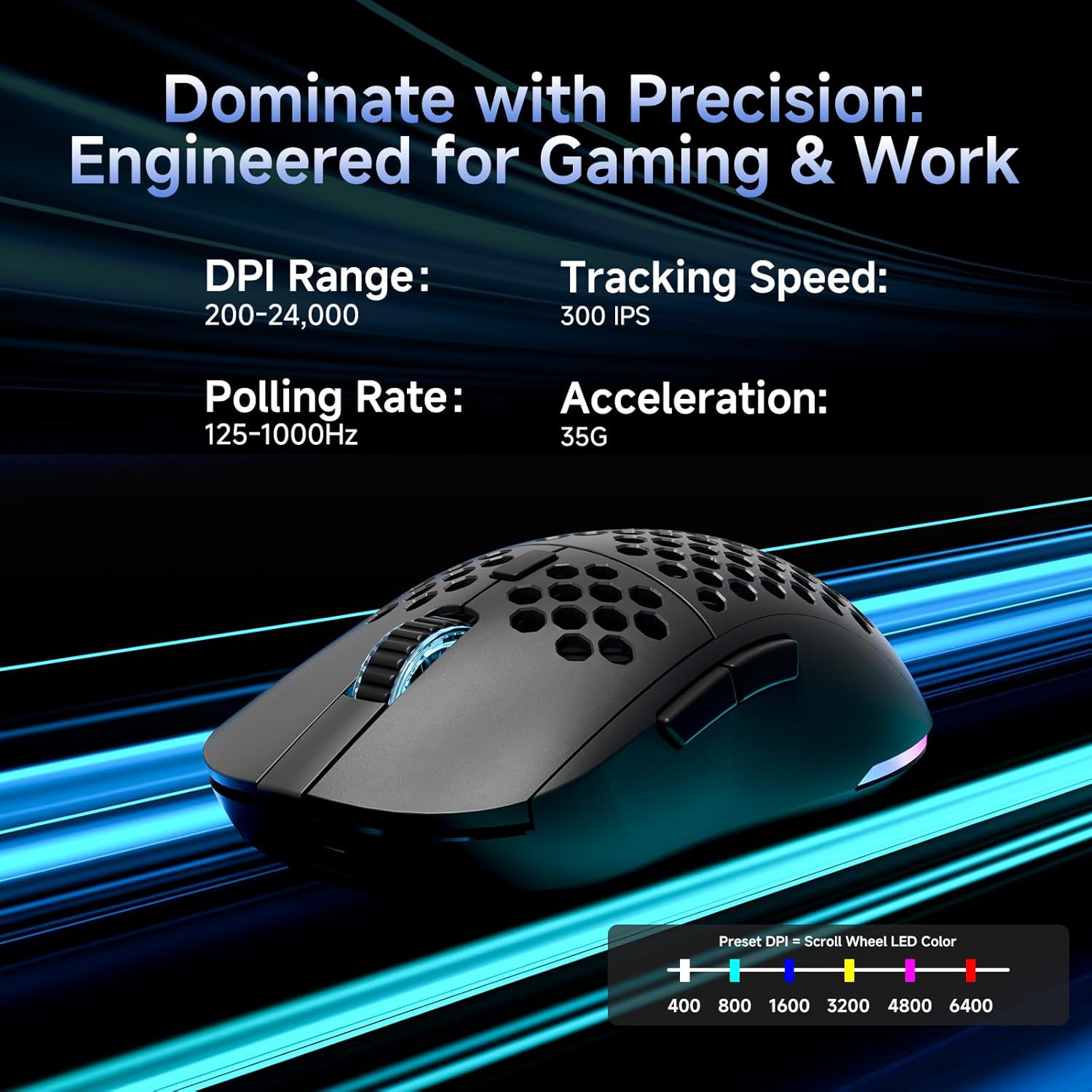
This image details the performance specifications of the Dierya M1 mouse, including a DPI range of 200-24,000, a tracking speed of 300 IPS, a polling rate of 125-1000Hz, and 35G acceleration. It also shows the preset DPI levels (400, 800, 1600, 3200, 4800, 6400) and the color indicators on the scroll wheel for each setting.
- Press the DPI Adjustment Button (4) to cycle through the 6 default DPI settings: 400, 800, 1600, 3200, 4800, and 6400 DPI.
- Each DPI level is indicated by a specific color on the scroll wheel LED.
- For custom DPI settings and a wider range (200-24,000 DPI), use the M1 Driver software.
4.2 Mana Rarama RGB
The Dierya M1 mouse features dynamic RGB lighting. You can control the lighting effects and colors using the M1 Driver software.
- The mouse has 13 built-in RGB lighting effects.
- Use the M1 Driver software to customize colors (16.8 million options), brightness, and speed of the lighting effects.
- The Power & Light Switch (9) on the underside can be used to turn the lighting on or off.
4.3 Ngā Pātene me ngā Pūmanawa Ka taea te Whakahōtaka
The M1 mouse has 6 programmable buttons that can be customized using the dedicated M1 Driver software.

The Dierya M1 driver software, currently available for Windows, allows users to customize various aspects of the mouse. This includes reassigning the 6 programmable buttons, creating macros, adjusting DPI settings, modifying the polling rate, and personalizing the 13 dynamic RGB lighting effects with 16.8 million colors.
- Hototahi Pūmanawa: The M1 Driver software is currently only available for Windows operating systems.
- Taumahi Matua: Reassign functions to any of the 6 programmable buttons (Left, Right, Middle, DPI, Forward, Back).
- Waihanga Tonotono: Create and assign complex macros to streamline in-game actions or productivity tasks.
- DPI & Polling Rate: Fine-tune DPI settings beyond the presets and adjust the polling rate.
- Whakaritenga RGB: Personalize lighting effects, colors, and patterns.
- Profile Whakahaere: Tiakina me te uta i ngā momo ngaio rerekēfilemō ngā kēmu, ngā taupānga rānei.
4.4 Aratau Tiaki Hiko
The M1 mouse is designed with automatic power-saving features to extend battery life:
- The mouse will enter an automatic power-saving mode after 1-5 minutes of inactivity.
- This inactivity time can be adjusted via the M1 Driver software.
- To wake the mouse, simply move it or click any button.
5. Tiaki
Proper maintenance ensures the longevity and optimal performance of your Dierya M1 mouse.
- Te horoi: Whakamahia he kakahu ngohengohe, maroke hei muru i te mata o te kiore. Mō te paru uaua, he paku paruamp Ka taea te whakamahi i te kakahu, engari kia kaua e uru te makuku ki roto i te kiore. Āta karohia ngā matū kaha, ngā kaihoroi whakakoi rānei.
- Tiaki pūoko: Kia ma te pūoko whatu kei raro i te kiore, kia kore hoki he puehu, he paru rānei, kia tika ai te aroturuki.
- Tiaki Pūhiko: Avoid fully discharging the battery frequently. For long-term storage, charge the mouse to about 50% and store it in a cool, dry place.
- Rokiroki: Ki te kore e whakamahia, penapenahia te kiore ki roto i te taiao ma, maroke kia matara atu i nga wera nui.
6. Te Raru
If you encounter issues with your Dierya M1 mouse, refer to the following common troubleshooting steps:
| Raruraru | Take pea | Rongoā |
|---|---|---|
| Kāore te kiore e whakautu (2.4GHz) | Low battery, receiver unplugged, incorrect mode, interference. | Charge the mouse. Ensure 2.4G receiver is securely plugged in. Set Mode Switch to '2.4G'. Try a different USB port. Reduce distance to receiver. |
| Kāore te kiore e whakautu (Nihokikorangi) | Low battery, incorrect mode, not paired, Bluetooth off on device. | Charge the mouse. Set Mode Switch to 'BT'. Ensure Bluetooth is enabled on your device. Re-pair the mouse in Bluetooth settings. |
| Kāore te kiore e whakautu (Waea) | Cable not connected, faulty cable/port. | Ensure USB-C cable is securely connected to both mouse and computer. Try a different USB port or cable. |
| Te aroturuki hē | Dirty sensor, unsuitable surface, incorrect DPI. | Clean the optical sensor. Use a mouse pad or a clean, non-reflective surface. Adjust DPI settings. |
| Ko te rama RGB kaore e mahi | Lighting switched off, low battery, software issue. | Check Power & Light Switch (9). Charge the mouse. Check settings in M1 Driver software. |
| Kaore nga patene e taea te hotaka | M1 Driver not installed/running, not on Windows. | Ensure M1 Driver software is installed and running (Windows only). Check software settings. |
7. Whakatakotoranga
| Ingoa Tauira | M1 |
| Waitohu | Dieria |
| Hangarau Hononga | Ahokore 2.4GHz, Nihokikorangi 5.2, Waea USB-C |
| Hangarau Hangarau Nekehanga | Optical |
| Awhe DPI | 200 - 24,000 DPI (6 preset levels: 400, 800, 1600, 3200, 4800, 6400) |
| Reiti Pooti | 125-1000 Hz |
| Tere Aroturuki | 300 FPS |
| Whakaterenga | 35G |
| Te maha o nga Patene | 6 (Ka taea te whakarite) |
| Pūhiko Raukaha | 1000 mAh Lithium-ion |
| Ora Pūhiko | Up to 180 hours (ECO mode), 48 hours (RGB mode) |
| Waa Whakatau | Approx. 1 haora |
| Taumaha | 90 Karamu |
| Ahu | 125 x 63 x 41 mm |
| Momo Whakawhiti | Huano (20 million clicks) |
| Feet Material | 100% PTFE |
| Hototahitanga Pūnaha Whakahaere | Windows, macOS, Linux, Chrome OS |
| Driver Software Compatibility | Matapihi anake |
8. Pūtāhui me te Tautoko
8.1 Pūtāhui Kaihanga
The Dierya M1 Wireless Gaming Mouse comes with a 1 tau te whakamana a te kaiwhakanao. Ka kapi tenei raihana i nga hapa o nga rawa me nga mahi i raro i te whakamahinga noa. Tena koa pupurihia to tohu mo te hoko mo nga kereme whakamana.
8.2 Tautoko Kiritaki
For further assistance, technical support, or warranty inquiries, please refer to the official Dierya website or contact your retailer. Ensure you have your product model (M1) and proof of purchase ready when seeking support.