
1. Kupu Whakataki me Nekeview
The Moxa NPort 5230-T is a 2-port industrial device server designed to connect serial devices to an Ethernet network. It features one RS-232 port and one RS-422/485 port, enabling seamless integration of legacy serial equipment into modern IP-based systems. This device server is built for harsh industrial environments, supporting an operating temperature range of -40 to 75°C. It provides reliable and robust serial-to-Ethernet connectivity for various applications.
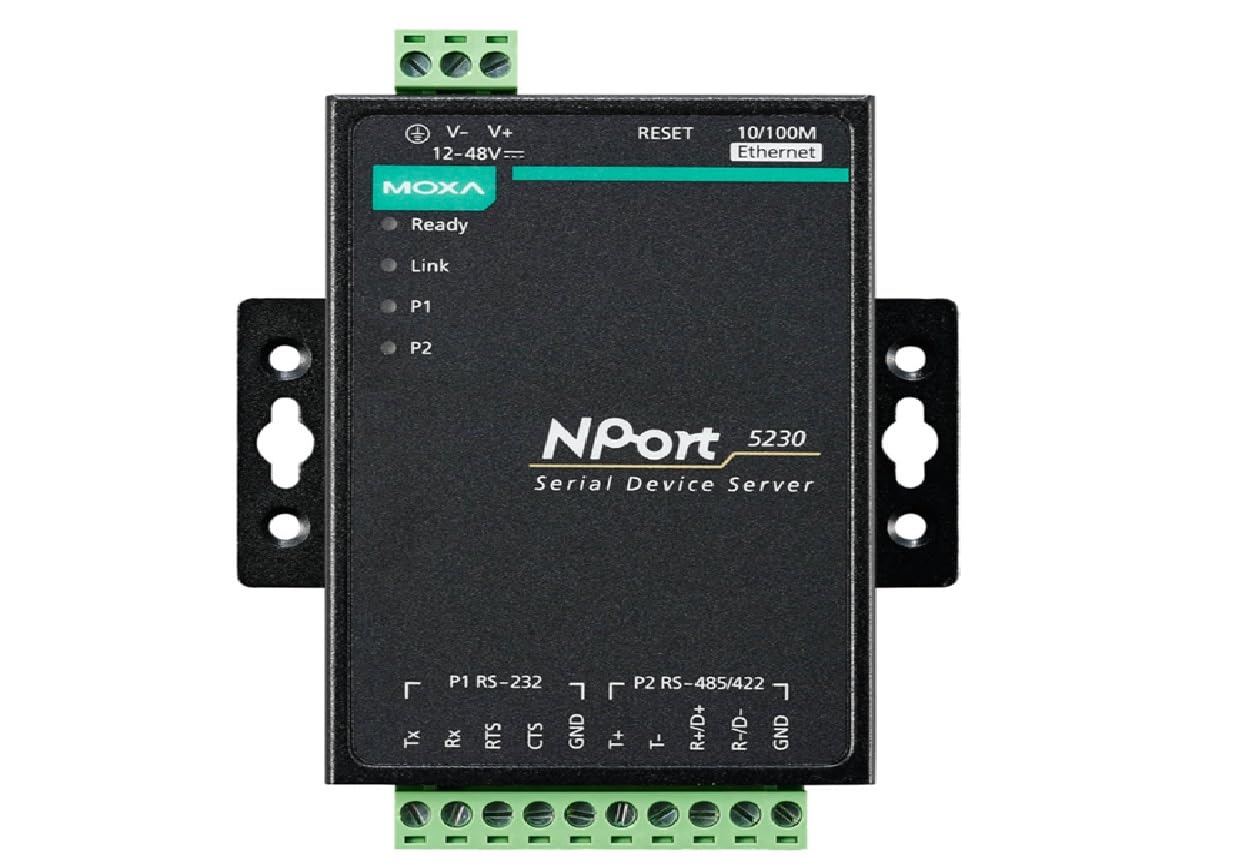
Figure 1: Moxa NPort 5230-T Device Server. This image displays the compact design of the NPort 5230-T, highlighting its serial and Ethernet connectivity options.
2. Nga waahanga matua
- Paemahana Mahi Whanui: Designed for industrial use with a temperature range of -40 to 75°C.
- Hoahoa Kiato: Facilitates easy installation in space-constrained environments.
- Versatile Socket Modes: Supports TCP server, TCP client, and UDP modes for flexible network communication.
- Whirihoranga ngawari: Utilizes an intuitive Windows utility for straightforward setup of multiple device servers.
- Automatic Data Direction Control (ADDC): Ensures reliable data transmission for 2-wire and 4-wire RS-485 connections.
- Whakahaere Whatunga: Includes SNMP MIB-II support for efficient network monitoring and management.
- Dual Serial Ports: One RS-232 port and one configurable RS-422/485 port.
3. Ihirangi mokete
Tena koa tirohia kei roto i to kete nga mea e whai ake nei:
- Moxa NPort 5230-T Device Server Unit
- Aratohu Tāuta Tere
- Kaari Raati
Tuhipoka: The power supply (e.g., PWR-12150-USJP-SA-T) is not included and must be purchased separately.
4. Tatūnga me te Tāuta
- Whakapiki: Securely mount the NPort 5230-T in your desired location, ensuring adequate ventilation and access to ports. The compact design allows for DIN-rail or panel mounting (mounting kits sold separately if not included).
- Hono Hono: Connect a compatible 12-48 VDC power adapter (not included) to the device server's power input terminal. Ensure the power source meets the device's specifications.
- Honoa te Ipurangi: Connect an Ethernet cable from your network switch or router to the NPort 5230-T's Ethernet port.
- Honoa ngā Pūrere Raupapa:
- For RS-232 devices, connect to the RS-232 port using an appropriate serial cable.
- For RS-422/485 devices, connect to the configurable RS-422/485 port. Ensure correct wiring for 2-wire or 4-wire configurations.
- Whirihoranga Tuatahi:
- Install the Moxa NPort Windows utility on a computer connected to the same network.
- Use the utility to discover the NPort 5230-T on the network.
- Configure network settings (IP address, subnet mask, gateway) and serial port parameters (baud rate, data bits, parity, stop bits, flow control) according to your application requirements.
- Set the desired socket mode (TCP Server, TCP Client, UDP) for each serial port.
5. Nga Tohutohu Whakahaere
Once configured, the NPort 5230-T operates by transparently converting serial data to Ethernet packets and vice-versa. The operational mode depends on the socket mode configured for each serial port:
- Aratau Tūmau TCP: The NPort 5230-T listens for incoming TCP connections from host computers. Once a connection is established, serial data is transmitted over the TCP connection.
- Aratau Kiritaki TCP: The NPort 5230-T initiates a TCP connection to a specified host IP address and port. This is useful for connecting to a central server or another device server.
- UDP Mode: Data is transmitted as UDP packets, which is connectionless. This mode is suitable for applications where speed is critical and some data loss is acceptable, or for broadcast/multicast scenarios.
- Real COM Mode: (Configured via the Windows utility) This mode allows Windows applications to access the serial ports of the NPort 5230-T as if they were local COM ports on the PC.
For RS-485 communication, the Automatic Data Direction Control (ADDC) feature automatically handles the data flow direction, eliminating the need for software control and simplifying integration.
6. Tiaki
To ensure optimal performance and longevity of your NPort 5230-T, follow these maintenance guidelines:
- Te horoi: Horoia te taha waho o te taputapu i ia wā ki te kakahu ngohengohe, maroke. Kaua e whakamahi i ngā horoi wai, i ngā horoi hau rānei.
- Whakahōu Firmware: Tirohia te Moxa website regularly for firmware updates. Keeping the firmware up-to-date can improve performance, add features, and address security vulnerabilities.
- Nga Tikanga Taiao: Ensure the device operates within its specified temperature and humidity ranges (-40 to 75°C). Avoid exposing it to excessive dust, moisture, or direct sunlight.
- Tikanga taura: Periodically inspect all connected cables (power, Ethernet, serial) for damage or loose connections.
7. Te Raru
| Raruraru | Take pea | Rongoā |
|---|---|---|
| Pūrere kaore i te hiko. | No power, incorrect power supply, or faulty power connection. | Verify power source, ensure correct voltage (12-48 VDC), and check power cable connections. Confirm power supply is compatible and functional. |
| Device not found by Windows utility. | Network connectivity issue, incorrect IP settings, or firewall blocking. | Check Ethernet cable connection. Ensure the PC and NPort are on the same subnet. Temporarily disable firewall on PC for testing. Reset NPort to factory defaults if necessary. |
| Kāore te pūrere raupapa e whakawhitiwhiti kōrero. | Incorrect serial port settings, wrong cable, or device incompatibility. | Verify baud rate, data bits, parity, stop bits, and flow control settings match the serial device. Check serial cable wiring (straight-through vs. null modem). Ensure ADDC is correctly configured for RS-485. |
| Intermittent network connection. | Faulty Ethernet cable, network congestion, or environmental interference. | Replace Ethernet cable. Check network load. Ensure device is not near strong electromagnetic interference sources. |
8. Whakatakotoranga
| Tawhā | Taipitopito |
|---|---|
| Tauira | Tauranga 5230-T |
| Tauranga Rangatū | 2 (1 x RS-232, 1 x RS-422/485) |
| Tauranga Itarangi | 1 x 10/100BaseT(X) auto-sensing |
| Te Waahi Mahi | -40 ki te 75°C (-40 ki te 167°F) |
| Whakauru Voltage | 12 to 48 VDC (Power supply not included) |
| Socket Modes | Tūmau TCP, Kiritaki TCP, UDP |
| Whakahaerenga | Windows Utility, Web Console, Telnet Console, SNMP MIB-II |
| Automatic Data Direction Control | Yes, for 2-wire and 4-wire RS-485 |
| Ahu | Compact design (specific dimensions not provided in source, general statement) |
9. Pūtāhui me te Tautoko
Moxa products are designed for high reliability and performance. For detailed warranty information, please refer to the warranty card included in your package or visit the official Moxa website. Technical support is available through Moxa's global support channels, including online resources, FAQs, and direct contact options. Please have your product model and serial number ready when contacting support.
For the latest drivers, utilities, and documentation, please visit the official Moxa support webpae: www.moxa.com/support