
1. Kupu Whakataki
The ChunHee Solar Outdoor Motion Sensor Alarm is designed to deter unwanted animals and intruders from your property using a combination of motion-activated strobe lights and loud sounds, including dog barking and gunshot effects. This device is solar-powered, environmentally friendly, and suitable for various outdoor environments.

Image 1.1: The Solar Outdoor Motion Sensor Alarm in an outdoor setting, illustrating its detection capabilities for animals like deer, bears, raccoons, and coyotes within a 110-degree angle and 33ft distance.
2. Hua Neke Atuview
Familiarize yourself with the main components of your Solar Outdoor Motion Sensor Alarm:
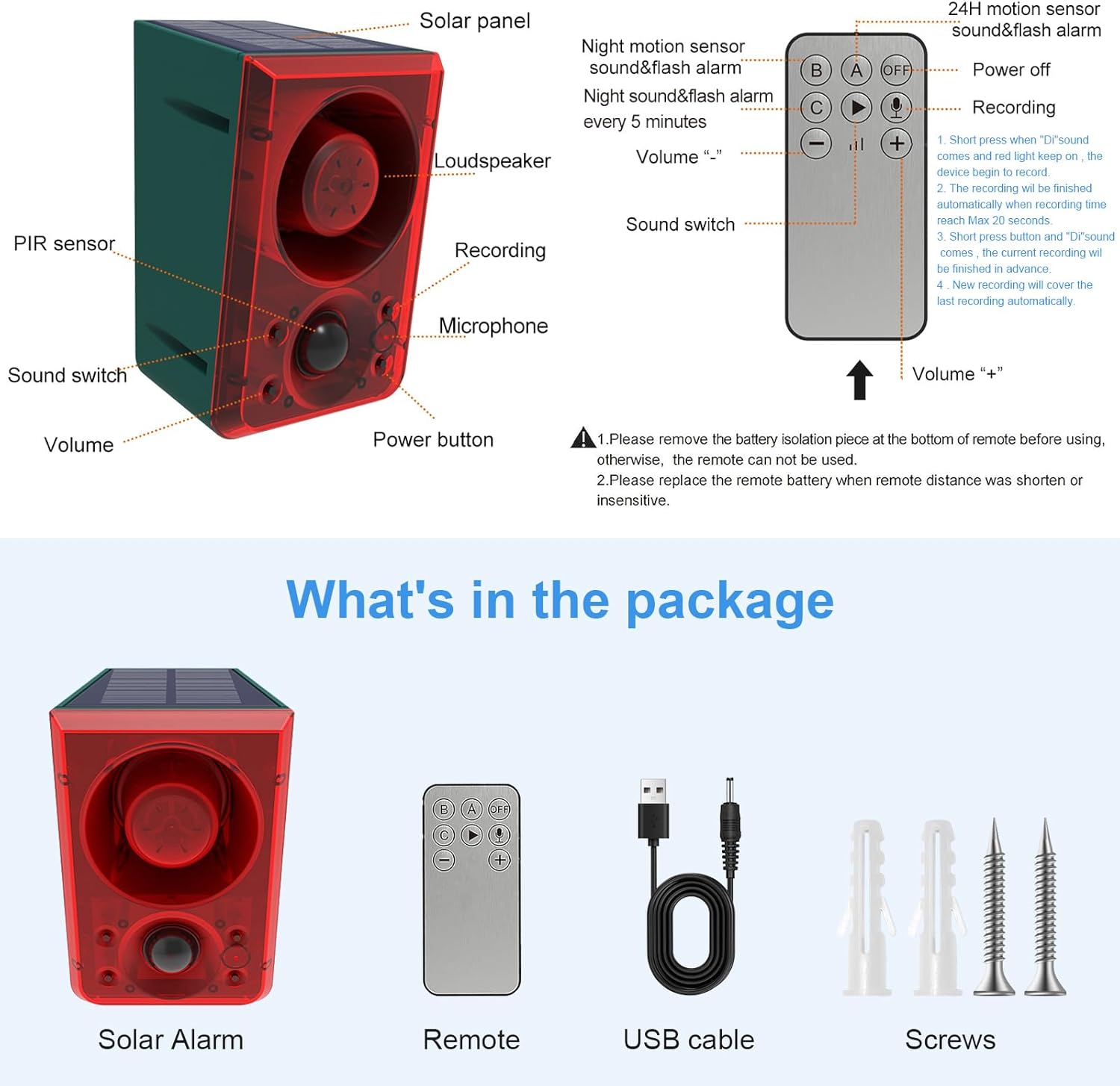
Image 2.1: Labeled diagram showing the solar panel, loudspeaker, PIR sensor, sound switch, volume control, power button, recording button, microphone, DC charge port, and mounting port.
- Paewhiri Solar: Converts sunlight into electrical energy to charge the internal battery.
- Kaikorero: Emits alarm sounds.
- PIR Pūoko: Passive Infrared sensor detects motion within its range.
- Whakawhiti Oro: Toggles between different sound options.
- Mana Rōrahi: Adjusts the alarm volume.
- Pātene Hiko: Turns the device on/off and cycles through modes.
- Patene Hopu: Initiates custom sound recording.
- hopuoro: Captures custom sound recordings.
- DC Charge Port: For alternative charging via USB cable.
- Mounting Port: Mō te tāutanga haumaru.
3. Nga ahuatanga
- Kitenga Nekehanga: PIR sensor detects movement within 5-8 meters and a 110-degree angle.
- Pūoho Nui: Produces a 130dB alarm sound to deter intruders and animals.
- Maama Maama: Flashing lights accompany the alarm sound for visual deterrence.
- Kōwhiringa Oro: Includes default dog barking and gunshot sounds.
- Te Tuhi Ritenga: Allows users to record their own alarm sounds (up to 20 seconds).
- Rōrahi Whakaritea: Three levels of volume adjustment.
- Whakahikohia te Ra: Equipped with a high-capacity solar panel for continuous operation.
- Taurangirangi: IP65 waterproof design ensures durability in various weather conditions.
- Multiple Work Modes: Three distinct operating modes for different needs.

Image 3.1: The alarm's ability to support DIY recording and produce a 129dB sound, shown deterring an intruder while residents sleep peacefully.
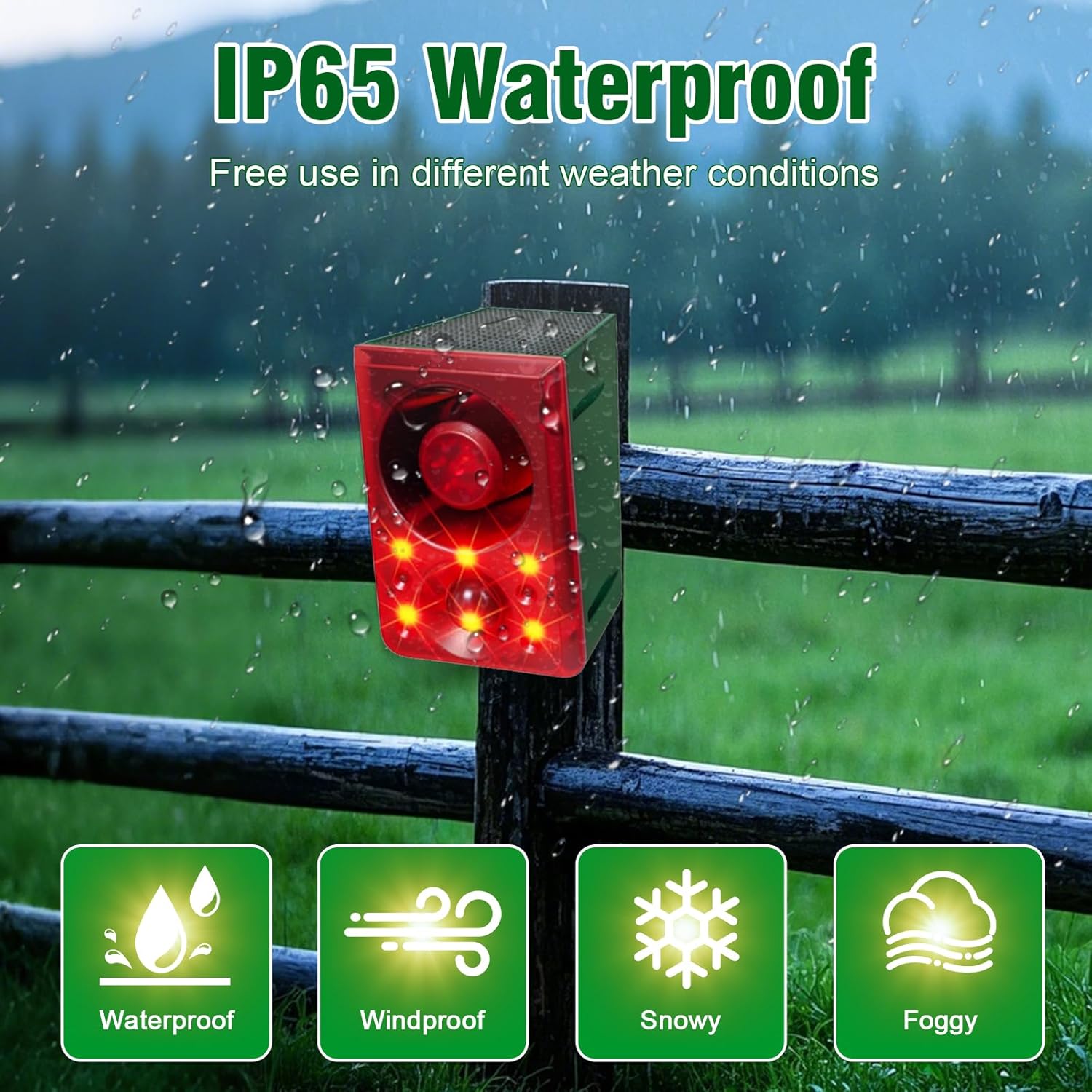
Image 3.2: The alarm mounted on a fence during rain, highlighting its IP65 waterproof, windproof, snowy, and foggy weather resistance.
4. Tatūnga
- Akona Tuatahi: Before first use, ensure the solar alarm charges under direct sunlight for at least 1 full day (24 hours). This activates the battery and ensures optimal performance.
- Whakahohenga Mana Mamao: Remove the battery isolation piece from the bottom of the remote control before use.
5. Aratau Mahi
The alarm offers three operating modes, selectable via the power button on the device or the remote control:

Image 5.1: Visual representation of the three operating modes: Mode A (24-hour flash and alarm), Mode B (Night 12-hour flash and alarm), and Mode C (Night 12-hour flash and alarm every 5 minutes).
- Mode A (24-hour Flash and Alarm): When motion is detected, the alarm will sound and flash for 24 hours a day.
- Mode B (Night 12-hour Flash and Alarm): When motion is detected, the alarm will sound and flash only during nighttime hours.
- Mode C (Night 12-hour Flash and Alarm Every 5 Minutes): During nighttime, if motion is detected, the alarm will sound and flash every 5 minutes.
Press the power button once to activate Mode A, twice for Mode B, three times for Mode C, and four times to power off the device.
6. Taumahi Rekoata
The alarm allows you to record a custom sound for personalized deterrence:
- Initiate Recording: Long press the recording button for 2 seconds. The indicator light will stay on, signaling that recording has begun.
- Tuhia te Oro: Speak clearly into the microphone. The device can record up to 20 seconds.
- Whakamutua te Hopu: Release the button to finish recording. The recording will automatically end after 20 seconds if the button is not released.
- Whakawhiti: A new recording will automatically overwrite the previous one.
The recording distance affects the playback effect. Ensure you are close enough to the microphone for clear audio capture.
7. Te utu
Your ChunHee Solar Outdoor Motion Sensor Alarm supports two charging methods:

Image 7.1: Illustration of the solar panel charging under sunlight and the DC charge port for USB charging.
- Whakatauhia te ra: The integrated solar panel charges the internal battery using sunlight. For optimal charging, ensure the device is placed where it receives at least 4 hours of direct sunlight daily. Charging efficiency may vary with weather conditions and seasons.
- Whakataunga DC: For faster charging or during periods of low sunlight, use the provided USB cable with a DC 5V ≤ 1A charger. DC charging typically takes less than 2 hours.
8. Installation & Placement
Proper installation and placement are crucial for the alarm's effectiveness:
- Te Maranga o te Ra: Mount the alarm in a location that receives ample direct sunlight throughout the day to maximize solar charging.
- Rohe Rapunga: Position the alarm to face the direction of animal activity or potential entry points. The PIR sensor has a 110-degree sensing angle and detects movement within 5-8 meters.
- Whakapiki: Use the provided installation kit (screws) to securely hang the alarm.
- Whakamahinga Whanui: The alarm is suitable for various outdoor locations, including farms, coops, barns, camping sites, homes, gardens, and yards.

Whakaahua 8.1: Examples of extensive use scenarios, including a garden, orchard, camping area, and courtyard, demonstrating the alarm's adaptability.
9. Tiaki
- Paewhiri Solar ma: Me horoi i nga wa katoa te panui solar ki te ngohengohe, damp cloth to remove dust and debris, ensuring efficient charging.
- Pūhiko Mamao: If the remote control's operating distance shortens or becomes insensitive, replace its battery.
- Tiaki kaupeka: In regions with prolonged cloudy or rainy weather, consider bringing the alarm indoors for manual DC charging to maintain battery levels.
10. Te Raru
| Putanga | Take pea | Rongoā |
|---|---|---|
| Kare te oho i te hohe | Insufficient charge; PIR sensor obstructed; device off or in incorrect mode. | Ensure initial 24-hour charge. Verify solar panel receives direct sunlight. Check for obstructions in front of the PIR sensor. Confirm device is powered on and in the desired operating mode. |
| Ko te mana mamao kaore e mahi | Battery isolation piece not removed; low remote battery; out of range. | Remove the battery isolation piece. Replace the remote battery if needed. Ensure you are within a few feet of the alarm for remote operation. |
| Animals not deterred immediately | Animals may need time to adapt to the deterrent. | It may take between two and four weeks for some animals to respond to the deterrent. Maintain consistent operation. |
| Awhe rapunga maiorooro | Low battery charge; environmental factors. | Ensure the device is fully charged. Optimal range is achieved with a full battery. Avoid placing near heat sources or objects that might interfere with PIR detection. |
11. Whakatakotoranga
| Āhuahira | Taipitopito |
|---|---|
| Waitohu | ChunHee |
| Puna Mana | Ko te hiko o te ra |
| Hunga Hua | 5"L x 3"W x 5"H |
| Tikanga Mana | Mamao, Pa |
| Haruru Rongo | 129 Decibels |
| Momo Whakaeke | Maunga Taiepa |
| Maximum Range (PIR) | 8 mita (tata ki te 26 putu) |
| Hangarau Hoko | Pokarekare Hangangi (PIR) |
| Taumaha Tūemi | 2.02 Kirokaramu |
| Whakatauranga parewai | IP65 |
12. Ataata Hua Whaimana
Outdoor Motion Sensor Alarm Overview
Ataata 12.1: Ka whakaratohia e tēnei ataata he tirohanga whānuiview of the ChunHee Solar Outdoor Motion Sensor Alarm, demonstrating its features, working principle, and application in various outdoor settings to deter animals and intruders.
Barking Dog Alarm Demonstration
Video 12.2: A short demonstration of the barking dog alarm sound feature, showing how it activates upon motion detection to scare away potential threats.
13. Raihana me te Tautoko
For any questions or further assistance regarding your ChunHee Solar Outdoor Motion Sensor Alarm, please refer to the included user manual or contact ChunHee customer support. Specific warranty details may be provided with your purchase documentation.