
CJ TECH 25305-EV
Pūrere Whakarewa/Kaitiaki Pūhiko Aunoa CJ TECH 750mA (Tauira 25305-EV) Pukapuka Kaiwhakamahi
Kupu Whakataki
This manual provides detailed instructions for the safe and effective use of your CJ TECH 750mA Automatic Float Battery Charger/Maintainer, Model 25305-EV. This device is designed to charge and maintain 6V and 12V lead-acid batteries, including AGM and GEL types, ensuring optimal battery performance and extending battery life. Please read this manual thoroughly before operation and retain it for future reference.
Nga korero haumaru
WHAKATOKANGA: Panuitia nga whakatupato me nga tohutohu haumaru katoa. Ki te kore e whai i nga whakatupato me nga tohutohu ka puta pea te ru hiko, te ahi, me te whara kino/ranei.
- Me whakahaere i nga wa katoa te rihi i roto i te waahi pai-hau.
- Avoid sparks, flames, or smoking near the battery during charging, as batteries can produce explosive gases.
- Mau kakahu whakamarumaru kanohi me nga kakahu whakamarumaru ina mahi me nga pākahiko.
- Disconnect the AC power supply before making or breaking connections to the battery.
- This charger is designed for 6V and 12V lead-acid batteries only. Do not use it to charge dry-cell batteries that are commonly used with home appliances, as these may burst and cause injury to persons and damage to property.
- Keep the charger and its components out of reach of children.
- The charger has an IP64 water-resistant rating, meaning it is protected from dust and splashing water. It is not designed to be submerged in water.
- Kaua e whakahaeretia te rihi mena kua pa te whiu, kua taka, kua pakaru ranei.
Ihirangi mokete
Manatokona kei roto katoa nga mea kei roto i to kete:
- CJ TECH 750mA Automatic Float Battery Charger/Maintainer Unit
- Pūhiko Clamp Kaihono
- Tuhono Kapeka Mowhiti

Image: The CJ TECH 750mA Automatic Float Battery Charger unit shown with its two interchangeable connection accessories: battery clampngā hononga pūrua s me te mowhiti.
Ka mutu te huaview
The CJ TECH 750mA Automatic Float Battery Charger/Maintainer is a compact and durable device designed for efficient battery care. It features automatic voltage detection and multiple safety protections.
Tohu LED
- LED Whero: E tohu ana kei te utu te pākahiko i tēnei wā.
- LED Koura: Indicates the battery is fully charged and the charger is in maintenance (float) mode.
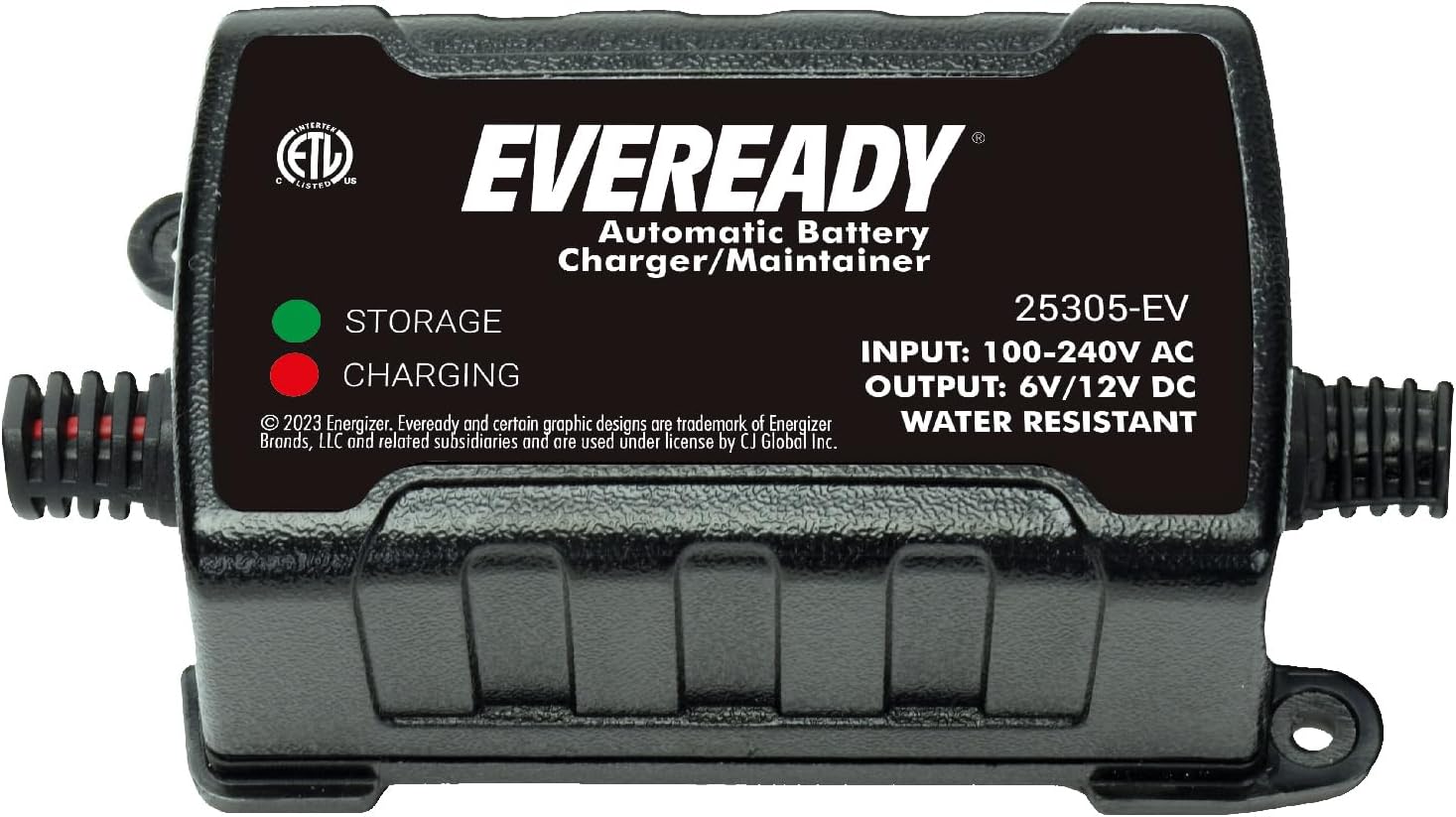
Whakaahua: He taipitopito view of the charger unit, highlighting the LED indicators for 'CHARGING' (red) and 'STORAGE' (green), along with input/output specifications.
Tatūnga
- Identify Battery Voltage: Determine if your battery is 6V or 12V. The charger automatically detects the voltage once connected.
- Kōwhiria te Hononga: Tīpakohia te taupoki pākahikoamp connector or the ring terminal connector based on your battery's terminals.
- Tūhono ki te Pūhiko:
- Honoa te Whero positive (+) connector to the positive (+) battery terminal.
- Honoa te Pango negative (-) connector to the negative (-) battery terminal.
Ensure a secure connection. Avoid touching the positive and negative connectors together.
- Hono ki te hiko AC: Plug the charger's AC power cord into a standard 100-240V AC electrical outlet.

Image: The charger unit shown connected to an ATV battery using the battery clamp connectors, illustrating a typical setup scenario.
Nga Tohutohu Whakahaere
The CJ TECH charger operates automatically once connected to a battery and power source.
- Aunoa Voltage Raputanga: The charger will automatically detect if the connected battery is 6V or 12V. It requires an activation voltage of 4V for 6V batteries and 8V for 12V batteries to begin charging.
- Aratau Whakatau: When the battery is charging, the LED Whero will illuminate. The charger delivers a constant current of 0.75A ±0.1A during this phase.
- Maintenance (Float) Mode: Once the battery reaches full charge, the charger automatically switches to maintenance mode, and the LED Koura will illuminate. In this mode, the charger provides a small, continuous current to keep the battery at optimal charge without overcharging, preventing sulfation and extending battery life.
- Momotu: To disconnect the charger, first unplug it from the AC power outlet, then disconnect the negative (-) battery connector, followed by the positive (+) battery connector.

Image: An illustration showing the charger's connection diagram to a battery and AC power, alongside a table detailing input voltage, putanga putangatage, charging current, battery types, activation voltage, and housing protection.
Te tiaki
Proper maintenance ensures the longevity and reliable operation of your charger and batteries.
- Te horoi: Keep the charger unit clean and free from dust and debris. Use a dry cloth to wipe the exterior. Do not use solvents or abrasive cleaners.
- Tirohanga taura: Regularly inspect the power cord and battery connectors for any signs of damage, fraying, or corrosion. Replace damaged components immediately.
- Rokiroki: When not in use, store the charger in a cool, dry place, away from direct sunlight and extreme temperatures. Ensure cables are neatly coiled to prevent damage.
- Tiaki Pūhiko: For optimal battery life, ensure battery terminals are clean and free of corrosion before connecting the charger.
Raparongoā
Mena ka raru koe ki to riihi, tirohia nga raru me nga otinga e whai ake nei:
| Raruraru | Take pea | Rongoā |
|---|---|---|
| Kāore te rihi e tahuri / Kāore he rama LED e mura ana | No AC power; Battery voltage too low for activation. | Check AC outlet and power cord connection. Ensure battery voltage is above 4V (for 6V) or 8V (for 12V). |
| RED LED stays on indefinitely | Battery is deeply discharged or damaged; Incorrect battery connection. | Allow more time for charging. Check battery connections for proper polarity. If the issue persists, the battery may be faulty. |
| GREEN LED is on, but battery seems low | Battery is faulty and cannot hold a charge. | Test the battery with a battery tester. The battery may need replacement. |
| Ka mahana te rihi i te wā e whakamahia ana | Mahi noa. | A slight increase in temperature is normal during charging. Ensure adequate ventilation around the charger. |
Whakatakotoranga
- Tau tauira: 25305-EV
- Whakauru Voltage: AC 100-240V, 50/60Hz
- Putanga Voltage: 6V DC / 12V DC (Automatic Detection)
- Kei te Whakataki i naianei: 0.75A ± 0.1A
- Momo Pūhiko: 6V/12V Lead-Acid Batteries (AGM, GEL)
- Activation Voltage: 4V for 6V batteries, 8V for 12V batteries
- Parenga Whare: IP64 Atete Wai
- Rahi Hua: 3 x 3 x 5 inihi
- Taumaha Tūemi: 9.9 hekere
- Tiwhikete: CETL / CE-EMC / CE-LVD / ROHS
Pūtāhui me te Tautoko
For warranty information or technical support, please refer to the documentation included with your purchase or contact CJ TECH customer service. Keep your proof of purchase for warranty claims.