
Kupu Whakataki
This manual provides detailed instructions for the setup, operation, and maintenance of your Geevon Wireless Digital Refrigerator Thermometer. This device is designed to monitor temperatures in your refrigerator, freezer, or other environments using two wireless sensors, ensuring optimal storage conditions for your items.
Pānuihia tēnei pukapuka ā-ringa i mua i te whakamahinga o te hua kia tika ai te mahi, kia roa ai hoki tōna ora.
Ihirangi mokete
Ina wetewetehia te taputapu, me whakaū kei te pai katoa ngā wāhanga:
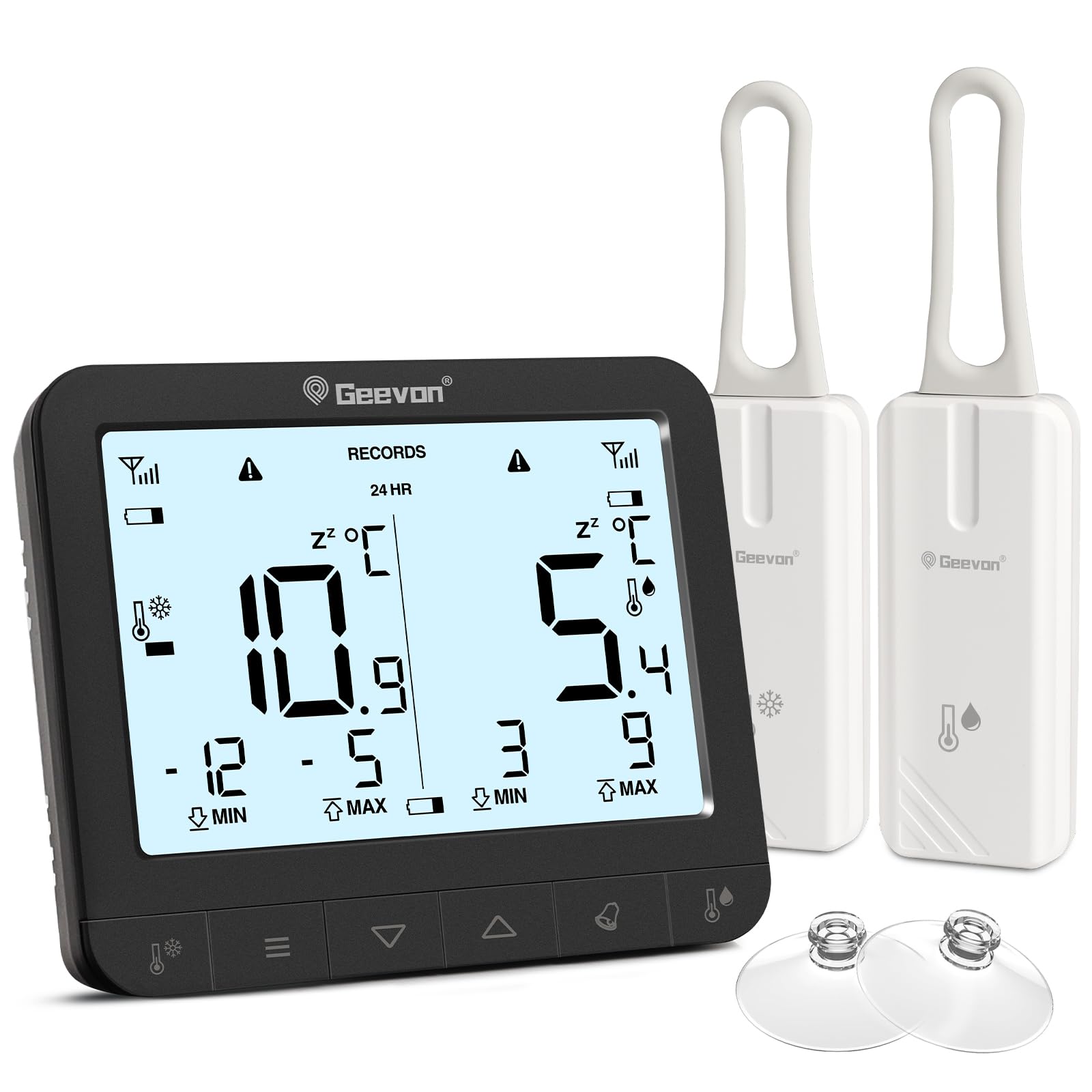
- 1 x Main Display Unit
- 2 x Wireless Sensors
- 6 x AAA Batteries (for main unit)
- 2 x CR2032 Batteries (pre-installed in sensors or included separately)
- 1 x Manual Kaiwhakamahi (tenei tuhinga)
- 2 x Suction Cups (for sensor mounting)

The image displays the main unit, two sensors, and accessories including suction cups for installation.
Tohutohu Tatūnga
1. Tāuta Pūhiko
For the Main Display Unit:
- Kimihia te wahanga pākahiko kei muri o te wae matua.
- Whakatuwheratia te uhi pākahiko.
- Kōkuhu 6 pākahiko AAA, mātakitaki i te polarity tika (+/-).
- Katia kia mau te taupoki pākahiko.
For the Wireless Sensors:
- Locate the battery compartment on the back of each sensor.
- Whakatuwheratia te uhi pākahiko.
- Insert 1 CR2032 battery into each sensor, observing the correct polarity (+/-).
- Katia kia mau te taupoki pākahiko.
The image illustrates the battery compartments for both the main unit and the wireless sensors.
2. Te Whakanohonga Pūoko
The wireless sensors can be placed inside your refrigerator, freezer, or any other area where temperature monitoring is desired. Ensure the sensors are not submerged in liquid and are placed in a location where they can transmit signals to the main unit.
- Iri: Use the integrated loop to hang the sensor from a shelf or rack.
- Āpitihanga autō: The sensors have built-in magnets for attachment to metallic surfaces.
- Kapu Momo: Attach the provided suction cups to the sensor for mounting on smooth surfaces like glass or plastic.

This image demonstrates different ways to position the wireless sensors within a refrigerator or freezer.
The main display unit can be placed on a countertop using its integrated stand or mounted on a metallic surface using its rear magnets.
Nga Tohutohu Whakahaere
Whakaatu Atuview

The main display unit shows current temperatures for two channels, along with max/min records and status icons.
The display shows temperatures for two channels (CH1 and CH2), along with their respective maximum (MAX) and minimum (MIN) recorded temperatures. Signal strength indicators for each sensor and battery level indicators are also present.
1. Temperature Unit Selection (℃/℉)
On the back of the main display unit, locate the small "C/F" button. Press this button to toggle between Celsius (℃) and Fahrenheit (℉) temperature units.

This image highlights the C/F switch on the back of the main unit and other key features.
2. Max/Min Temperature Records
The display shows the maximum and minimum temperatures recorded over a 24-hour period. To view historical max/min records (since the last reset or power cycle), briefly press the "UP" or "DOWN" buttons on the main unit. To reset the max/min records, press and hold the "CLEAR" button (usually indicated by a trash can icon or similar) for a few seconds.
3. 2-Channel Alarm Setting
The thermometer allows you to set high and low temperature alarms for each channel.
- Briefly press the channel button (e.g., "CH1" or "CH2" button, or a general "Channel" button) to enter alarm setting mode for that channel.
- Use the "UP" and "DOWN" buttons to adjust the desired high and low temperature thresholds.
- Press and hold the "Alarm" button (often indicated by a bell icon) to toggle the alarm function ON or OFF for the selected channel.
- An audible alarm will sound if the temperature exceeds the set high threshold or falls below the set low threshold.

This image illustrates the alarm function, showing how to set upper and lower temperature limits for alerts.
4. Mahi Whakamuri
To illuminate the display for easier reading in low-light conditions, touch the light bulb icon on the top of the main unit. The backlight will activate for approximately 10 seconds.
Nga waahanga matua
- Dual Wireless Sensors: Monitor two separate locations simultaneously.
- Awhe Pawera Whānui: Measures temperatures from -40°C to 37°C (-40°F to 98.6°F).
- Morahi/Min Rekoata: Tracks the highest and lowest temperatures recorded over 24 hours or historically.
- Nga Whakaoho Pato: Alerts you when temperatures exceed or fall below preset thresholds.
- Tohu Pūhiko Iti: Displays icons for low battery on both the main unit and sensors.
- Maama Whakamuri: Provides temporary illumination for clear reading in dim environments.
- Whakatakotoranga maha: Main unit features a stand and magnets; sensors can be hung, magnetically attached, or secured with suction cups.
The thermometer is suitable for various applications, including refrigerators, freezers, and wine coolers.
Te tiaki
- Te horoi: Wipe the main unit and sensors with a soft, damp cloth. Do not use abrasive cleaners or immerse the devices in water.
- Whakakapinga Pūhiko: Replace batteries promptly when the low battery indicator appears on the display. Refer to the "Battery Installation" section for instructions.
- Rokiroki: Mena ka roa te wā e rongoa ai te taputapu, tangohia ngā pākahiko katoa kia kore ai e turuturu. Rokiroki ki te wāhi hauhautanga, maroke hoki.
Tohu Pūhiko Iti
The display unit features separate low battery indicators for the main unit and each sensor. When a battery icon appears, it indicates that the corresponding battery needs replacement.

This image highlights the low battery indicators for the sensors and the main display unit.
Raparongoā
| Raruraru | Take pea | Rongoā |
|---|---|---|
| Kāore he whakaaturanga i te waeine matua. | Kua mate nga pākahiko, kua he ranei te whakaurunga. | Tirohia te āhua o te pākahiko, ka whakakapi ki ngā pākahiko AAA hou. |
| Sensor reading "---" or inaccurate. | Sensor batteries are dead, sensor is out of range, or interference. | Replace sensor CR2032 batteries. Move sensor closer to the main unit. Avoid placing near large metal objects or electronics that may cause interference. |
| Kare e tangi te whakaoho. | Alarm function is off or thresholds are set too wide. | Ensure the alarm is enabled for the desired channel. Adjust alarm thresholds to appropriate levels. |
| Kāore te rama whakamuri e mahi. | Kua iti, kua pau rānei ngā pākahiko o te wae matua. | Replace main unit AAA batteries. |
Whakatakotoranga
| Waitohu | Geevon |
| Tau tauira | 86218 |
| Ahu Hua (Waeine Matua) | 16 x 4.8 x 17.5 cm (6.3 x 1.9 x 6.9 inihi) |
| Taumaha | 310 karamu (0.68 lbs) |
| Te Mana Waeine Matua | 6 x AAA Battery (kei roto) |
| Mana Hoko | 1 x CR2032 Battery per sensor (included) |
| Awhe Pawera | -40°C ki te 37°C (-40°F ki te 98.6°F) |
| Tikanga ine | ± 0.1 ℉/℃ |
| Momo Whakaatu | Pepa Matapihi |
| Nga waahanga motuhake | Low Battery Indicator, Backlit Display, Max/Min Record, 2-Channel Alarm |
| Rauemi | Acrylonitrile Butadiene Styrene (ABS) |
Pūtāhui me te Tautoko
Geevon is committed to providing high-quality products. For any questions, issues, or support needs regarding your Geevon Refrigerator Thermometer, please contact our customer service. We offer lifetime consultation service for our products.
Please refer to your purchase documentation or the official Geevon webpae mo nga kupu whakamana motuhake me nga korero whakapā.
Tautoko Aipurangi: Contact Seller (GEEVON UK)