
1. Kupu Whakataki me Nekeview
This manual provides essential information for the safe and effective use of your Sharp Humidifying Air Purifier, model KI-TS50-W. This appliance combines air purification with humidification, featuring Sharp's unique Plasmacluster 25000 technology and an efficient Coanda airflow system. Its slim design is suitable for various room sizes, including single rooms and bedrooms.

Image: The Sharp KI-TS50-W Humidifying Air Purifier positioned in a modern living space, highlighting its slim profile.
2. Nga korero haumaru
Pānuihia ngā tohutohu haumaru katoa i mua i te whakahaere i te taputapu hei ārai i ngā whara, i ngā pakaru rānei. Puritia tēnei pukapuka hei tirotiro māu ā muri ake nei.
- Always connect the appliance to a power outlet with the specified voltage.
- Do not block the air inlet or outlet vents. Ensure adequate space around the unit for proper airflow.
- Do not insert fingers or objects into any openings.
- Do not use the appliance near flammable gases or combustible materials.
- Unplug the power cord before cleaning, maintenance, or when not in use for extended periods.
- Tiakina te taputapu kei tawhiti atu i nga tamariki me nga kararehe.
- Use only clean tap water in the water tank. Do not add chemicals or aromatic substances.
3. Waenga Hua
Familiarize yourself with the main parts of your air purifier:
- Waeine Matua: Houses the fan, motor, and control panel.
- Tāke Wai: Removable tank for humidification.
- Tātari-mua: Captures large dust particles. Located on the rear panel.
- Electrostatic HEPA Filter: Captures fine particles.
- Double Deodorizing Filter: Absorbs various odors.
- Tātari Whakamakuku: Used for humidification.

Whakaahua: Mua view of the Sharp KI-TS50-W Humidifying Air Purifier, showing the main unit and control panel.

Whakaahua: Rear view of the Sharp KI-TS50-W Humidifying Air Purifier, showing the air intake and pre-filter location.

Whakaahua: Pahū view of the internal filter assembly, showing the pre-filter, electrostatic HEPA filter, and double deodorizing filter.
4. Tatūnga
Follow these steps to set up your air purifier:
- Wewete ana: Tangohia marietia te taputapu mai i tōna takai. Puritia te takai mō te kawe, te penapena rānei a muri ake nei.
- Whakanoho Tātari: Open the rear panel. Ensure all filters (pre-filter, HEPA filter, deodorizing filter) are correctly installed and any protective plastic bags are removed. Close the rear panel securely.
- Turanga: Place the unit on a stable, flat surface. Ensure there is at least 20 cm of space from walls or furniture to allow for optimal airflow. Avoid placing it in direct sunlight or near heat sources.
- Fill Water Tank (for humidification): Remove the water tank from the side of the unit. Fill it with clean tap water up to the maximum fill line. Reinsert the tank firmly into the unit.
- Hononga Hiko: Monohia te taura hiko ki roto i te putanga hiko kua tu.
5. Nga Tohutohu Whakahaere
The control panel on top of the unit allows you to manage various functions.

Image: Close-up of the top control panel with various buttons and indicators.
- Hiko Whakaka/Weto: Pēhia te pātene hiko hei whakakā, whakaweto rānei i te kōwae.
- Kōwhiringa Aratau: Cycle through available modes such as Air Purification Only, Humidifying Air Purification, and various fan speed settings.
- Tere Kiri: Adjust the fan speed (e.g., Silent, Medium, High, Auto). The 'Silent' mode operates at a low noise level, ideal for bedrooms.
- Plasmacluster Operation: The Plasmacluster 25000 function operates automatically in most modes to release ions into the air, helping to purify and deodorize.
- Coanda Airflow: The unit utilizes Coanda airflow to efficiently draw in dust and particles from a wide area, enhancing air purification performance.

Image: Diagram showing the Coanda airflow pattern, where air is circulated to draw in dust from a wide area, combined with Plasmacluster ion release.
The unit is designed for low-noise operation, achieving approximately 43dB even during strong humidification, ensuring a comfortable environment.

Image: Visual representation of humidification mist being released from the top of the unit, emphasizing quiet operation.
6. Tiaki
Ko te tiaki i nga wa katoa ka whakarite i te mahi tino pai me te roa o to horoi rangi.
- Te Horoi Tātari-Mua: The large pre-filter on the rear panel can be easily cleaned by vacuuming directly without removing the panel. Clean approximately once a month or as needed.

Image: A person demonstrating how to clean the pre-filter on the rear of the air purifier using a vacuum cleaner attachment.
- Horoi Taaka Wai: Clean the water tank regularly to prevent mold and bacteria growth. Rinse with clean water and wipe dry.
- Humidifying Filter Cleaning: The humidifying filter should be cleaned periodically. Refer to the detailed instructions in the full manual for specific cleaning methods and frequency.
- Electrostatic HEPA Filter & Double Deodorizing Filter: These filters are not washable and should be replaced according to the recommended schedule (typically every 10 years, depending on usage and environment).

Image: Diagram showing the three filter layers: the pre-filter, the double deodorizing filter, and the electrostatic HEPA filter.

Image: Illustration of the double deodorizing filter and various odors it is designed to absorb, such as tobacco smoke, pet odors, cooking smells, and VOCs.
7. Te Raru
Mena ka pa ki a koe nga raru o to para rangi, tirohia nga raru me nga otinga e whai ake nei:
- Karekau te waeine e ka ana: Check if the power cord is securely plugged into the outlet. Ensure the rear panel and water tank are correctly installed.
- No humidification: Check if the water tank is filled with water and correctly inserted. Ensure the humidification mode is selected.
- Haruru rereke: Check for any foreign objects in the air inlets or outlets. Ensure filters are properly seated. If the noise persists, contact customer support.
- Reduced airflow or purification: Clean the pre-filter. Check if other filters need replacement.
- Indicator lights flashing: Refer to the full instruction manual for specific error codes or indicator light patterns. This often indicates a need for cleaning or water refill.
If the problem persists after attempting these solutions, please contact Sharp customer support.
8. Whakatakotoranga
| Āhuahira | Whakatakotoranga |
|---|---|
| Tau tauira | KI-TS50-W |
| Waitohu | koi |
| Recommended Plasmacluster Area (approx.) | 13 tatami mats (approx. 21.5 m²) |
| Recommended Air Purification Area (approx.) | 23 tatami mats (approx. 38 m²) |
| Maximum Humidification Capacity | 600 mL/h |
| Air Purification Time (8 tatami mats) | meneti 12 |
| Taumata Haruru Mahi | 17-51 dB |
| Ahu (W x D x H) | 38.4 x 23 x 61.9 cm |
| Taumaha Hua | 7.9 kg |
| Puna Mana | Waea hiko AC |
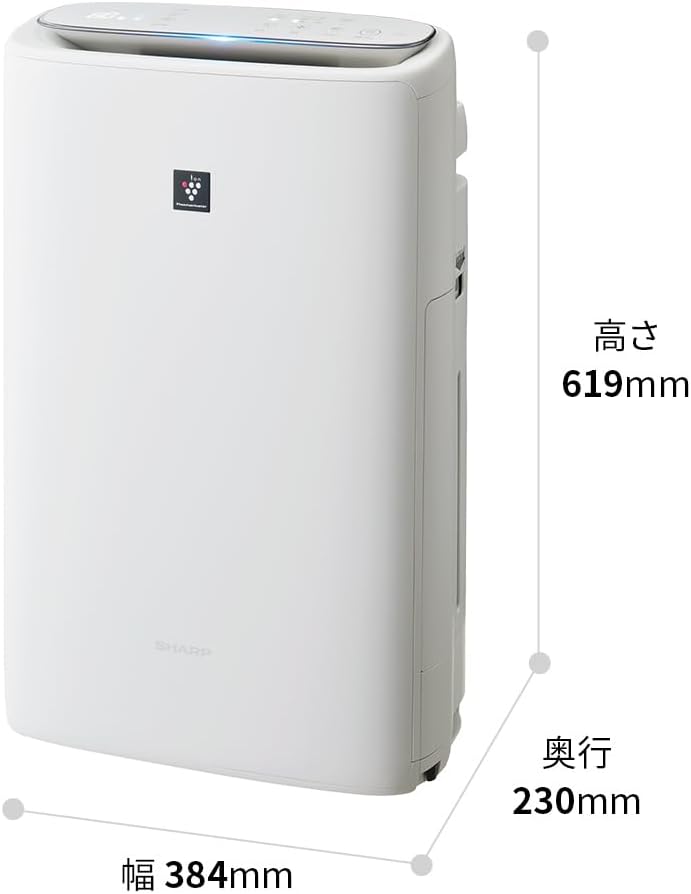
Image: Diagram illustrating the width (384mm), depth (230mm), and height (619mm) of the Sharp KI-TS50-W unit.
9. Pūtāhui me te Tautoko
For warranty information, please refer to the separate warranty card included with your product. For technical support, replacement parts, or further assistance, please contact Sharp customer service. Contact details can typically be found on the manufacturer's webpae, i roto ranei i nga tuhinga whakamana.