
1. Kupu Whakataki
Mauruuru koe mo te hokoasing the MLWSHR Digital LED Alarm Clock Model 8808. This device combines a digital alarm clock with a thermo-hygrometer, offering dual alarms, snooze function, date and year display, 12/24 hour switch, weekday settings, Daylight Saving Time (DST) functionality, auto-dimmable display with three brightness levels, and a convenient 5V1A USB output for charging other devices. Please read this manual carefully to ensure proper use and maintenance of your new alarm clock.
2. Nga korero haumaru
- Tiakina te taputapu mai i te wai me nga taiao makuku nui.
- Kaua e tukuna te taputapu ki te wera nui, ki te ra tika ranei mo te wa roa.
- Use only the provided USB Type-C cable for power.
- Kaua e ngana ki te wetewete, ki te whakatika ranei i te taputapu. Whakapa atu ki te tautoko a nga kaihoko mena ka puta nga take.
- Ensure proper ventilation when using the USB output to charge other devices.
3. Ihirangi mokete
- MLWSHR Digital LED Alarm Clock Model 8808
- USB Momo-C Waea Mana
- Pukapuka Kaiwhakamahi
4. Hua Neke Atuview
Kia mōhio koe ki ngā wāhanga matua me ngā mana whakahaere o tō karaka whakaoho.
This image displays the front of the MLWSHR Digital LED Alarm Clock, highlighting the time display, weekday indicators, temperature in Celsius, humidity percentage, and dual alarm icons. It also points to the Daylight Saving Time (DST) indicator.

This image illustrates the side and back of the alarm clock, detailing the USB Type-C input for primary power, the battery compartment for 3x AAA backup batteries (not included), and the USB-A output (5V1A) for charging other devices. It also shows the control buttons located on the top edge.
Mana:
- PATU Whakatakotoria: Enters setting mode for time, date, and alarms.
- UP (+) Button: Increases values during setting, adjusts brightness.
- DOWN (-) Button: Decreases values during setting, adjusts brightness.
- Pātene WHAKAMĀ/MĀRAMA: Activates snooze, adjusts display brightness.
- ALARM 1 Button: Activates/deactivates Alarm 1, enters Alarm 1 setting.
- ALARM 2 Button: Activates/deactivates Alarm 2, enters Alarm 2 setting.
- 12/24HR Button: Switches between 12-hour and 24-hour time formats.
- Patene °C/°F: Whakawhiti i waenga i te whakaaturanga pāmahana Celsius me Fahrenheit.
5. Tatūnga
5.1 Tuku Hiko
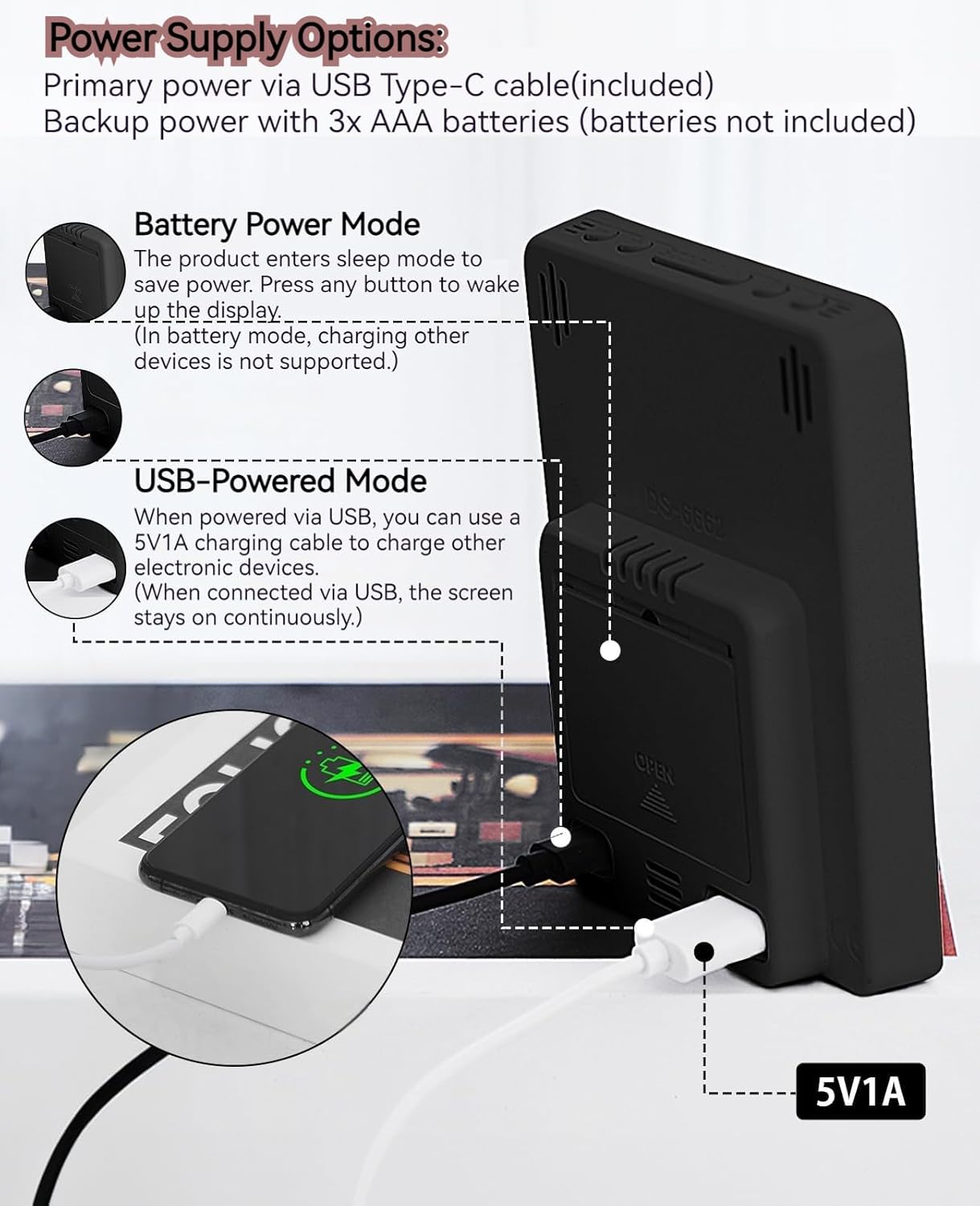
The MLWSHR Digital LED Alarm Clock can be powered in two ways:
- Primary Power (USB Type-C): Connect the provided USB Type-C cable to the clock's input port and plug the other end into a 5V1A USB power adapter (not included). When powered via USB, the display will remain continuously on.
- Backup Power (3x AAA Batteries): Insert 3 AAA batteries (not included) into the battery compartment on the back of the clock. In battery-only mode, the display will enter sleep mode to conserve power. Press any button to temporarily activate the display. Note that the USB output for charging other devices is not supported when operating on battery power alone.
5.2 Tautuhinga Wā tuatahi me te Rā
After connecting power, the clock will typically display a default time. To set the correct time and date:
- Patohia me te pupuri i te SET pātene mo te 3 hēkona ki te whakauru i te aratau tautuhinga wa. Ka korikori nga mati haora.
- Whakamahia te UP (+) or Raro (-) nga paatene hei whakatika i te haora.
- Perehi SET anō hei whakaū i te hāora, ka neke ki te tautuhinga meneti. Ka kimo ngā mati meneti.
- Whakamahia te UP (+) or Raro (-) nga paatene hei whakatika i nga meneti.
- Me pehi tonu SET to cycle through and set the Year, Month, and Day using the UP (+) or Raro (-) buttons for adjustment.
- After setting the Day, press SET he wa whakamutunga ki te puta i te aratau tautuhinga.
6. Nga Tohutohu Whakahaere
6.1 12/24 Hour Format Switch
Pehia te 12/24HR button to toggle between 12-hour (with AM/PM indicator) and 24-hour time formats.
This video demonstrates various features of the MLWSHR Digital LED Alarm Clock, including the time, temperature, humidity, weekday display, auto/manual brightness adjustment, 12/24 hour switch, and the easy-to-use buttons and USB-C input/USB-A output.
6.2 Te Tautuhi i ngā Pūoho (Pūoho 1 me te Pūoho 2)
The clock features two independent alarms. Each alarm can be set for specific days of the week (Monday-Friday, Monday-Saturday, or Monday-Sunday).

This image illustrates the dual alarm functionality, showing how each alarm can be customized to ring on specific days of the week: Monday to Friday, Monday to Saturday, or every day. It highlights the alarm icons and weekday indicators on the display.
- Pehia te PANUI 1 or PANUI 2 button to select the desired alarm. The alarm icon will appear on the display.
- Press and hold the selected ohooho button for 3 seconds to enter alarm setting mode. The hour digits will flash.
- Whakamahia te UP (+) or Raro (-) nga paatene hei whakatika i te haora whakaoho.
- Pehia te ohooho button again to confirm the hour and move to minute setting.
- Whakamahia te UP (+) or Raro (-) nga paatene hei whakatika i nga meneti whakaoho.
- Pehia te ohooho button again to set the alarm frequency (e.g., Mon-Fri, Mon-Sat, Mon-Sun). Use UP (+) or Raro (-) ki te whiriwhiri.
- Pehia te ohooho button one last time to exit alarm setting mode.
- To turn an alarm ON or OFF, simply press the corresponding PANUI 1 or PANUI 2 button briefly. The alarm icon will appear (ON) or disappear (OFF) from the display.
6.3 Mahi Koura
Ina tangi te whakaoho, ka taea e koe te whakahohe i te mahi whakaroa mō tētahi wā poto.

This image shows the clock's snooze button and how it functions. When the alarm rings, a brief press of the snooze button will delay the alarm for 5 minutes. Holding the button for more than two seconds will turn off the alarm for that day.
- Ka tangi te whakaoho, pehia te PUKA / Rama button briefly. The alarm will pause and ring again after 5 minutes.
- To turn off the alarm for the current day, press and hold the PUKA / Rama button for more than 2 seconds, or press any other button (except PUKA / Rama).
6.4 Whakaritenga Tirohanga
The clock features an auto-dimmable display and three manual brightness levels.
- Moama Aunoa: The built-in light sensor automatically adjusts the display brightness based on ambient light conditions. This is the default setting.
- Te Kanapa ā-Ringa: Patohia poto te PUKA / Rama button to cycle through 3 manual brightness levels (L-01, L-02, L-03).
- To return to auto-dimmable mode, continue pressing the PUKA / Rama button until 'L-AU' appears on the display.
6.5 Thermometer & Hygrometer
The clock displays indoor temperature and humidity levels.

This image highlights the temperature and humidity readings on the clock's display. It also provides guidance on ideal humidity levels and suggests actions (humidifier/dehumidifier) if levels are too low or too high. The temperature detection range is 23°F to 122°F (-5°C to 50°C) with an error margin of ±2°F.
- Whakawhiti Wae Pawera: Pehia te ° C / ° F. button to switch between Celsius and Fahrenheit temperature display.
- The temperature range is 23°F to 122°F (-5°C to 50°C) with an error margin of ±2°F.
- The humidity measurement error is within ±5%.
6.6 USB Power Output (5V1A)
The clock features a USB-A output port (5V1A) that can be used to charge other electronic devices.

This image demonstrates the use of the clock's USB-A output port to charge a smartphone. The clock provides a 5V1A output, making it a convenient charging station. This feature is only available when the clock is powered via its USB Type-C input.
- Connect your device's charging cable to the USB-A output port on the back of the alarm clock.
- Ensure the alarm clock is powered via its USB Type-C input for this feature to function. The USB output is not active when the clock is running on battery power alone.
6.7 Wā Tiaki Awatea (DST)
The clock supports Daylight Saving Time adjustment.
- To activate or deactivate DST, press and hold the DST button (if available, or refer to the SET button sequence for DST in specific models). The DST indicator will appear or disappear.
7. Tiaki
- Horoia te karaka ki te kakahu ngohengohe, maroke. Kaua e whakamahi i ngā kaihoroi whakakoi, i ngā whakarewa rānei.
- If the clock will not be used for an extended period, remove the AAA batteries to prevent leakage.
- Keep the USB ports free from dust and debris.
8. Te Raru
| Raruraru | Take pea | Rongoā |
|---|---|---|
| Display is off or intermittent. | Running on battery power in sleep mode, or no power. | Press any button to activate display in battery mode. Connect USB Type-C cable for continuous display. Check USB power source. |
| Ko te putanga USB kaore i te utu taputapu. | Clock is running on battery power, or USB cable is faulty. | Ensure the clock is connected to primary USB Type-C power. Try a different USB cable. |
| Kare e tangi te whakaoho. | Ko te whakaoho kaore i te whakahohe, i te he ranei te whakatakotoranga. | Check if the alarm icon is displayed. Re-set the alarm time and frequency. |
| He hē te panui o te pāmahana. | Environmental factors or sensor error. | Allow time for the sensor to stabilize. Ensure the clock is not near heat sources or vents. Note the ±2°F error margin. |
| Cannot set time/date. | Not in setting mode, or buttons are unresponsive. | Press and hold the SET button for 3 seconds. Ensure the clock has stable power. |
9. Whakatakotoranga
- Waitohu: MLWSHR
- Tau tauira: 8808
- Momo Whakaatu: LED
- Puna Hiko: USB Type-C (5V1A) / 3x AAA Batteries (backup)
- Rahi Hua: 3.54"W x 4.72"H
- Āhuatanga: Dual Alarms, Snooze, Thermo-Hygrometer, Date & Year Display, 12/24 Hour Switch, Weekdays, DST, Auto Dimmable (3 levels), USB Output (5V1A)
- Rauemi: Kirihou Ā-taiao
- Whakamahinga o roto/waho: Roo-roto
10. Raihana me te Tautoko
The MLWSHR Digital LED Alarm Clock Model 8808 comes with a 2-Tau Pūtāhui mai i te ra o te hokonga. Ka kapi tenei whakamana i nga hapa o te hangahanga me nga mahi kino i raro i te whakamahinga noa.
For technical support, warranty claims, or any questions regarding your product, please contact MLWSHR customer service through the retailer's platform or visit our official webpae mo nga korero whakapā. Tena koa kia rite to riirii hoko me to nama tauira ina whakapā atu ki te tautoko.