
Kupu Whakataki
This manual provides detailed instructions for the installation, operation, and maintenance of your Stemedu BLS-HV70MG 70KG Brushless Digital RC Servo. This high-performance servo is designed for 1:8 and 1:10 scale RC cars, offering high torque, speed, and durability. It features a brushless motor, all-metal gears, and an IP67 waterproof rating, ensuring reliable operation in various conditions.
Nga waahanga hua
- 70KG Brushless Servo: Putanga whakahaere teiteitage mai i te 4.8V ki te 8.4V DC.
- Tere Tere: No-load speed of 0.12sec/60° at 8.4V.
- Torque Teitei: Stall torque of 71 Kg-cm at 8.4V.
- Mahinga parewai: IP67 rated for reliable use in wet conditions.
- Hanganga Whakarewa Katoa: Full aluminum case, stainless steel metal gears for precision, reduced noise, and high operating accuracy.
- Koki Mana: Controllable angle range from 0 to 180 degrees.
He aha kei roto i te Pouaka
Kei roto i te kete nga waahanga e whai ake nei:
- 1 x Stemedu BLS-HV70MG 70KG Brushless Digital RC Servo
- Multiple plastic servo arms (various shapes)
- 1 x 25T metal servo horn
- Mounting screws and brass inserts

Image: The BLS-HV70MG servo shown with its complete set of accessories, including various plastic servo arms, a red metal 25T servo horn, mounting screws, and brass inserts.
Tohutohu Tatūnga
- Mounting the Servo: Securely mount the servo into your RC vehicle's servo tray using the provided screws and brass inserts. Ensure the servo is firmly seated to prevent movement during operation.
- Connecting to Receiver/BEC: Connect the servo's 3-pin connector to the appropriate channel on your RC receiver. If using a separate Battery Eliminator Circuit (BEC), ensure it is properly connected and configured to supply the recommended voltage range (4.8V-8.4V) to the servo.
- Attaching Servo Horn: With the RC system powered on and the servo centered (usually by turning on the transmitter and receiver first), attach the desired servo horn to the servo output shaft. Ensure the horn is aligned correctly for your application. The included 25T metal servo horn is recommended for high-stress applications.
- Whakaritenga Tuatahi: Before full operation, perform a basic calibration to ensure the servo responds correctly to your transmitter inputs. Check for full range of motion and proper centering.
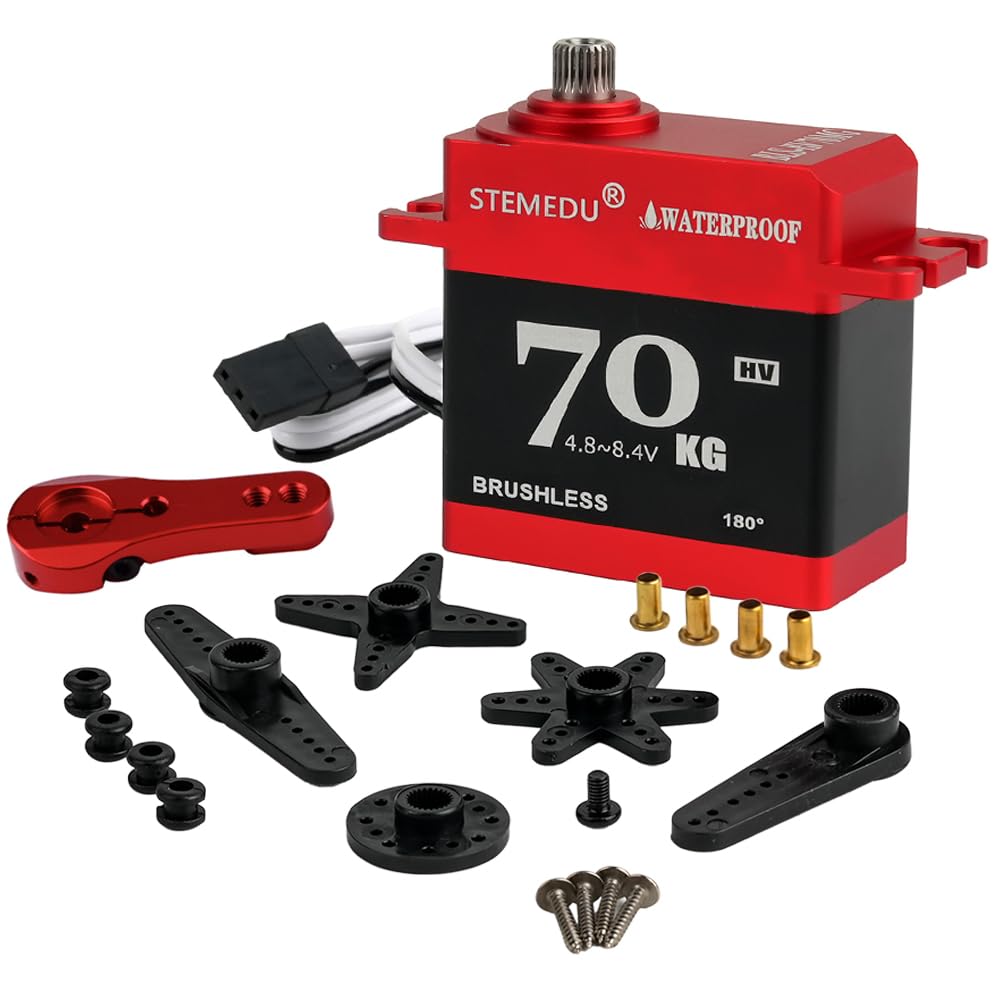
Whakaahua: He taipitopito view of the Stemedu BLS-HV70MG servo, showing its compact design and wiring for connection.
Nga Tohutohu Whakahaere
The BLS-HV70MG servo operates with a control angle of 180 degrees, responding to standard PWM signals. The pulse width range for control is typically from 500 to 2500 microseconds, with 1500 microseconds representing the neutral position.
- Voltage Awhe: This servo is designed for high voltage (HV) operation, accepting inputs from 4.8V to 8.4V. Operating within this range ensures optimal performance and longevity.
- Speed and Torque: The servo's speed and torque vary with the input voltage. Vol teiteitages (e.g., 8.4V) will result in faster speeds (0.12sec/60°) and higher torque (71 Kg-cm).
- Mana: Use your RC transmitter to send control signals to the servo. Adjust the trim and sub-trim settings on your transmitter for precise centering and endpoint adjustments.

Image: A visual representation of the servo's 180-degree control angle, indicating the pulse width modulation (PWM) values corresponding to different positions.
Video: An official product video demonstrating the features and performance of the Stemedu 70KG Brushless Servo, including its waterproof capabilities and high-speed operation.
Te tiaki
Proper maintenance ensures the longevity and optimal performance of your servo.
- Parewai: The servo has an IP67 waterproof rating. While it can withstand splashes and temporary immersion, avoid prolonged submersion or high-pressure water jets. After exposure to water, allow the servo to dry completely before storage.
- Tirohanga taputapu: Periodically inspect the metal gears for any signs of wear, damage, or debris. Clean any accumulated dirt or grime.
- Te horoi: Use a soft, dry cloth to clean the exterior of the servo. Avoid using harsh chemicals or solvents.
- Rokiroki: Store the servo in a dry, cool place away from direct sunlight and extreme temperatures.

Image: The BLS-HV70MG servo is shown amidst splashing water, illustrating its IP67 waterproof design, which protects it from dust and water ingress.
Raparongoā
- Servo Not Responding:
- Check all connections between the servo, receiver, and power source.
- Ensure the receiver and transmitter are properly bound and powered on.
- Manatokohia te voltage is within the servo's operating range (4.8V-8.4V).
- Inconsistent Centering:
- Adjust the sub-trim on your transmitter.
- Check for any mechanical binding or obstruction in the linkage.
- Ensure the servo horn is securely attached and not stripped.
- Excessive Noise or Grinding:
- Inspect the gears for damage or foreign objects.
- Ensure the servo is not under excessive load or binding.
- Te wera nui:
- Reduce the load on the servo if possible.
- Ensure adequate ventilation around the servo.
- Manatokohia te urunga voltage kore e tiketike rawa.
Whakatakotoranga
| Tūemi | Whakatakotoranga |
|---|---|
| Tohu Whakahau | Pulse Width Modification (PWM) |
| Ampmomo Momo | Kaitatau Mamati |
| Te Awhe whanui o te Pulse | 500-2500 µsec |
| Tūnga kūpapa | 1500 µsec |
| Running Degree | 180±3° (when 500-2500 µsec) |
| Dead Band Width | 3 µsec |
| Aronga Hurihuri | Counterclockwise (when 1000-2000 µsec) |
| Mahi Voltage | 4.8V ~ 8.4V |
| No-load Speed (4.8V) | 0.21 hēkona/60° |
| No-load Speed (6.0V) | 0.17 hēkona/60° |
| No-load Speed (7.4V) | 0.14 hēkona/60° |
| No-load Speed (8.4V) | 0.12 hēkona/60° |
| Running Current (4.8V-8.4V) | 500mA-1200mA |
| Peak Stall Torque (4.8V) | 58 Kg-cm |
| Peak Stall Torque (6.0V) | 62 Kg-cm |
| Peak Stall Torque (7.4V) | 68 Kg-cm |
| Peak Stall Torque (8.4V) | 71 Kg-cm |
| Stall Current (4.8V-8.4V) | 8000mA-13000mA |
| Hunga Hua | 1.57 x 0.79 x 1.57 inihi (40 x 20 x 40 mm) |
| Taumaha Tūemi | 3.2 hekere (92.2g) |
| Whakatauranga parewai | IP67 |

Image: A table presenting the comprehensive specifications of the BLS-HV70MG servo, detailing its performance characteristics under different voltage tikanga.
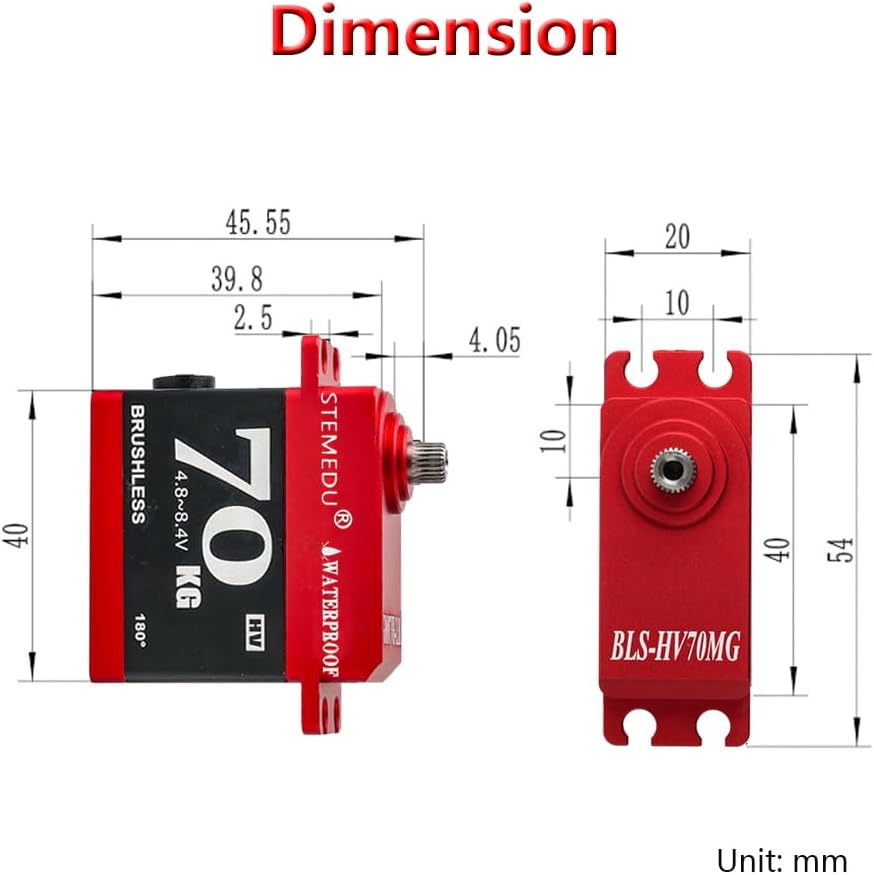
Image: A technical diagram illustrating the exact dimensions of the BLS-HV70MG servo in millimeters, useful for fitment and installation.

Image: The BLS-HV70MG servo on a digital scale, showing its weight of 92.2 grams, indicating its robust yet lightweight construction.
Pūtāhui me te Tautoko
Stemedu products are manufactured to high-quality standards. For any issues or questions regarding your BLS-HV70MG servo, please refer to the seller's return policy or contact Stemedu customer support through the platform where the product was purchased. Please retain your proof of purchase for warranty claims.