
1. Kupu Whakataki
The DEWENWILS Wireless Motion Detector Light Switch offers a convenient and flexible solution for automated lighting control. This system eliminates the need for new wiring, allowing for easy replacement of existing light switches. It features sensitive motion detection, a wide detection angle, and multiple operating modes to suit various applications in areas such as garages, basements, and stairwells.
2. Nga korero haumaru
- Always disconnect power at the circuit breaker before installing or servicing the receiver unit.
- Me whakarite kia mau nga hononga hiko katoa me te whai ki nga waehere hiko o te rohe.
- Do not expose the sensor or receiver to moisture or extreme temperatures outside the specified operating range.
- Kaua e taea e nga tamariki.
- Use only the specified battery type for the motion sensor.
3. Ihirangi mokete
- 1 x Wireless Motion Detector Sensor
- 1 x Wāhanga Kaiwhiwhi Ahokore
- Whakaekea taputapu
- Pukapuka Kaiwhakamahi
4. Hua Neke Atuview
The system consists of a battery-powered motion sensor and a wired receiver unit. The sensor detects movement and wirelessly transmits a signal to the receiver, which then controls the connected light or device.

Motion Sensor Features:
- Rotary Mode Switch: Selects between PIR, NTM, DTD, and RND modes.
- Delay Time Switch: Adjusts the duration the light stays on after motion detection (1, 5, 15, 30 minutes).
- Paatene takirua: Used to link the sensor with the receiver.
- Wāhanga Pūhiko: Houses 3x AAA batteries (not included).
- DC 5V Power Connection: Optional power input for the sensor.
Ngā Āhuatanga o te Wāhanga Kaiwhiwhi:
- Compact design for flexible installation.
- Wired connection to lighting fixtures or other devices.
- Receives wireless signals from the motion sensor.
5. Tatūnga me te Tāuta
5.1 Whakaaturanga Whakaoho
- Kōkuhu Pūhiko: Open the battery compartment on the back of the motion sensor and insert 3x AAA batteries (not included), ensuring correct polarity. Alternatively, connect a DC 5V power adapter (not included) to the DC 5V port.
- Maunga te Pūoko: Choose a suitable location for the sensor, typically on a wall or ceiling, where it can cover the desired detection area. The sensor can be rotated up to 180 degrees for optimal positioning. The recommended installation height is between 0.9 and 2.1 meters.

5.2 Receiver Installation (Wiring)
WHAKATŪPATO: Disconnect power at the circuit breaker before proceeding with wiring.
- Tautuhi Waea: Locate the Live (L), Neutral (N), and Ground (G) wires from your power source and the lighting fixture.
- Tūhono Kaiwhiwhi: Connect the receiver's wires according to the wiring diagram provided. Typically, the receiver's input Live (L) and Neutral (N) connect to the power source, and its output Live (L) and Neutral (N) connect to the light fixture.
- Hononga Haumaru: Me whakarite kia piri tonu ngā hononga waea katoa, ā, kia tika hoki te whakamarumaru.
- Maunga Kaiwhiwhi: Place the compact receiver unit in a suitable location, such as inside a junction box or fixture canopy.

5.3 Pairing the Sensor and Receiver
After installing both units, follow the receiver's specific pairing instructions (usually involves pressing a pairing button on the receiver and then activating the sensor) to establish a wireless connection. Refer to the receiver's individual manual for detailed pairing steps.
6. Nga Tohutohu Whakahaere
6.1 Te Kowhiri i nga Aratau Mahi
The motion sensor offers four distinct operating modes, selected by rotating the dial on the front of the sensor:
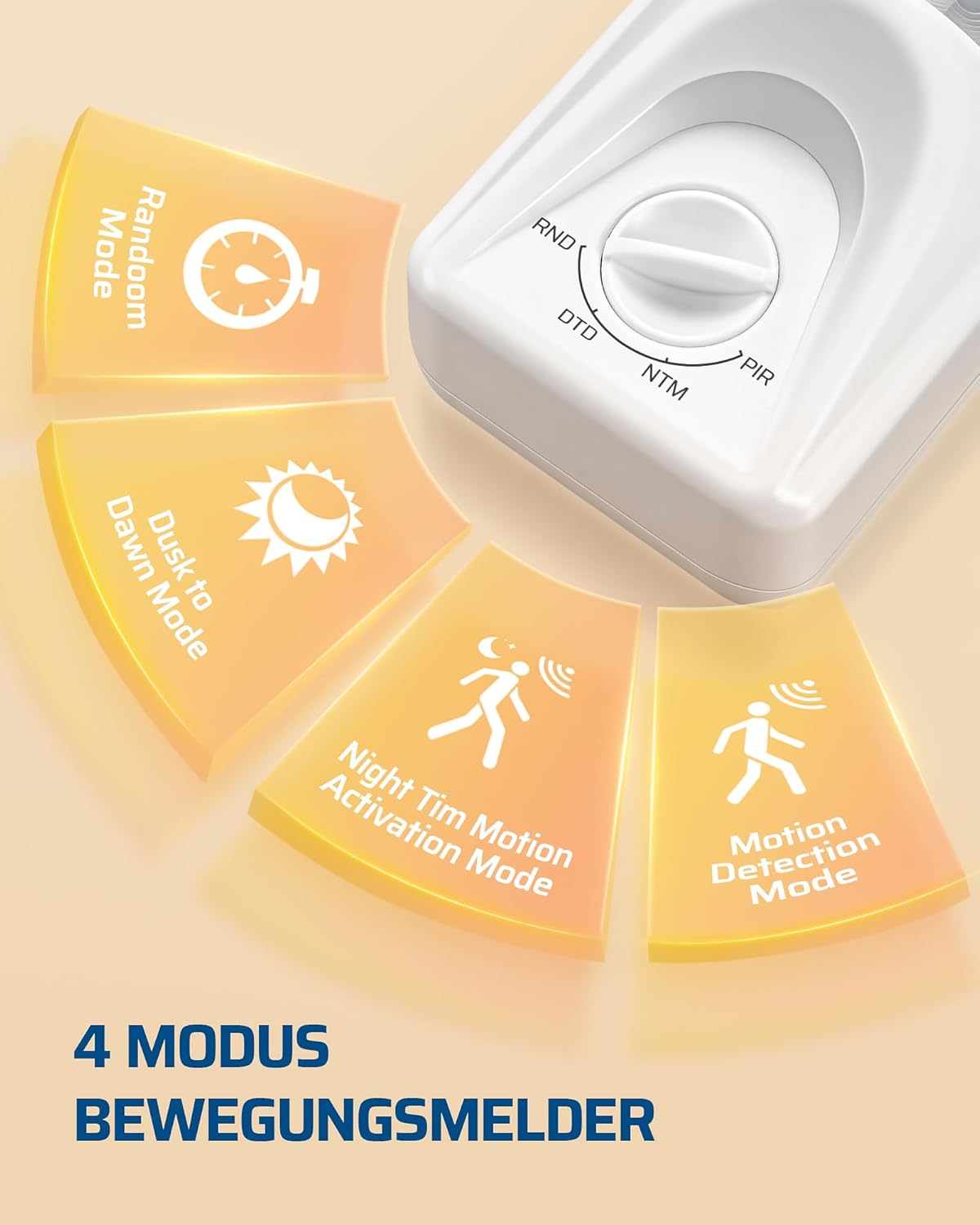
- PIR (Motion Detection Mode): The light activates when motion is detected, regardless of ambient light conditions.
- NTM (Night Time Motion Activation Mode): The light activates only when motion is detected in low light conditions.
- DTD (Dusk to Dawn Mode): The light turns on automatically at dusk and turns off at dawn, without motion detection.
- RND (Random Mode): The light turns on and off randomly to simulate occupancy, typically used for security purposes when away from home.

6.2 Adjusting Delay Time
In PIR and NTM modes, the delay time (how long the light stays on after the last detected motion) can be adjusted using the switch on the side of the sensor. Available settings are 1, 5, 15, and 30 minutes.
6.3 Detection Range and Angle
The motion sensor has a detection range of approximately 6 meters and an adjustable detection angle of 120 degrees. The wireless signal between the sensor and receiver can transmit up to 30 meters in open areas, even through walls.


7. Tiaki
7.1 Whakakapinga Pūhiko
When the motion sensor's performance degrades or it stops responding, it may be time to replace the batteries. Open the battery compartment on the back of the sensor and replace the 3x AAA batteries with new alkaline or lithium batteries, ensuring correct polarity. If using the DC 5V power option, ensure the power adapter is functioning correctly.
7.2 Te horoi
Wipe the sensor and receiver units with a soft, dry cloth. Do not use abrasive cleaners or solvents, as these can damage the surfaces or internal components.
8. Te Raru
- Light does not turn on with motion:
- Check if the sensor batteries are dead or incorrectly installed.
- Ensure the sensor and receiver are properly paired. Re-pair if necessary.
- Verify the sensor is within the 30-meter wireless range of the receiver.
- Check the selected operating mode (PIR or NTM for motion detection).
- Ensure the light fixture connected to the receiver is functional.
- Ka mau tonu te rama:
- Check the selected operating mode. If in DTD mode, it will stay on from dusk till dawn.
- Ensure there is no continuous motion within the sensor's detection area.
- Verify the delay time setting is not excessively long.
- Poor detection range or sensitivity:
- Adjust the sensor's position and angle to optimize coverage.
- Me whakarite karekau he arai e aukati ana i te pukoro view.
- Replace sensor batteries if they are low.
- Nga take hononga ahokore:
- Reduce the distance between the sensor and receiver.
- Whakaitihia te pokanoa mai i etahi atu taputapu ahokore.
- Re-pair the sensor and receiver.
9. Whakatakotoranga
| Āhuahira | Whakatakotoranga |
|---|---|
| Waitohu | DEWENWILS |
| Tau tauira | DMLC18+DRLS02 |
| Tae | kūpapa |
| Pūtake Hiko (Pono) | 3x AAA Batteries (Alkaline or Lithium) or DC 5V |
| Pūtake Hiko (Kaiwhiwhi) | Wired (230V, 50Hz implied from context) |
| Awhe Ahokore Max | 30 mita (waahi tuwhera) |
| Te Awhe Tirohanga Motini | Approx. 6 Meters |
| Koki Rapu | 120 Waeine |
| Wā Whakaroa Whakaritea | 1, 5, 15, 30 Minutes (PIR & NTM modes) |
| Aratau Mahi | PIR, NTM, DTD, RND |
| Mounting Type (Sensor) | Wall/Ceiling Mount (Adjustable) |
| Mounting Type (Receiver) | Flexible (e.g., within fixture canopy) |
| Ngā Ahu o te Hua (Pūoko) | 4.3D x 5.6W x 9H cm |
| Te Waahi Mahi | 10°C (Note: This value seems unusually low for a typical operating range. Please refer to product packaging for full range.) |
| Pūrere Hototahi | Lighting control, Smart Home Hub, Alarm systems |
10. Pūtāhui me te Tautoko
For warranty information and technical support, please refer to the documentation included with your product or visit the official DEWENWILS webpae. Puritia to rihiti hoko mo nga kereme whakamana.