
WONDOM ADAU1701
WONDOM ADAU1701 DSP Preamp: 2-I roto 4-Out Digital Signal Processor Manual Tohutohu
Model: ADAU1701
Kupu Whakataki
This manual provides detailed instructions for the installation, operation, and maintenance of your WONDOM ADAU1701 DSP Preamp. This unit is designed for advanced audio signal processing, offering a 2-input, 4-output configuration with digital crossover capabilities and support for SigmaStudio programming.
Ko nga ahuatanga matua ko:
- Powered by ADAU1701 DSP, a 28/56bit Digital Signal Processor Engine.
- 24bit ADC/DAC Resolution Ratio with a 48kHz Sampling Reeti.
- Unbalanced 2-Input, 4-Output Preamp Waeine.
- USB Type-C Port for DC 5V Power.
- Four Potentiometers for High-Pass Filter (HPF), Low-Pass Filter (LPF), and Volume Control.
- Integrated Mute & Phase Switches.
- Supports SigmaStudio Programming when connected with an ICP5 programmer.
- Open-sourced Demo Program & HEX Files are provided for restoring factory settings.
Ihirangi mokete
Tena koa tirohia kei roto nga taonga katoa kei roto i te kete:
- WONDOM ADAU1701 DSP Preamp Waeine
- USB Type-C Cable (for power)
- Pukapuka Kaiwhakamahi (tenei tuhinga)
- (Optional: ICP5 Programmer, sold separately for advanced programming)
Nga korero haumaru
- Ensure the power supply matches the device's requirements (DC 5V, 1A via USB Type-C).
- Kaua e tukuna te waeine ki te makuku, ki te wera nui ranei.
- Avoid opening the enclosure unless you are a qualified technician.
- Kaua e taea e nga tamariki.
Tatūnga
1. Hononga Tinana
Refer to the diagrams below for proper connection of audio inputs, outputs, and power.

Whakaatu 1: Hononga Paewhiri Whakamuri. This image shows the rear panel of the ADAU1701 DSP Preamp, highlighting the DC Input (5V, 1A), ICP Port, Line In (ADC0 Left, ADC1 Right), and Line Out (DAC0 Right, DAC1 Left, DAC2 Right, DAC3 Left) RCA jacks.
- Hononga Hiko: Connect a DC 5V, 1A power supply to the USB Type-C port labeled "DC INPUT 5V, 1A" on the rear panel.
- Tāuru Ororongo: Connect your audio source (e.g., media player, pre-amplifier) to the "LINE IN" RCA jacks (ADC0 Left, ADC1 Right).
- Putanga Ororongo: Honoa to amplifiers or powered speakers to the "LINE OUT" RCA jacks. The default configuration provides 2-channel mid-range output (DAC2 Right, DAC3 Left) and 2-channel bass output (DAC0 Right, DAC1 Left) for a 2-way digital crossover setup.
- ICP Port: This port is used for connecting an ICP5 programmer (sold separately) for advanced SigmaStudio programming.
2. Hia Tuatahi
Once all connections are secure, apply power to the unit. The "POWER" LED on the front panel should illuminate, indicating the device is operational.
Nga Tohutohu Whakahaere
The WONDOM ADAU1701 DSP Preamp features several controls on its front panel for direct adjustment, as well as advanced programming capabilities via SigmaStudio.

Pikitia 2: Ngā Mana Whakahaere o te Paewhiri o Mua. This image displays the front panel, showing the Power LED, Busy LED, SW1 (Mute) and SW2 (Phase) switches, and four potentiometers (POT1, POT2, POT3, POT4) for various audio adjustments.
Mana Paewhiri Mua:
- Arahina mana: E tohu ana kei te hiko te waeine.
- BUSY LED: Indicates DSP activity.
- SW1 (Mute Switch): Toggles audio output mute on/off.
- SW2 (Phase Switch): Adjusts the phase of the audio output.
- POT1 (MP3 / ADC2): Controls the High-Pass Filter (HPF) for Bank B (3kHz-20kHz).
- POT2 (MP8 / ADC3): Controls the Low-Pass Filter (LPF) for Bank A (210Hz-3kHz).
- POT3 (MP9 / ADC0): Controls the High-Pass Filter (HPF) for Bank A (10Hz-310Hz).
- POT4 (VOL): Ka whakahaere i te rōrahi whānui.
Digital Crossover Configuration:
The unit's default output is configured as a 2-way digital crossover, providing dedicated outputs for bass and mid-range frequencies.
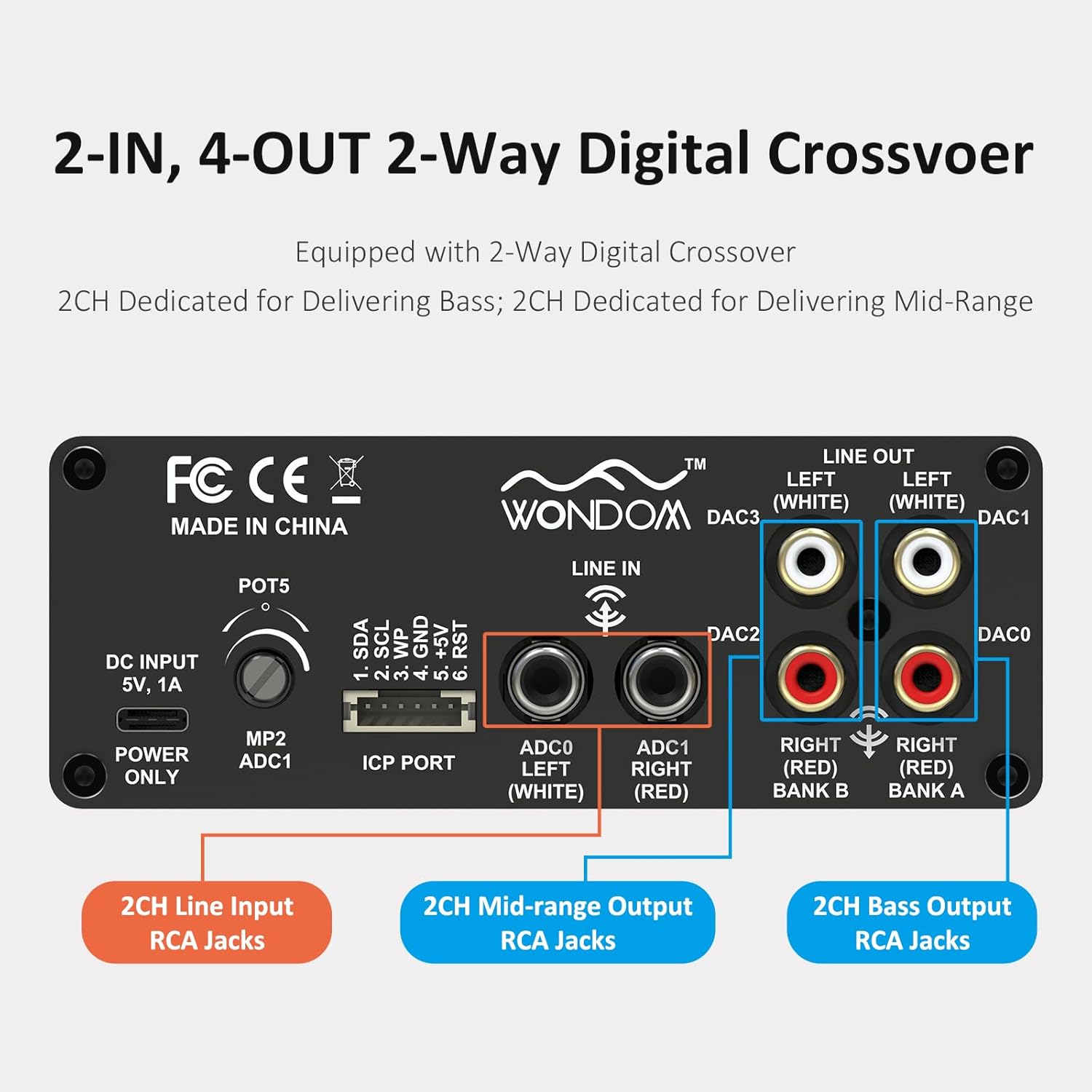
Figure 3: 2-In, 4-Out Digital Crossover. This diagram shows the RCA jack assignments for 2-channel Line Input, 2-channel Mid-range Output, and 2-channel Bass Output, facilitating a 2-way digital crossover setup.
- 2CH Line Input: ADC0 Left (White), ADC1 Right (Red).
- 2CH Mid-range Output: DAC2 Right (Red), DAC3 Left (White).
- 2CH Bass Output: DAC0 Right (Red), DAC1 Left (White).
SigmaStudio Programming:
For advanced customization and fine-tuning of the DSP functions, the unit supports programming via Analog Devices' SigmaStudio software. An ICP5 programmer (sold separately) is required to connect the DSP unit to your computer.

Figure 4: SigmaStudio Programming Setup. This image illustrates the connection between the DSP unit and an ICP5 programmer, along with a visual representation of the SigmaStudio graphical programming interface.
- Pūmanawa: Download and install SigmaStudio from the Analog Devices webpae.
- Pūmārō: Connect the ICP5 programmer to the ICP Port on the DSP unit and to your computer via USB.
- Papatonotanga: Utilize the open-sourced demo program and HEX files provided by WONDOM to get started or to restore factory settings. All terminal functions can be tailored to specific needs using SigmaStudio.
Te tiaki
- Kia ma o te waeine ma te muru ki te kakahu ngohengohe, maroke.
- A ape i te whakamahi i nga matū kino, i nga horoi horoi ranei.
- Me whakarite kia pai te hau huri noa i te waahanga kia kore ai e wera rawa.
- Tirohia nga hononga taura katoa mo te pai kia mau.
Raparongoā
| Raruraru | Take pea | Rongoā |
|---|---|---|
| Kāore he hiko / Kua mate te rama hiko | Incorrect power supply, loose connection, faulty cable. | Verify DC 5V, 1A power supply. Check USB Type-C cable connection. Try a different power source or cable. |
| Kaore he putanga ororongo | Incorrect input/output connections, Mute switch engaged, volume too low, faulty audio cables. | Check all RCA connections. Ensure SW1 (Mute) is disengaged. Increase POT4 (Volume). Test with different audio cables. |
| Audible hiss or noise | Ground loop, interference, power supply noise, high gain settings. | Ensure all components are properly grounded. Use a high-quality, stable 5V power supply (a separate USB power bank/battery can help reduce noise from PC USB). Reduce gain settings if applicable. |
| Cannot connect to SigmaStudio | ICP5 programmer not connected or faulty, DSP not powered, incorrect software drivers. | Ensure ICP5 programmer is correctly connected to the DSP and computer. Verify DSP unit is powered on. Install SigmaStudio drivers in administrator mode (as suggested by user reviews). |
Whakatakotoranga
| Āhuahira | Taipitopito |
|---|---|
| DSP Tipi | ADAU1701 (28/56bit Digital Signal Processor) |
| ADC/DAC Resolution | 24-bit |
| Sampreiti reiti | 48 kHz |
| Whirihoranga Whakauru | 2-Input (Unbalanced RCA) |
| Whirihoranga Huaputa | 4-Output (Unbalanced RCA, default 2-way digital crossover) |
| Tuku Hiko | DC 5V, 1A (via USB Type-C) |
| Mana whakahaere | 4 Potentiometers (HPF/LPF/Volume), Mute Switch, Phase Switch |
| Tautoko Hōtaka | SigmaStudio (requires ICP5 programmer, sold separately) |
| Ahu (L x W x H) | 4.72 x 4.72 x 1.77 inihi |
| Taumaha | 1.23 pauna |
| Whare | Sleek Aluminum Enclosure |
Pūtāhui me te Tautoko
WONDOM products are manufactured by Sure Electronics. For warranty information, technical support, and further assistance, please refer to the official Sure Electronics webpaetukutuku, whakapā atu ranei ki ta raatau ratonga kaihoko. Puritia to riirii hoko hei tohu mo te hoko mo nga kereme whakamana.
Manufacturer: Sure Electronics
For additional resources and community support regarding SigmaStudio programming, online forums and tutorials can be a valuable resource.