
1. Kupu Whakataki
The TOPPING D70 Pro Sabre is a high-performance Digital-to-Analog Converter (DAC) designed for audiophiles seeking exceptional sound quality. Featuring the ES9039SPro chip, advanced I/V conversion circuitry, and versatile input/output options, this device delivers precise and immersive audio reproduction. It supports various audio formats and offers a user-friendly interface for an enhanced listening experience.
2. Nga korero haumaru
- Kaua e wetewetehia, kaua hoki e whakarerekētia te taputapu. Mā ngā whakarerekētanga kāore i whakamanahia ka whakakorea pea te pūtāhui, ā, ka tūpono pea he mōrearea ki te haumaru.
- Puritia te taputapu kia matara atu i te wai, te makuku me ngā pāmahana tiketike.
- Me whakarite kia tika te hau huri noa i te waahanga kia kore ai e wera rawa.
- Whakamahia anake te taura hiko me ngā taputapu kua whakaratohia.
- Momotuhia te taura hiko i te wā e uira ana, e kore rānei e whakamahia mō te wā roa.
3. Ihirangi mokete
Tena koa tirohia nga mea katoa kei roto i te kete:
- 1 x TOPPING D70 Pro Sabre DAC
- 1 x Mana Mamao
- 1 x Tauira USB
- 1 x AC Power Cable
- 1 x Antenna Nihokikorangi
- 1 x Manual Kaiwhakamahi (tenei tuhinga)

Image: TOPPING D70 Pro Sabre DAC with its included accessories and dimensions.
4. Hua Neke Atuview
4.1 Paewhiri Mua

Whakaahua: Mua view of the TOPPING D70 Pro Sabre, showing the full-color display and control knob.
The front panel features a full-color display (Aurora UI) that shows current input, sample rate, volume level, and other playback information. A multi-function knob allows for input selection, volume adjustment, and menu navigation. Touch buttons provide quick access to various settings and display modes like FFT and VU meters.
4.2 Paewhiri Whakamuri

Whakaahua: Rear view of the TOPPING D70 Pro Sabre, illustrating the various input and output connections.
The rear panel provides a comprehensive set of input and output options:
- Ngā Tāuru: USB, AES, Optical, Coaxial, Bluetooth 5.1 (with antenna connector).
- Putanga: Balanced XLR, Unbalanced RCA.
- Mana: Whakauru hiko AC.
5. Tatūnga
5.1 Te Mana Hononga
- Connect the provided AC power cable to the power input on the rear panel of the D70 Pro Sabre.
- Plug the other end of the AC power cable into a suitable wall outlet.
5.2 Te Hono i nga Puna Ororongo
Kōwhiria tētahi o ngā tikanga whakauru e whai ake nei:
- Whakauru USB: Connect a USB cable from your computer (Windows 10/11, macOS, Linux) to the USB input on the D70 Pro Sabre. For Windows systems, a driver installation may be required for ASIO applications.
- Optical/Coaxial/AES Input: Connect your digital audio source (e.g., CD player, streamer) using an optical, coaxial, or AES cable to the corresponding input on the D70 Pro Sabre.
- Whakauru Nihokikorangi: Screw the Bluetooth antenna onto the designated connector on the rear panel.
5.3 Te hono atu ki tētahi Amplifier/Headphones
Connect the D70 Pro Sabre to your ampkaiwhakaora, potae ranei amplifier using either XLR or RCA cables:
- Putanga XLR: For balanced connections, use XLR cables to connect the D70 Pro Sabre to an amplifier with XLR inputs.
- Putanga RCA: For unbalanced connections, use RCA cables to connect the D70 Pro Sabre to an amplifier with RCA inputs.

Image: Diagram illustrating typical connections for the D70 Pro Sabre with a PC, headphone amplifier, and headphones.
6. Nga Tohutohu Whakahaere
6.1 Hiko / Whakaweto
Press the power button on the front panel or the remote control to turn the device on or off.
6.2 Kōwhiringa Tāuru
Rotate the multi-function knob or use the remote control to cycle through available inputs (USB, AES, Optical, Coaxial, Bluetooth).
6.3 Mana Rōrahi
Rotate the multi-function knob to adjust the output volume. The D70 Pro Sabre features independent volume memory for Single Ended, Balanced, and All modes, automatically recalling the last used volume for each output type.

Image: The D70 Pro Sabre display showing the current volume level and PCM sample reiti.
6.4 Display Modes (Aurora UI)
The D70 Pro Sabre features an intuitive Aurora UI with a full-color display. Use the touch buttons or remote to navigate and customize the display, including options for FFT (Fast Fourier Transform) and VU (Volume Unit) meters to visualize playback information.
6.5 Takirua Nihokikorangi
- Select Bluetooth as the input source on the D70 Pro Sabre.
- On your Bluetooth device (e.g., smartphone, tablet), search for available devices and select "TOPPING D70 Pro Sabre".
- Once paired, audio will be streamed wirelessly to the DAC. The D70 Pro Sabre supports LDAC, aptX-Adaptive, aptX HD, aptX, AAC, and SBC codecs for high-quality wireless audio transmission.

Image: Illustration of Bluetooth 5.1 connectivity and performance graphs of the D70 Pro Sabre.
6.6 Timbre Fine-Tuning
The D70 Pro Sabre allows direct switching between different timbre modes: Default, Valve, and Transistor. These modes adjust the sound characteristics to suit your preference.
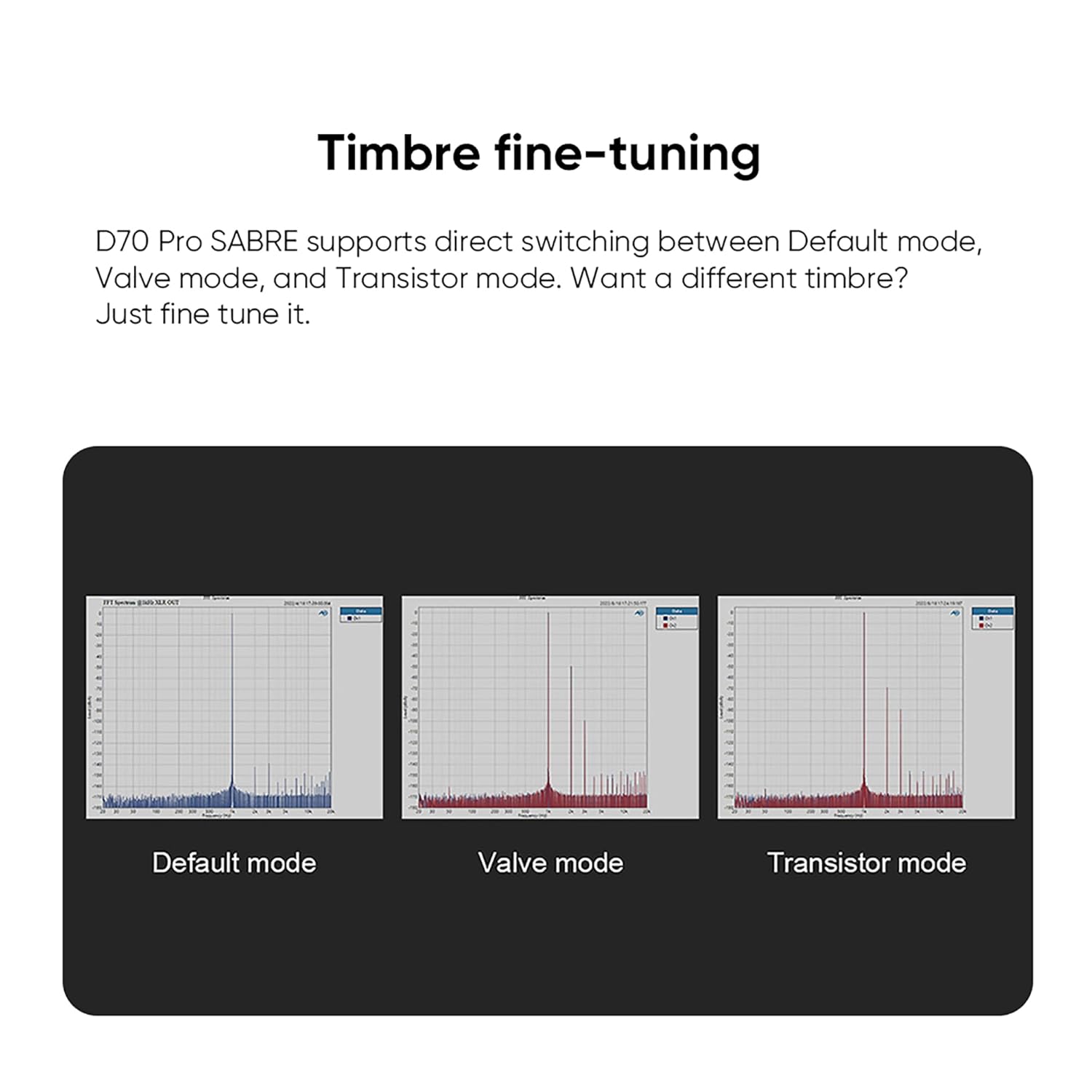
Image: Visual representation of the Default, Valve, and Transistor timbre modes available on the D70 Pro Sabre.
7. Tiaki
- Clean the device regularly with a soft, dry cloth. Avoid using abrasive cleaners or solvents.
- Me whakarite kei te mau tonu ngā hononga katoa, ā, kāore he puehu.
- Whakaorangia te taputapu ki te waahi makariri, maroke ina kore e whakamahia.
8. Te Raru
| Raruraru | Take pea | Rongoā |
|---|---|---|
| Kaore he putanga oro | Incorrect input selected, cables loose, amplifier off, volume too low. | Verify input selection, check all cable connections, ensure amplifier is on and volume is adequate. |
| Korekore te hononga Nihokikorangi | Antenna not connected, interference, device too far. | Ensure Bluetooth antenna is securely attached. Reduce distance between devices. Avoid sources of interference. |
| Karekau he whakaaturanga | Device not powered on, display settings. | Check power connection and power button. Adjust display settings via menu. |
| Oro kerekere | hē sample rate, faulty cable, source issue. | Tirohia ngā pūtakeample rate matches DAC capabilities. Try different cables. Test with another audio source. |
9. Whakatakotoranga
The TOPPING D70 Pro Sabre DAC features the powerful ES9039SPro chip and advanced I/V conversion circuitry. Below are key performance parameters (Line Out/USB In@96kHz):
| Tawhā | Putanga RCA | Putanga XLR |
|---|---|---|
| THD+N (A-wt) @1kHz | <0.00008% | <0.00006% |
| THD @90kBw (No-wt) @20-20kHz | <0.0004% | <0.0002% |
| SNR (A-wt) @1kHz | 128dB | 133dB |
| Dynamic Range (A-wt) @1kHz | 128dB | 133dB |
| Whakautu auau | 20Hz-20kHz (+0.05dB), 20Hz-40kHz (+0.2dB) | 20Hz-20kHz (+0.05dB), 20Hz-40kHz (+0.2dB) |
| Output Level @0dBFS (4V mode) | 2.1Vramatanga | 4.2Vramatanga |
| Output Level @0dBFS (5V mode) | 2.5Vramatanga | 5.0Vramatanga |
| Haruru (A-wt) | <1.0uVrms | <1.0uVrms |
| Whakawhitiwhiti korero @1kHz | -128dB | -140dB |
| Taurite Hongere | 0.3dB | 0.3dB |
| Putanga Putanga | 50Ω | 100Ω |
Note: The above data is the result obtained from TOPPING's laboratory tests at AC220V 50Hz, with D70 Pro SABRE set to 5V output mode.
Whakatakotoranga Whānui:
- Kaihanga: TOPPING
- Tau Wāhanga: D70Pro SE
- Taumaha Hua: 2.02 Kirokaramu
- Rahi Hua: 22.2 x 17.6 x 4.8 cm
- Tae: Pango
- Momo Atanga: RCA, USB
- Minimum/Maximum Supply Voltage: 5 Volts (DC)
10. Pūtāhui me te Tautoko
TOPPING provides after-sales support and technical assistance for its products. If you encounter any issues during purchase or use, please contact the seller directly for assistance. For general inquiries or technical support, refer to the official TOPPING webpaetukutuku, whakapā atu ranei ki ta raatau ratonga kaihoko.
The seller, AOSHIDA Audio-JP, is available to assist with product-related concerns. You can find their contact information on the Amazon platform.