
CREATE 93512_187855
Pukapuka Kaiwhakamahi mō te Hanga Hau Nui DC mō te Pā Whakamuri
Tauira: 93512_187855
1. Kupu Whakataki
Thank you for choosing the CREATE WIND LARGE DC Ceiling Fan. This manual provides essential information for the safe and efficient installation, operation, and maintenance of your new ceiling fan. Please read this manual thoroughly before installation and keep it for future reference.
This ceiling fan is designed for optimal air circulation, featuring a quiet DC motor, multiple speed settings, and a programmable timer for enhanced comfort and energy efficiency. It also includes a reversible motor function for both summer and winter use.
2. Nga Tohutohu Haumaru
- Me momotu te hiko mai i te whati hiko matua i mua i te tāutanga, te tiaki, te horoi rānei.
- Installation must be performed by a qualified electrician and in accordance with all local and national electrical codes.
- Ensure the mounting structure is capable of supporting the fan's weight (approximately 7.14 kg) and the dynamic load of the rotating fan.
- Do not operate the fan if any part is damaged or missing.
- Puritia ngā ringaringa, ngā kākahu me ētahi atu mea kia ma i ngā mata o te pā hau i te wā e whakamahia ana te pā hau.
- Ko tenei taputapu ehara i te mea mo te whakamahi ma te hunga (tae atu ki nga tamariki) he iti te kaha o te tinana, te tairongo, te hinengaro, te kore wheako me te mohiotanga, mena ka tukuna atu ki a raatau te tirotiro, te tohutohu ranei mo te whakamahi i te taputapu e te tangata whai mana mo to raatau haumaru.
- Me mataki nga tamariki kia kore ai ratou e takaro ki te taputapu.
- Kaua e whakamahia te powhiriwhiri i roto i te damp nga waahi maku ranei.
- Me whakarite te turanga tika kia kore ai e ru te hiko.
3. Tatūnga me te Tāuta
The CREATE WIND LARGE DC Ceiling Fan is designed for ceiling mounting and comes with two support rods of different lengths to adjust the fan's height from the ceiling.
3.1 Nga Waahanga Nekeview

Whakaahua 3.1: Matua view of the CREATE WIND LARGE DC Ceiling Fan with its included remote control. The fan features natural wood blades and a white motor housing and downrod.

Whakaahua 3.2: Taipitopito view of the fan's motor housing and the attachment point for the natural wood blades, showing the secure mounting screws.
3.2 Choosing Installation Height (Double Height Feature)
The fan comes with two downrods (15 cm and 25 cm) allowing for flexible installation heights. This ensures optimal air circulation regardless of your ceiling height.

Whakaahua 3.3: Illustration of the dual height installation options. Option A uses a shorter downrod resulting in a fan height of 44 cm from the ceiling. Option B uses a longer downrod for a total fan height of 69 cm from the ceiling.
3.3 Nga Ahinga Fan
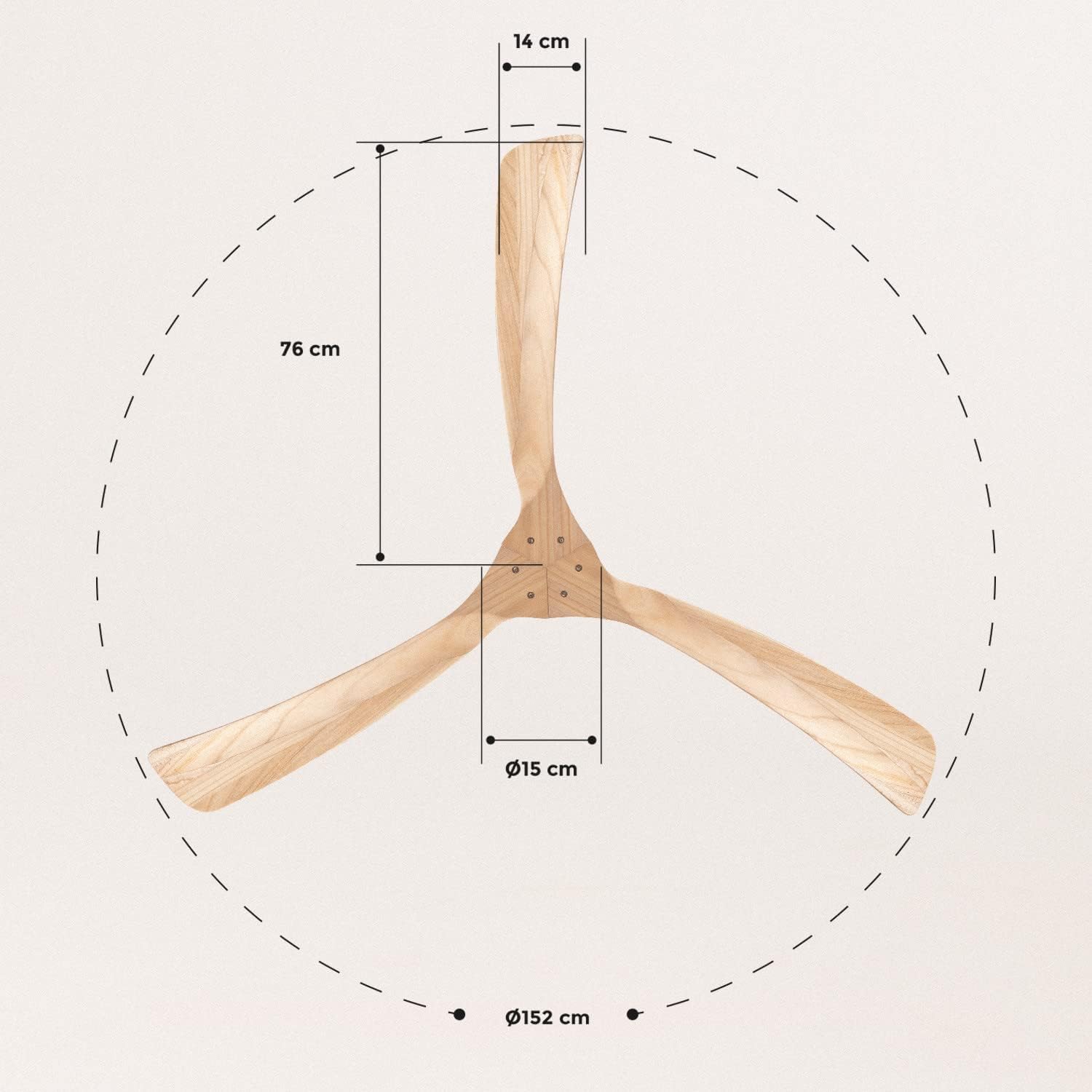
Understanding the fan's dimensions is crucial for proper placement and clearance.

Whakaahua 3.4: Dimensional drawing of the fan. Each blade measures 76 cm in length, and the total fan diameter is 152 cm. The central hub has a diameter of 15 cm.
For detailed installation steps, please refer to the separate assembly manual included with your product.
4. Nga Tohutohu Whakahaere
Your CREATE WIND LARGE DC Ceiling Fan is operated via the included remote control, offering convenient access to all functions.
4.1 Nga Mahi Mana Mamao
- Hiko Whakaka/Weto: Whakahohe, wetewete ranei te powhiriwhiri.
- Mana Tere: Adjusts between 6 different fan speeds, from a gentle breeze to powerful airflow. The DC motor ensures quiet operation even at higher speeds.
- Taumahi Matawā: Set the fan to automatically turn off after 1, 2, 4, or 8 hours. This is ideal for nighttime use or when leaving a room.
- Aratau Raumati/Hotoke: Reverses the direction of blade rotation to optimize air circulation for different seasons.
4.2 Summer Mode Operation
In summer mode, the fan blades rotate counter-clockwise, pushing cool air downwards. This creates a wind-chill effect, making the room feel cooler and reducing the need for air conditioning.

Whakaahua 4.1: Visual representation of the fan's operation in summer mode. Air is drawn upwards and then pushed downwards, creating a cooling breeze.
4.3 Winter Mode Operation
In winter mode, the fan blades rotate clockwise, gently drawing cool air upwards and pushing warm air (which naturally rises) down along the walls. This redistributes heat evenly throughout the room, helping to reduce heating costs.
Whakaahua 4.2: Visual representation of the fan's operation in winter mode. Air is drawn upwards, circulating warm air from the ceiling downwards to warm the room more efficiently.
5. Tiaki
Ko te tiaki i nga wa katoa ka whakarite i te roa me te mahi tino pai o to mea powhiriwhiri tuanui.
- Te horoi: I mua i te horoinga, kia tino whakawetohia te hau pā, kia momotu hoki te pūtake hiko. Whakamahia he mea ngohengohe, he meaamp cloth to wipe down the blades and motor housing. Do not use abrasive cleaners or solvents.
- Tirohanga Mata: Periodically check the fan blades for any signs of damage or warping. Ensure all blade screws are securely tightened.
- Whakahinuhinu motuka: The DC motor is designed for maintenance-free operation and does not require lubrication.
- Whakapiri Whakapiri: Over time, some fasteners may become loose. Check all mounting screws and blade attachment screws at least once a year and tighten them if necessary.
6. Te Raru
Mena ka pa ki a koe nga raru me to kaiwhaiwhai, tirohia nga raru me nga otinga e whai ake nei:
| Raruraru | Take pea | Rongoā |
|---|---|---|
| Kaore e timata te Fan | Kāore he pūtake hiko; He waea koretake; He iti te pākahiko o te mana mamao. | Tirohia te pūwāhi ara iahiko; Tirohia mēnā kei te mau ngā hononga waea katoa; Whakakapia ngā pākahiko mana mamao. |
| Ka wiri te Fan | Nga wiri o te mata; Matatahi kore taurite; Te awhi whakapuru wewete. | Tighten all blade screws; Use a balancing kit (not included) if necessary; Ensure mounting bracket is securely fastened to the ceiling. |
| Mahi haruru | Tiwiri wewete; Huna moto; Nga matatahi e patu ana i te arai. | Check and tighten all screws; Ensure no wires are rubbing against the motor housing; Verify blades have clear clearance. |
| Ko te mana mamao kaore e mahi | Kua mate ngā pākahiko; Kāore te mana mamao i honoa; Kei te arai te mana mamao me te kaiwhiwhi. | Replace batteries; Refer to pairing instructions in the assembly manual; Ensure clear line of sight. |
Mena kei te haere tonu te raru i muri i te whakamatau i enei otinga, tena koa whakapā atu ki te tautoko a te kaihoko.
7. Whakatakotoranga
Below are the technical specifications for the CREATE WIND LARGE DC Ceiling Fan (Model: 93512_187855).
| Āhuahira | Taipitopito |
|---|---|
| Kaihanga | HANGA |
| Tau tauira | 93512_187855 |
| Tae | White - Natural wood blades |
| Kāhua | No WIFI |
| Whakaoti | Taiao |
| Rauemi | Te parahi |
| Puna Mana | Hiko Hiko |
| Voltage | 240 Volts |
| Wattage | 40 watts |
| Te Kaha Rererangi | 152 Cubic meters per minute |
| Taumata Haruru | 50 dB |
| Te roa o te Mata | 76 Henemita |
| Nga tere | 6 |
| Diameter Fan | 152 Henemita |
| Momo Whakaeke | Maunga Pouaka |
| Nga waahanga motuhake | Matawā |
| Nga Waahanga kei roto | Mana mamao |
| Taumaha Tūemi | 7.14 Kirokaramu |
| Hunga Hua | 76D x 152W x 44H henimita |
| Momo Rūma | Whare moenga, Rūma Noho |
Tuhipoka: A technical data sheet for this product is available.View Technical Data Sheet (External Link)
8. Pūtāhui me te Tautoko
For warranty information and customer support, please refer to the documentation provided with your purchase or contact CREATE customer service directly. The product typically includes a standard return policy of 30 days for refund/replacement.
Mō ētahi atu āwhina, ka taea e koe te toro atu ki te kamupene hanga website or contact their support channels. Keep your purchase receipt and model number handy when contacting support.
Ask a question about this manual
Ask about setup, troubleshooting, compatibility, parts, safety, or missing instructions. Manuals+ will review the question and use this page’s manual context to help answer it.