
Kupu Whakataki
This manual provides detailed instructions for the setup, operation, and maintenance of your Monkey Loop WS-10 Wireless Guitar System. This system is designed to offer musicians a cable-free solution for their instruments, maintaining sound quality and signal integrity.
Ka mutu te huaview
The Monkey Loop WS-10 system consists of a transmitter and a receiver unit. Both units are compact, lightweight, and feature a rotatable design for compatibility with various instruments.
Text description: An image showing the Monkey Loop WS-10 wireless guitar system, featuring both the transmitter and receiver units side-by-side, highlighting their compact design and the 'Monkey Loop WS-10' branding.

Āhuatanga matua:
- Wireless UHF System: Utilizes UHF technology for clear audio transmission and reduced interference.
- Roa te Ora Pūhiko: Integrated rechargeable battery provides approximately 5 to 6 hours of operation.
- Kiato me te Kawe: Lightweight design for easy transport and use.
- Mono Hurihuri: Ensures compatibility with most electric guitars and basses.
- Hototahi Whānui: Suitable for various 6.35mm audio devices.
Tohutohu Tatūnga
1. Charging the Units
Before initial use, fully charge both the transmitter and receiver units. Use the included dual USB charging cable to connect both units to a USB power source (e.g., computer USB port, USB wall adapter).
Text description: An image showing the transmitter and receiver units connected to a dual USB charging cable, with a charging LED indicator visible on each unit, illustrating the charging process.

The charging indicator light will illuminate during charging and turn off or change color when fully charged (refer to the specific LED behavior in the operating section).
2. Te hono i te Kaituku
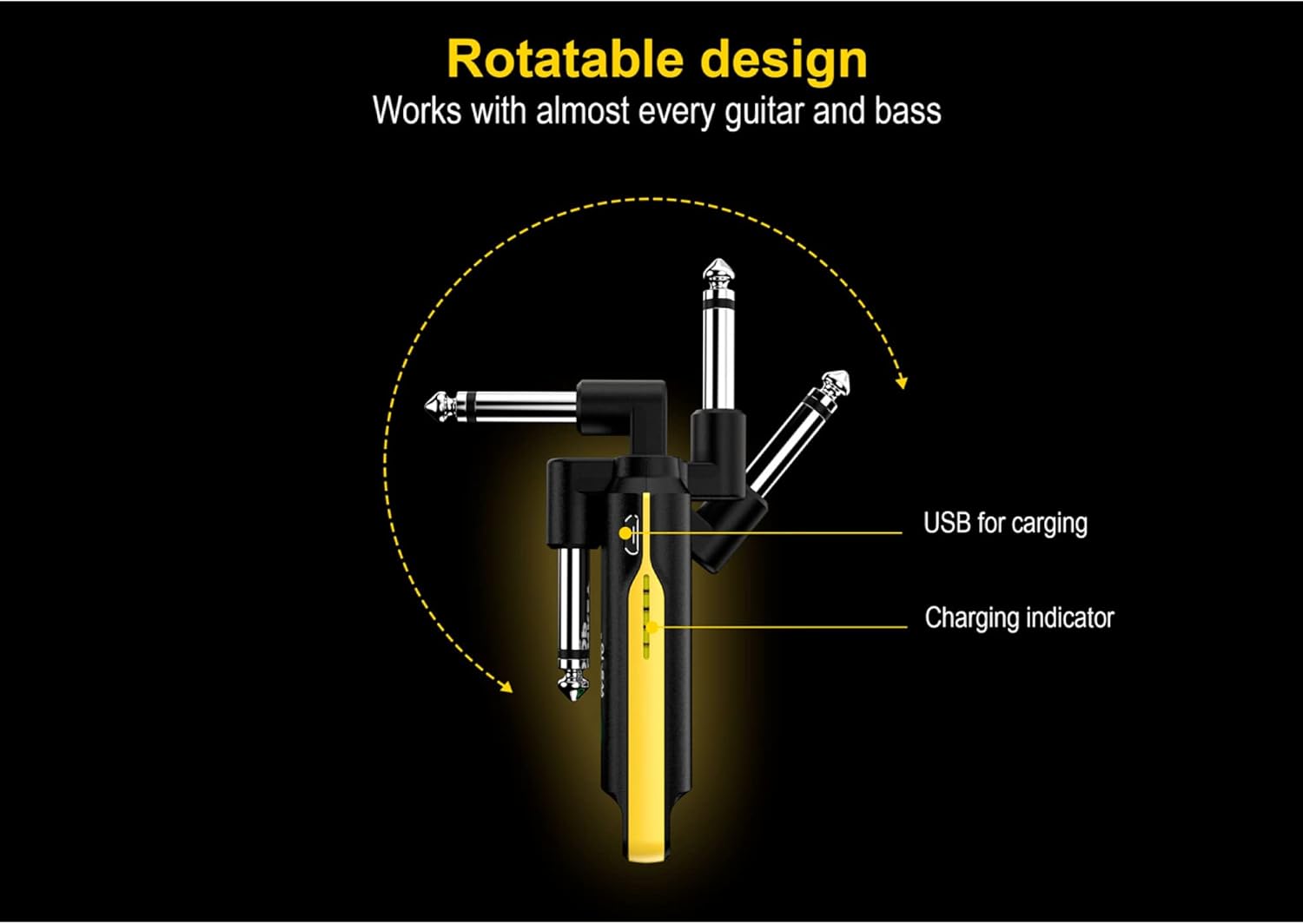
Plug the transmitter unit into your instrument's 6.35mm output jack. The rotatable plug allows for optimal positioning on various guitar and bass body types.
Text description: An image illustrating the rotatable design of the Monkey Loop WS-10 unit, showing how the 6.35mm jack can pivot to different angles for flexible connection to an instrument, ensuring compatibility.
3. Te hono i te Kaiwhiwhi
Plug the receiver unit into the input jack of your amplifier, audio interface, or other audio device.
Text description: An image showing the Monkey Loop WS-10 receiver connected to an amplifier, with a guitar connected to the transmitter, demonstrating a typical wireless setup for an instrument.

Nga Tohutohu Whakahaere
1. Te Whakakaha/Weto
Press and hold the power button on both the transmitter and receiver units to turn them on. Repeat the action to power them off.
2. Takirua
The units are typically pre-paired from the factory. If they do not connect automatically, ensure both units are powered on and within range. If issues persist, consult the troubleshooting section.
3. Whakamahinga
Once both units are powered on and paired, your instrument's signal will be transmitted wirelessly to your audio device. The system offers a maximum transmission range of 50 meters (approximately 164 feet) in an open environment.
Text description: An image displaying the Monkey Loop WS-10 transmitter and receiver units side-by-side, highlighting their compact form factor and indicating their roles as transmitter and receiver.
4. Multi-Unit Operation
Up to 99 sets of Monkey Loop WS-10 systems can be used simultaneously in the same environment without interference, provided they are on different channels (if channel selection is available, refer to advanced settings, otherwise, they should auto-select).
Te tiaki
- Te horoi: Horoia nga waeine ki te kakahu ngohengohe, maroke. Kaua e whakamahi i nga kai horoi me nga whakarewa.
- Rokiroki: Penapenahia ngā waeine ki te wāhi hauhautanga, maroke, kia matara atu i te rā tika me te pāmahana tino kino.
- Tiaki Pūhiko: To prolong battery life, avoid fully discharging the units frequently. Charge them regularly, even if not in use for extended periods.
Raparongoā
- No Sound or Intermittent Signal:
- Me whakarite kia kī katoa te utu o te tuku me te kaiwhiwhi, ā, kia whakakā hoki.
- Verify that both units are within the operational range (up to 50 meters).
- Check for potential sources of interference (e.g., Wi-Fi routers, other wireless devices).
- Confirm that the transmitter is securely plugged into the instrument and the receiver into the audio input.
- Test with a standard cable to rule out issues with the instrument or ampkaikawe
- Poor Sound Quality or Noise:
- Neke atu i ngā pūtake pea o te pokanoa hikohiko.
- Ensure the units are not too close to other electronic devices.
- Tirohia te putanga o te taputapu, ā, amplifier's input for proper function.
- The UHF system is designed for clarity; if noise persists, it might indicate environmental interference or a faulty unit.
- Ngā Wāhanga Kāore e Honohono:
- Power off and then power on both units.
- Ensure they are close to each other during the pairing process.
- If there's a reset function (not explicitly mentioned, but common), perform a factory reset.
Whakatakotoranga
| Āhuahira | Taipitopito |
|---|---|
| Waitohu | MAKIKI LOOP |
| Tau tauira | 10194525 (WS-10) |
| Hangarau Ahokore | UHF |
| Ora Pūhiko | Tata ki te 5-6 haora |
| Te utu | USB (dual USB charging cable included) |
| Awhe Tuku | Tae atu ki te 50 mita (taiao tuwhera) |
| Ahu (hua) | 120 x 29 x 18 mm |
| Hototahi | Most electric guitars, basses, and 6.35mm audio devices |
Text description: An image detailing the physical dimensions of the Monkey Loop WS-10 unit, showing measurements for length, width, and thickness in millimeters for precise understanding of its size.

Pūtāhui me te Tautoko
Information regarding specific warranty terms and support contacts is not available in the provided product data. Please refer to the product packaging or the manufacturer's official website for detailed warranty information and customer support options.