
1. Kupu Whakataki
This instruction manual provides essential information for the proper installation, operation, and maintenance of the Master-Bilt Bit-25 Lae Controller, model 19-14605-IHC27. This component is a genuine OEM replacement part designed for specific Master-Bilt equipment. Adhering to these instructions will help ensure the longevity and correct functionality of the controller and the equipment it serves.
2. Nga korero haumaru
WHAKATŪPATO: Electrical components should only be handled and installed by qualified personnel. Failure to follow these safety guidelines may result in electric shock, injury, or damage to the equipment.
- Always disconnect power to the equipment before installing, servicing, or removing the controller.
- Me whakarite kia tutuki ngā hononga waea katoa i ngā ture hiko ā-rohe me ā-motu.
- Manatokohia te voltage and current ratings of the controller match the equipment's requirements.
- Kaua e whakahaerehia te pūmana mēnā te āhua nei kua pakaru.
- Keep the controller dry and away from excessive moisture or corrosive environments.
3. Ihirangi mokete
Upon opening the package, verify that the following item is present:
- Master-Bilt Bit-25 Lae Controller (Model: 19-14605-IHC27)
4. Hua Neke Atuview
The Master-Bilt Bit-25 Lae Controller is an integral electronic component designed to manage and regulate specific functions within compatible Master-Bilt refrigeration or industrial equipment. It features various terminals for power input, sensor connections, and output controls.
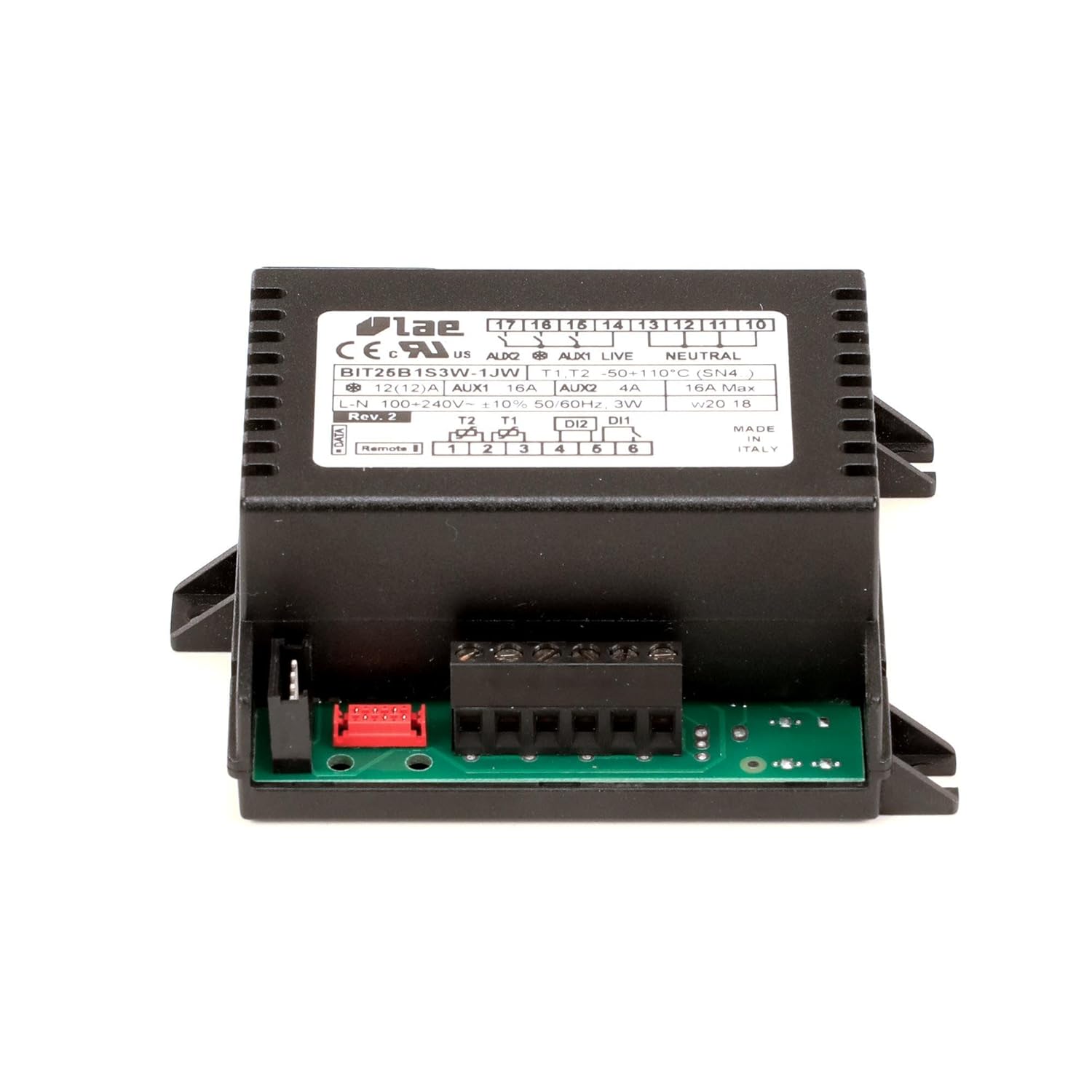
Whakaahua 4.1: Mua view of the Master-Bilt Bit-25 Lae Controller. This image displays the main body of the controller, including the product label which details the model number, electrical specifications (120V-23), and various terminal designations for connection points such as T1, T2, DI1, DI2, AUX, and LIVE/NEUTRAL inputs. The 'Made in Italy' origin is also visible.

Whakaahua 4.2: runga-iho view of the controller. This perspective highlights the various terminal blocks and connectors on the circuit board, including a red connector and multiple screw terminals, which are used for wiring the controller into the equipment's electrical system. The main label is also visible from this angle.

Whakaahua 4.3: Te taha view of the controller. This image shows the robust plastic casing and the integrated mounting tabs on the sides, designed for secure installation within an equipment panel or enclosure. The compact form factor of the unit is evident.
5. Tāuta me te Tatūnga
Installation of the Master-Bilt Bit-25 Lae Controller should only be performed by a certified technician or qualified electrician. Refer to the specific wiring diagrams and service manuals for your Master-Bilt equipment for detailed installation instructions.
- Momotu Hiko: Ensure all power to the equipment is disconnected at the main breaker before beginning installation.
- Uru: Open the equipment's control panel or access compartment to locate the existing controller or mounting location.
- Te tango (mēnā ka whakakapia): Carefully disconnect all wires from the old controller, noting their positions and labels. Remove the old controller from its mounting.
- Whakapiki: Secure the new Master-Bilt 19-14605-IHC27 controller in the designated location using appropriate fasteners.
- Waea waea: Connect all wires to the corresponding terminals on the new controller. Refer to the wiring diagram provided with your equipment. Pay close attention to Live (L), Neutral (N), Auxiliary (AUX), and sensor (T1, T2) connections.
- Manatoko: Double-check all connections for tightness and correct placement. Ensure no bare wires are exposed.
- Whakaora Hiko: Close the equipment's access panel. Restore power to the equipment.
6. Nga Tohutohu Whakahaere
The Master-Bilt Bit-25 Lae Controller functions as a control module within a larger system. Its operation is typically integrated with the equipment's main control panel or display. Specific operational parameters and settings are usually configured through the equipment's user interface, not directly on the controller itself.
- Hinga-Whakaoho tuatahi: After installation and power restoration, the controller should initialize automatically. Observe the equipment's main display for any error codes or operational indicators.
- Whakauru Pūnaha: The controller receives input from sensors (e.g., temperature probes) and sends commands to actuators (e.g., compressors, fans) based on programmed setpoints and logic.
- Whakaritenga Tawhā: Any adjustments to operational parameters (e.g., temperature setpoints, defrost cycles) should be made via the equipment's primary control interface, following the equipment's specific user manual.
- Aroturuki: Regularly monitor the equipment's performance and any associated display readings to ensure the controller is functioning correctly.
7. Tiaki
The Master-Bilt Bit-25 Lae Controller is designed for reliable operation with minimal maintenance. However, periodic checks can help ensure its continued performance.
- Tirotiro Ataata: Periodically inspect the controller and its wiring for any signs of damage, corrosion, or loose connections. Ensure the casing is intact.
- Te horoi: If necessary, gently clean the exterior of the controller with a dry, soft cloth. Do not use liquid cleaners or solvents, as these can damage the electronic components.
- Nga Tikanga Taiao: Me whakarite kia noho te taiao mahi i roto i ngā awhe pāmahana me te haumākū kua tohua hei ārai i te pakaru wawe.
8. Te Raru
If the equipment is not functioning as expected, consider the following basic troubleshooting steps. For complex issues, consult a qualified service technician.
- Kore Mana: Check the main power supply to the equipment and ensure all circuit breakers are on. Verify that the controller's power input terminals are correctly wired and receiving the specified voltage.
- Incorrect Readings/Operation: Ensure all sensor connections (T1, T2) are secure and that the sensors themselves are functioning correctly. Refer to the equipment's manual for sensor testing procedures.
- Waehere Hapa: If the equipment's main display shows an error code, consult the equipment's specific service manual for the meaning of the code and recommended corrective actions.
- Hononga Wewete: Power down the equipment and carefully check all wiring connections to the controller for tightness.
9. Whakatakotoranga
| Āhuahira | Whakatakotoranga |
|---|---|
| Tau tauira | 19-14605-IHC27 |
| Waitohu | Master-Bilt |
| Momo Wahi | Bit-25 Lae Controller |
| Voltage | 120V-23 (as per product description) |
| Hunga Hua | 4.2 x 6 x 5 inihi |
| Taumaha Tūemi | 5.28 hekere |
| Kaihanga | Master-Bilt |
10. Pūtāhui me te Tautoko
As a genuine OEM replacement part, the Master-Bilt Bit-25 Lae Controller is manufactured to high-quality standards. Specific warranty terms are typically provided by Master-Bilt or the authorized distributor at the time of purchase. Please retain your proof of purchase for warranty claims.
For technical support, service, or warranty inquiries, please contact Master-Bilt customer service or your authorized Master-Bilt service provider. Refer to the documentation provided with your Master-Bilt equipment for contact information.