
1. Kupu Whakataki me Nekeview
The Elektrobock FRT7B2 is a wireless room thermostat system designed to control heating sources based on the desired room temperature. It consists of two main components: a wireless transmitter unit (thermostat) that monitors the temperature in a specific room, and a switching element receiver that controls the connected heating source. This system offers clear display with backlighting, extended wireless range, and various programmable features for efficient temperature management.
2. Waenga Hua
The FRT7B2 system includes the following main components:
- Wireless Thermostat (Transmitter): This unit features a clear backlit display and controls for setting temperature and operating modes. It is powered by batteries.
- Whiwhi Kaihoko: This unit connects to your heating system and receives signals from the wireless thermostat to switch the heating on or off. It is mains powered.

Figure 2.1: The Elektrobock FRT7B2 wireless thermostat (left) and its receiver unit (right).

Figure 2.2: Detailed dimensions of the FRT7B2 wireless thermostat and receiver unit.
3. Tatūnga me te Tāuta
3.1. Thermostat (Transmitter) Battery Installation
- Gently open the battery compartment cover on the back of the thermostat unit.
- Insert two 1.5V AAA alkaline batteries, ensuring correct polarity (+/-).
- Katia kia mau te uhi o te wahanga pākahiko.

Whakaahua 3.1: Whakamuri view of the thermostat, indicating the battery compartment and mounting points.
3.2. Receiver Unit Wiring and Placement
The receiver unit must be wired to your heating system. This installation should be performed by a qualified electrician to ensure safety and proper functionality.
- Ensure the main power supply to the heating system is turned off before commencing any wiring.
- Connect the receiver unit according to the wiring diagram provided in the full product manual (not included here). The receiver operates at 230 Volts.
- Mount the receiver unit in a suitable location, typically near the heating appliance, ensuring it is within the wireless range of the thermostat (up to 35m indoors, 200m outdoors).
- Restore power to the heating system after installation is complete.
3.3. Whakahoahoa i te Thermostat me te Kaiwhiwhi
The thermostat and receiver are typically pre-paired from the factory. If re-pairing is necessary, refer to the detailed instructions in the complete product manual. The system uses digital signal coding for reliable communication.
4. Nga Tohutohu Whakahaere
4.1. Whakaatu Atuview
The thermostat features a clear backlit display showing current temperature, set temperature, time, and operating mode indicators. The display provides essential information at a glance.
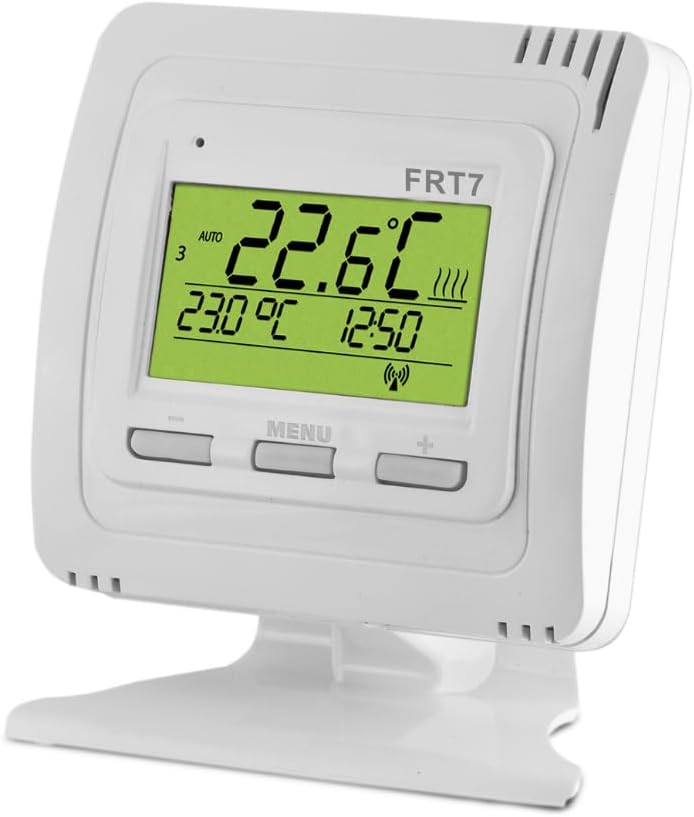
Whakaahua 4.1: Mua view of the thermostat, highlighting the backlit display and control buttons.
4.2. Te Whakatikatika i te Pāmahana Taketake
Hei whakatika i te pāmahana e hiahiatia ana:
- Pehia te + or - buttons located below the display to increase or decrease the set temperature.
- The temperature can be adjusted in 0.5°C increments.
- The new setting will be active immediately in manual mode or as a temporary override in automatic mode.
4.3. Aratau Mahi
Ka tautokohia e te thermostat ētahi momo mahi:
- MONO (Aunoa): E whai ana i te maramataka kua whakaritea mō ia wiki.
- MANU (Manual): Maintains a constant temperature set by the user, overriding the program.
- WATE: Turns off the heating. Frost protection (3°C) remains active.
- Hararei: Sets a specific temperature for a defined holiday period.
Whakamahia te MENU button to cycle through and select the desired operating mode.
5. Ngā Āhuatanga Hōtaka
The FRT7B2 offers advanced programming capabilities for energy efficiency and comfort.
5.1. Weekly Program
The thermostat comes with a predefined weekly program. You can customize this program based on individual days (Mon-Sun), weekdays (Mon-Fri), weekends (Sat-Sun), or the entire week (Mon-Sun). Up to 6 temperature changes can be set per day.
5.2. Short-Term Temperature Modification
While in AUTO mode, you can temporarily adjust the temperature. This change will be active for a short period (e.g., 10 minutes) or until the next programmed temperature change, after which the thermostat will revert to its schedule.
5.3. 'OPEN WINDOW' Function
This intelligent feature automatically switches off the heating if a sudden drop in temperature is detected, indicating an open window or door. This helps prevent energy waste.
5.4. Hysteresis Setting
The hysteresis (temperature differential) can be adjusted from 0.1°C to 6°C. This setting determines the temperature range around the set point within which the heating will not switch on or off, preventing rapid cycling of the heating system.
6. Tiaki
6.1. Whakakapinga Pūhiko
When the battery indicator appears on the display, replace the AAA batteries in the thermostat unit as described in Section 3.1. Use only high-quality alkaline batteries.
6.2. Te horoi
Clean the thermostat and receiver units with a soft, dry cloth. Do not use abrasive cleaners or solvents, as these can damage the surfaces and electronic components.
7. Te Raru
If you encounter issues with your Elektrobock FRT7B2 thermostat, consider the following common solutions:
- No Display/Thermostat Not Responding: Check and replace the batteries in the thermostat unit. Ensure they are inserted with correct polarity.
- Te Whakawera Kaore i te Whakautu ki te Thermostat: Verify that the receiver unit has power and its indicator lights are active. Check the wireless connection; try re-pairing if necessary (refer to the full manual). Ensure the thermostat is within range of the receiver.
- He Te Panui Pawera: Ensure the thermostat is not placed near heat sources (e.g., direct sunlight, lamps) or cold drafts, which can affect its accuracy. The measurement precision is ± 0.5°C.
- Te Uauatanga ki te Hōtaka: Refer to the detailed programming section in the complete product manual for step-by-step instructions. Initial setup can sometimes require careful attention to detail.
For persistent issues, contact Elektrobock customer support or consult a qualified technician.
8. Whakatakotoranga
| Āhuahira | Whakatakotoranga |
|---|---|
| Tau tauira | FRT7B2 |
| Waitohu | Elektrobock |
| Pūtake Hiko (Thermostat) | 2 x 1.5V AAA Pūhiko Kawakore |
| Pūtake Hiko (Kaiwhiwhi) | 230 Volts |
| Wireless Range (Indoor) | Tae atu ki te 35 mita |
| Wireless Range (Outdoor) | Tae atu ki te 200 mita |
| Awhe Tautuhinga Pawera | 5°C ki te 39°C |
| Temperature Adjustment Increment | 0.5°C |
| Whananga Inenga | ± 0.5°C |
| Hysteresis Range | 0.1°C ki te 6°C |
| Tiaki Hukapapa | 3°C |
| Aratau Mahi | AUTO/MANU/OFF/HOLIDAY |
| Programmable Changes per Day | 6 |
| Ahu (Thermostat) | 81 x 81 x 24 mm |
| Ahu (Kaiwhiwhi) | 80 x 110 x 29 mm |
| Taumaha | 207 karamu (katoa) |
| Hangarau Hononga | RF (Irirangi Auaumoka) |
| Āhuahira Motuhake | Programmable, Clear Backlit Display, Open Window Function, Automatic Summer/Winter Time Change |
9. Pūtāhui me te Tautoko
Warranty information for the Elektrobock FRT7B2 thermostat is typically provided with the product packaging or can be found on the manufacturer's official webpae. Tena koa pupurihia to tohu mo te hoko mo nga kereme whakamana.
For technical support, further assistance, or to inquire about spare parts, please contact Elektrobock customer service directly. Contact details can usually be found in the product documentation or on the Elektrobock webpae.