
1. Kupu Whakataki
This manual provides essential information for the safe operation, maintenance, and troubleshooting of your Kobalt Hybrid 24-Volt Max Jobsite Fan. Please read this manual thoroughly before operating the fan and retain it for future reference. This fan is designed for air circulation in various indoor and outdoor environments, offering both battery-powered portability and corded operation.
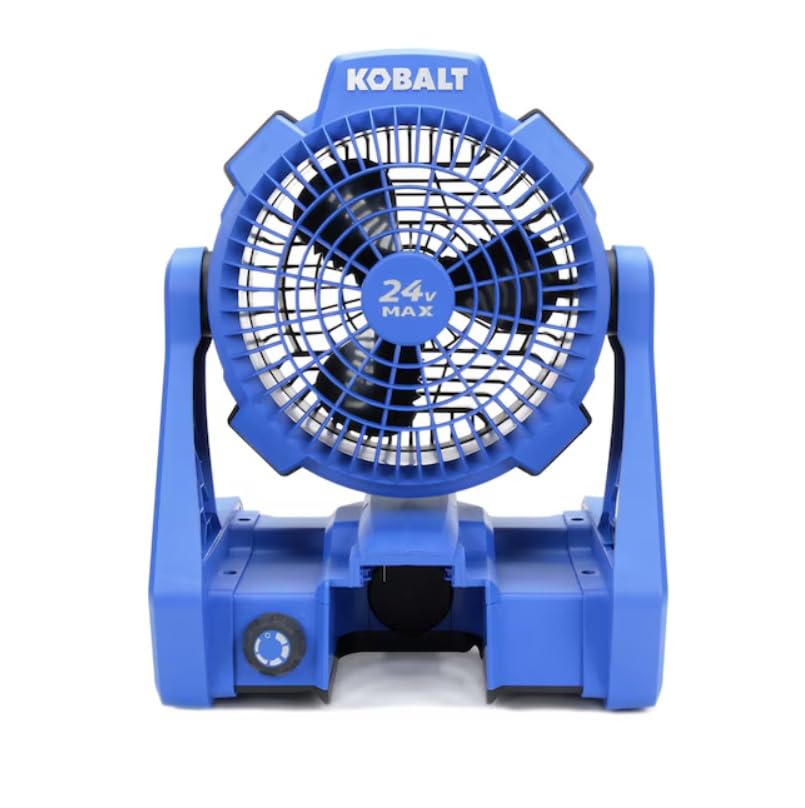
Figure 1: Kobalt Hybrid 24-Volt Max Jobsite Fan. This image displays the fan in its upright position, highlighting its robust blue and black casing and the 24V MAX branding on the fan grille.
2. Nga korero haumaru
Kia mau tonu ki nga whakaritenga haumaru taketake hei whakaiti i te tupono o te ahi, te ru hiko, me te whara whaiaro.
- Kaua e whakahaeretia te powhiriwhiri me te taura pakaru, te mono ranei.
- Avoid placing hands or objects near the fan blades during operation.
- Me whakarite kia utaina te mea powhiriwhiri ki runga i te papa, te mata papatahi kia kore ai e pakaru.
- Keep the fan away from water or wet environments when using AC power.
- Use only Kobalt 24-Volt Max batteries and chargers with this product.
- Momotuhia te hiko i mua i te horoi, te mahi tiaki ranei.
3. Ihirangi mokete
Manatokona kei te noho nga mea katoa i te wa e wetewete ana:
- Kobalt Hybrid 24-Volt Max Jobsite Fan (Model KJF 124B-03)
- Waea hiko AC
Tuhipoka: Ka hokona motuhake te pākahiko me te rihi.
4. Nga ahuatanga
The Kobalt Hybrid 24-Volt Max Jobsite Fan offers versatile performance with the following key features:
- Hybrid Power Source: Operates on a Kobalt 24-Volt Max battery or standard AC power.
- Mana Tere Taurangi: A rotary knob allows for precise adjustment of airflow from low to high.
- Adjustable Fan Head: The fan head pivots to direct airflow where needed.
- Matau Iri whakauru: Convenient hooks on the frame allow for easy suspension in various locations.
- Hanga Roa: Built to withstand demanding jobsite conditions.
- Hoahoa Maamaa: Facilitates easy transport and repositioning.
5. Tatūnga me te Runanga
5.1 Battery Installation/Removal
- To install the battery (not included), align the battery pack with the battery port on the fan base.
- Kiriata te pākahiko ki roto i te tauranga tae noa ki te pao tika ki te waahi.
- To remove the battery, press the battery release button (usually located on the battery pack) and slide the battery out.
5.2 Hononga Mana AC
- Locate the AC power inlet on the fan base.
- Insert the provided AC power cord firmly into the inlet.
- Plug the other end of the power cord into a standard 120V AC electrical outlet.
6. Nga Tohutohu Whakahaere
6.1 Kei te Hiko / Weto
The fan features a rotary knob that controls both power and speed.
- To turn on the fan, rotate the knob clockwise from the 'OFF' position.
- To turn off the fan, rotate the knob counter-clockwise until it reaches the 'OFF' position.
6.2 Te Whakatikatika i te Tere Kiriata
The rotary knob provides variable speed control:
- Rotate the knob clockwise to increase the fan speed.
- Rotate the knob counter-clockwise to decrease the fan speed.
6.3 Adjusting Fan Angle
The fan head can be manually tilted to direct airflow:
- Grasp the fan housing firmly and gently tilt it to the desired angle. The fan head will hold its position.
6.4 Using Hanging Hooks
For elevated airflow, utilize the integrated hanging hooks:
- Extend the metal hooks located on the sides of the fan frame.
- Hang the fan from a secure overhead structure, such as a tent frame or scaffolding. Ensure the structure can support the fan's weight.
7. Tiaki
7.1 Te horoi
- Always disconnect the fan from its power source (remove battery or unplug AC cord) before cleaning.
- Horoia nga mata o waho o te powhiriwhiri ki te ngohengohe, damp kakahu. Kaua e whakamahi i nga kai horoi me nga whakarewa.
- Use a vacuum cleaner with a brush attachment to remove dust and debris from the fan grille and blades.
7.2 Tiaki Pūhiko
- Whakaorangia nga pākahiko ki te waahi makariri, maroke atu i te ra tika me te wera nui.
- Charge batteries fully before storage and periodically during long storage periods to maintain battery health.
8. Te Raru
Mena ka pa ki a koe nga raru me to kaiwhaiwhai, tirohia nga raru me nga otinga e whai ake nei:
| Raruraru | Take pea | Rongoā |
|---|---|---|
| Kare te Fan e huri. | No power supply; Battery depleted; AC cord not plugged in. | Ensure battery is charged and properly installed, or AC cord is securely plugged into a live outlet. |
| Te rere hau iti. | Fan speed set too low; Obstruction in front/rear grille; Dirty blades. | Increase fan speed; Remove any obstructions; Clean fan blades and grilles. |
| Ka haruru rerekee te Fan. | Loose components; Debris in fan housing. | Inspect for loose parts; Disconnect power and carefully remove any debris. |
9. Whakatakotoranga
| Āhuahira | Whakatakotoranga |
|---|---|
| Waitohu | Kobalt |
| Ingoa Tauira | KJF 124B-03 |
| Puna Mana | Battery Powered (24V Max) / AC Cord |
| Voltage | 24 Volts |
| Wattage | 288 watts |
| Tere | Tae atu ki te 1000 RPM |
| Te maha o nga Matatahi | 3 |
| Te maha o nga taumata hiko | Variable (via rotary knob) |
| Tikanga Mana | Mana Pātene (Poro Hurihuri) |
| Momo Whakaeke | Tabletop Mount, Hanging |
| Taumaha Tūemi | 5.5 Pauna |
| Mahinga o roto/waho | Roto, Waho |
| Rauemi | Kirihou |
10. Pūtāhui me te Tautoko
This Kobalt product is covered by the manufacturer's warranty. For specific warranty details, please refer to the warranty card included with your purchase or visit the official Kobalt website. For technical support, replacement parts, or service inquiries, please contact Kobalt customer service through their official channels.