
CHANZON SR5100
CHANZON SR5100 (SB5100) Schottky Barrier Rectifier Diodes Instruction Manual
Tauira: SR5100
1. Kupu Whakataki
This manual provides essential information for the proper use and handling of CHANZON SR5100 (SB5100) Schottky Barrier Rectifier Diodes. These diodes are designed for applications requiring high efficiency and low power loss, such as power supplies, inverters, and converters. Please read this manual thoroughly before installation and operation.
2. Hua Neke Atuview me nga ahuatanga
The CHANZON SR5100 (SB5100) is a Schottky Barrier Rectifier diode with the following key characteristics:
- Tau Wāhanga: SR5100 (SB5100)
- Inaianei Whakamua: 5 Amperes (A)
- Morahi Repetitive Peak Whakamuri Voltage: 100 Ngā Waohiko (V)
- Package Case: DO-201AD (Axial, DO-27)
- Lead-Free and RoHS Compliant.
- Features high forward surge current capability.
- Designed for high temperature soldering.
- Offers low power loss and high efficiency.

Figure 1: CHANZON SR5100 Schottky Barrier Rectifier Diodes in their protective ESD bag.
3. Whakatakotoranga
Detailed electrical and physical specifications for the SR5100 diode are provided below. For comprehensive datasheet information, refer to the manufacturer's official documentation.
| Whakatakotoranga | Uara |
|---|---|
| Nama Wahi | SR5100 |
| Forward Current (IF) | 5 A |
| Morahi Repetitive Peak Whakamuri Voltage (VRRM) | 100 V |
| Puhi mokete | DO-201AD (Axial) |
| Kaihanga | HANAHANA |
| Taumaha Tūemi | Approximately 1.02 ounces (for 20 pieces) |
| Hunga Hua | 6.69 x 5.12 x 0.59 inihi (whakapakoko) |
| Rauemi | Other (Standard semiconductor materials) |
| Nga waahanga motuhake | ESD Bag for protection and identification |
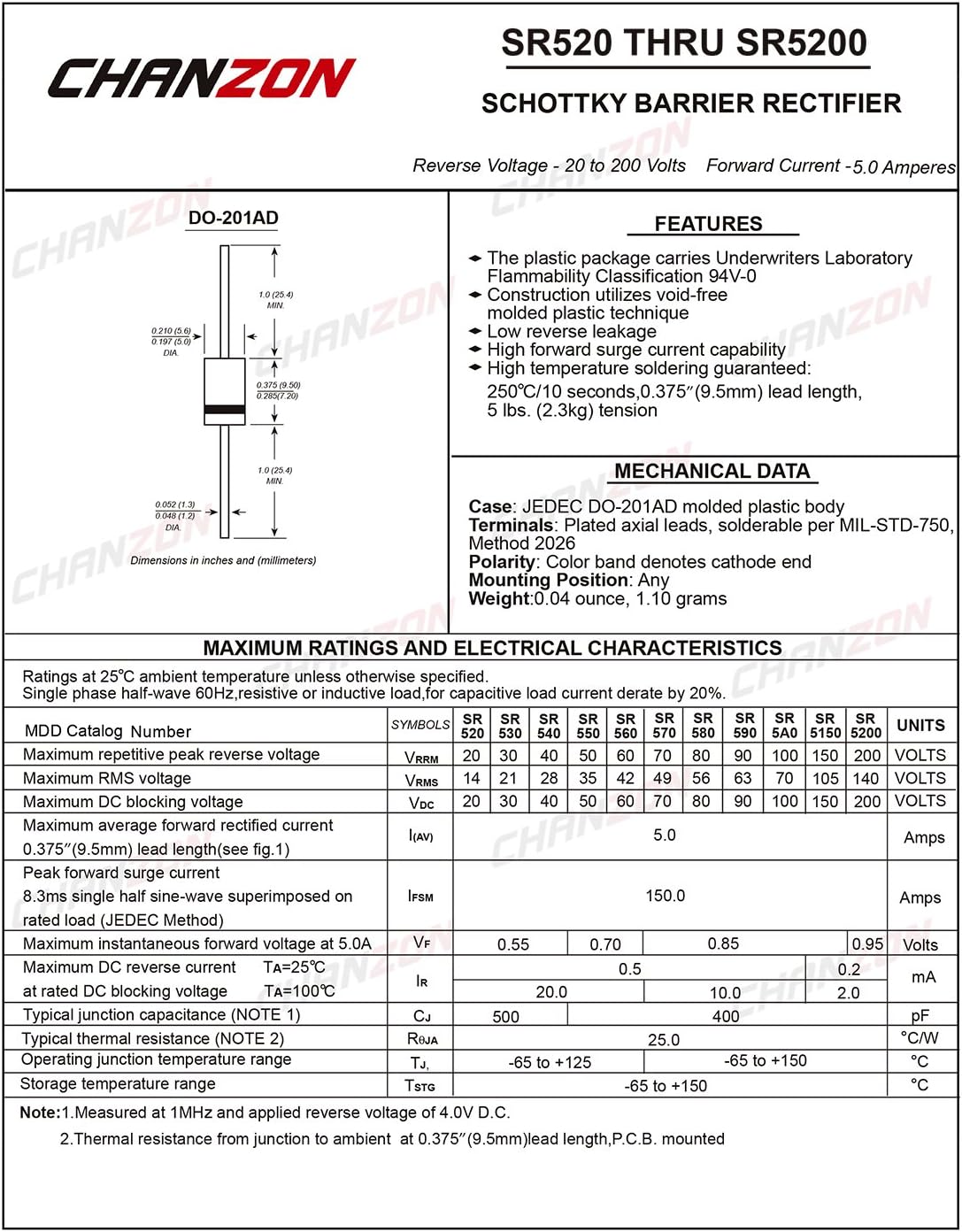
Figure 2: Mechanical data and features for SR5100 series diodes, including DO-201AD package dimensions.

Figure 3: Ratings and characteristic curves for SR5100 series diodes, illustrating performance under various conditions.
4. Nga korero haumaru
When working with electronic components, always observe the following safety precautions:
- Ensure power is disconnected from the circuit before installing or removing components.
- Mau taputapu tiaki whaiaro e tika ana, penei i nga mohiti haumaru.
- Handle components carefully to avoid physical damage or electrostatic discharge (ESD).
- Verify correct polarity before connecting the diode into a circuit. Incorrect polarity can lead to component failure or circuit damage.
- Kaua e nui ake i te vol nuitage and current ratings specified in the datasheet.
5. Tatūnga me te Tāuta
The SR5100 diodes are axial leaded components designed for through-hole mounting. Follow these general guidelines for installation:
- Tāutuhia te Polarity: The cathode end of the diode is typically indicated by a color band (e.g., silver or white band) on the diode body. The anode is the opposite end. Ensure correct polarity matching in your circuit design.
- Lead Forming: Carefully bend the leads to fit the PCB holes, ensuring not to stress the diode body or the glass-to-metal seal.
- Whakapiki: Insert the diode leads into the designated through-holes on the printed circuit board (PCB).
- Whakakotahi: Solder the leads to the PCB pads. The SR5100 is designed for high-temperature soldering. Follow standard soldering practices, ensuring good solder joints without overheating the component. The recommended soldering temperature and duration are typically 250°C for 10 seconds, 0.375 inches (9.5mm) from the lead body.
- Te horoi: After soldering, clean any flux residue from the PCB.
The diodes are packaged in an ESD bag for protection. Always handle them in an ESD-safe environment to prevent damage from static electricity.
6. Nga Tikanga Whakahaere
Schottky barrier rectifiers like the SR5100 are semiconductor devices that allow current to flow in one direction with a very low forward voltage drop and fast switching speed. They are commonly used in:
- Whakatikatika: Converting alternating current (AC) to direct current (DC).
- Switching Power Supplies: Due to their fast recovery time, they are ideal for high-frequency applications.
- Voltage Clampkei: Protecting circuits from overvoltage.
- Whakawhitinga Whakamarumaru Polarity: Preventing damage from incorrect power connections.
Ensure that the operating conditions (voltage, current, temperature) remain within the specified limits to ensure optimal performance and longevity of the diode.
7. Tiaki
Schottky diodes are passive components and generally require no active maintenance. However, proper handling and environmental conditions are crucial for their lifespan:
- Rokiroki: Store unused diodes in their original ESD-protective packaging in a dry, cool environment to prevent moisture absorption and static damage.
- Nga Tikanga Taiao: Ensure the operating environment for the circuit containing the diodes is free from excessive moisture, dust, and corrosive substances.
- Whakahaere Weariki: Adequate heat dissipation is essential, especially in high-current applications. Ensure proper heatsinking if required by your circuit design to keep the junction temperature within specified limits.
8. Te Raru
If a diode-related issue arises in your circuit, consider the following:
- No Current Flow / Open Circuit:
- Check for incorrect polarity.
- Inspect solder joints for cold joints or bridges.
- Verify the diode is not damaged (e.g., cracked body, broken leads).
- Short Circuit / Excessive Current Flow:
- The diode may have failed due to overvoltage, overcurrent, or overheating.
- Ensure the diode's ratings are appropriate for the application.
- Te wera nui:
- Check if the forward current exceeds the diode's rating.
- Ensure adequate heat dissipation (e.g., proper PCB layout, heatsink if necessary).
- Manatokohia kei roto te pāmahana a tawhio noa i roto i nga rohe whakahaere.
Always use a multimeter to test diode functionality (forward voltage drop, reverse leakage) if you suspect a component failure.
9. Whakapā me te Tautoko
For further technical assistance or inquiries regarding CHANZON products, please refer to the official CHANZON website or contact their customer support. You can visit the CHANZON Store on Amazon mo etahi atu korero.
Ask a question about this manual
Ask about setup, troubleshooting, compatibility, parts, safety, or missing instructions. Manuals+ will review the question and use this page’s manual context to help answer it.