
1. Kupu Whakataki
This manual provides comprehensive instructions for the safe and efficient operation, installation, and maintenance of your Daitsu DS-12 UDIN Wall-Split Inverter Air Conditioner. Please read this manual thoroughly before using the appliance and keep it for future reference. This unit is designed to provide both cooling and heating functions for optimal indoor climate control.
2. Nga korero haumaru
Me ū tonu ki ngā tūpato haumaru e whai ake nei kia kore ai e whara, kia tūkinotia rānei te kōwae:
- Installation must be performed by a qualified professional in accordance with local electrical and safety regulations.
- Do not attempt to repair or modify the unit yourself. Contact authorized service personnel for all repairs.
- Me whakarite kia ōrite te pūhiko ki ngā whakaritenga kua whakarārangihia ki te pereti ingoa o te waeine.
- Kaua e kuhu maihao maihao, taonga ranei ki roto i te urunga hau.
- Puritia atu nga mea muramura mai i te waahanga.
- Regularly clean the air filter to maintain efficiency and air quality.
- If abnormal operation, strange sounds, or smoke occurs, immediately turn off the unit and disconnect the power supply.
3. Hua Neke Atuview
The Daitsu DS-12 UDIN is a wall-mounted split-system air conditioner consisting of an indoor unit and an outdoor unit. It features inverter technology for energy-efficient climate control.

Image: The Daitsu DS-12 UDIN indoor unit, showcasing its sleek white design and 'inverter' and 'daitsu' branding.

Whakaahua: Mua view of the Daitsu DS-12 UDIN indoor unit with its digital display showing '25' degrees Celsius, indicating current temperature or setting.

Whakaahua: Koki view of the Daitsu DS-12 UDIN indoor unit, highlighting its modern design and the digital temperature display.
Ahu Waeine:
- Wae o Roto: Teitei 275 mm x Whānui 790 mm x Hōhonu 200 mm
- Wae Waho: Teitei 596 mm x Whānui 842 mm x Hōhonu 320 mm
4. Tatūnga me te Tāuta
Installation of the Daitsu DS-12 UDIN split-system air conditioner requires specialized knowledge and tools. It is strongly recommended that installation be carried out by a certified HVAC professional to ensure proper functioning, safety, and compliance with warranty conditions.
Nga Whakaaro Whakataunga Matua:
- Tauwāhi: Choose a location for both indoor and outdoor units that allows for optimal airflow, minimal obstruction, and easy access for maintenance.
- Whakapiki: Securely mount the indoor unit on a wall and the outdoor unit on a stable surface or wall bracket.
- Paipa Rerigerant: Connect the indoor and outdoor units with appropriate refrigerant piping, ensuring proper insulation and leak-free connections.
- Whakaheke wai: Install a drainage pipe for condensate water from the indoor unit.
- Hononga Hiko: Connect the unit to a dedicated power supply circuit as per electrical codes. Ensure proper grounding.
- Vacuuming and Refrigerant Charge: The system must be thoroughly vacuumed to remove air and moisture before charging with the correct amount of refrigerant (R32).
5. Nga Tohutohu Whakahaere
Your Daitsu DS-12 UDIN air conditioner offers various modes and functions for customized comfort. Control is typically managed via a remote control (not detailed in this manual).
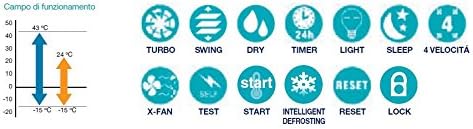
Image: Visual representation of the operating temperature range and various function icons including Turbo, Swing, Dry, Timer, Light, Sleep, 4 Speeds, X-FAN, Test, Start, Intelligent Defrosting, and Lock.
Ngā Aratau Whakahaere Matua:
- Aratau whakamatao: Reduces room temperature to the desired setting.
- Aratau Whakawera: Increases room temperature to the desired setting.
- Aratau maroke: Ka whakaheke i te hau, ka whakaheke i nga taumata haumākū.
- Aratau Fan: Ka huri i te hau me te kore whakamatao, whakamahana ranei.
Nga Mahi Motuhake:

Image: Detailed descriptions of various operating functions: Turbo, Active Carbon Filter, Swing, Dry, Timer, Light, Sleep, Four Air Speeds, X-FAN, Test, Start, Intelligent Defrosting, Reset, and Lock.
- Mahinga Turbo: Rapidly increases cooling or heating capacity to reach the desired temperature quickly.

Image: Diagram illustrating the 'TURBO' function, which rapidly increases cooling capacity to reach the desired temperature quickly.
- Mahi Piu: Automatically moves the air outlet louvers vertically to distribute air evenly.
- Dry Function: Ka whakaiti i te makuku i roto i te ruma.
- Matawā: Allows programming of operation for up to 24 hours.
- Mahinga Marama: Turns off all indicator lights on the indoor unit display.
- Mahi Moe: Adjusts room temperature for optimal comfort and energy saving during sleep.
- Four Air Speeds: High for rapid dehumidification, Medium for normal operation, Low for silent operation, and Auto option to select appropriate speed.
- X-FAN Function: Ensures the internal unit's heat exchanger is dried to prevent mold formation.

Image: Diagram showing the 'X-FAN' function, which eliminates residual humidity to prevent mold formation on the heat exchanger, keeping the unit clean and healthy.
- Mahi Whakamatau: Checks the appliance's operation and displays error codes on the indoor unit panel.
- Start Function: The indoor unit fan only activates when the heat exchanger reaches the ideal temperature.
- Whakarewa Maramarama: An intelligent defrosting system that activates only when necessary, significantly increasing energy savings and comfort.
- Mahinga Maukati: Locks the remote control settings to prevent accidental changes.
6. Tiaki
Mā te tiaki auau ka roa te ora me te mahi pai o tō hauhautanga. Momotuhia te hiko i mua i te mahi i tētahi mahi tiaki.
Horoi Tātari Hau:
- Whakatuwherahia te papa o mua o te waahanga o roto.
- Tangohia nga whiriwhiringa hau.
- Horoia ngā tātari ki te mīhini whakakore puehu, horoia rānei ki te wai māhana (i raro i te 40°C).
- Tukua ngā tātari kia maroke rawa i roto i te wāhi marumaru i mua i te tāutanga anō.
- Whakapaihia nga whiriwhiringa ia rua wiki neke atu ranei i runga i te whakamahinga me te kounga o te hau.
Whakapai Mata Wae:
- Wipe the indoor and outdoor unit surfaces with a soft, damp kakahu.
- Do not use harsh detergents, abrasive cleaners, or solvents, as these can damage the plastic parts.
Tiakitanga o te tau:
- At the beginning of each season (cooling/heating), check for any obstructions around the outdoor unit.
- Ensure the drainage hose is clear and not blocked.
- Whakaarohia te tirotiro me te horoi ngaio i ia tau.
7. Te Raru
I mua i te whakapā atu ki te ratonga, tirohia nga take noa e whai ake nei:
- Karekau te waeine e timata: Check if the power plug is securely inserted, the circuit breaker is tripped, or the remote control batteries are dead.
- He iti rawa te whakamahana/whakawera: Ensure air filters are clean, windows and doors are closed, and there are no obstructions to airflow. Check if the temperature setting is appropriate.
- Nga haruru rereke: A slight gurgling sound is normal due to refrigerant flow. Loud or persistent noises may indicate an issue.
- Te rerenga wai mai i te waahanga o roto: Check if the drainage hose is blocked or kinked.
If the problem persists after checking these points, or if an error code is displayed (use the Test function), please contact a qualified service technician. Do not attempt to repair the unit yourself.
8. Whakatakotoranga
Technical data for the Daitsu DS-12 UDIN Wall-Split Inverter Air Conditioner.

Image: Technical data sheet for the Daitsu DS-12 UDIN, detailing power, efficiency, sound levels, and refrigerant type.
| Āhuahira | Whakatakotoranga |
|---|---|
| Waitohu | Daitsu |
| Ingoa Tauira | DS-12 UDIN (ASD12UI DN) |
| Nama Wahi | 3NDA8325 |
| Momo | Wall-Split Inverter Air Conditioner |
| Te Whakamaoho | 3.2 kW (Min 0.6 - Max 3.6 kW) / 12000 BTU / 1 Ton |
| Te Raukaha Whakawera | 3.4 kW (Min 0.6 - Max 3.8 kW) |
| SEER (Tauwehe Pungao Pungao) | 6.1 |
| SCOP (Waihanga Tau o te Mahi) | 4.0 |
| Energy Label (Cooling/Heating) | A+++ / A+ |
| PDesign (Cooling/Heating) | 3.2 kW / 3.2 kW |
| Indoor Unit Sound Pressure (A/M/B) | 42 / 37 / 35 dBA |
| Outdoor Unit Sound Pressure | 52 dBA |
| Indoor Unit Airflow (Max/Min) | 560 / 410 m³/ha |
| Outdoor Unit Airflow | 2200 m³/ha |
| Tuku Hiko | 230V / 1 Phase / 50 Hz |
| Absorbed Power (Cooling/Heating) | 0.99 kW / 0.94 kW |
| Annual Energy Consumption (Cooling/Heating) | 184 kWh/a / 1120 kWh/a |
| Pipe Diameter (Liquid/Gas) | 6.35 mm / 9.52 mm |
| Momo Tere | R32 (GWP approx. 675) (Note: Technical sheet image indicates R410A, please verify with product label) |
| Pre-charge / Max. Pipe Length | 5 m / 15 m |
| Awhe Mahi (Mao) | -15°C ki te 43°C |
| Awhe Mahi (Whakawera) | -15°C ki te 24°C |
| Ngā Rahi o te Wāhanga o Roto (T x W x D) | 275 x 790 x 200 mm |
| Ngā Ahu o te Wāhanga o Waho (T x W x D) | 596 x 842 x 320 mm |
| Tae | Mā |
| Tikanga Tāuta | Pūnaha wehewehe |
9. Pūtāhui me te Tautoko
For warranty information, please refer to the warranty card included with your product or contact your local Daitsu dealer. Keep your purchase receipt as proof of purchase.
For technical support, service requests, or spare parts, please contact the authorized Daitsu service center in your region. Do not attempt to service the unit yourself.