
1. Nga Tohutohu Haumaru
Please read these safety instructions carefully before installing or using your appliance. Keep this manual for future reference.
- Haumaru Hiko: Ensure the appliance is connected to a properly grounded power outlet. Do not use extension cords or multiple socket adapters. Disconnect the appliance from the power supply before cleaning or maintenance.
- Whakahau: Ensure adequate ventilation around the appliance. Do not block ventilation openings. Insufficient ventilation can lead to overheating and reduced efficiency.
- Rauemi mura: Kaua e rokirokia nga matū pahū penei i te kēne aerosol me te aporo muramura ki roto i tenei taputapu.
- Haumaru tamariki: Ko tenei taputapu ehara i te mea mo te whakamahi ma te hunga (tae atu ki nga tamariki) he iti te kaha o te tinana, te tairongo, te hinengaro, te kore wheako me te mohiotanga, mena ka tukuna atu ki a raatau te tirotiro, te tohutohu ranei mo te whakamahi i te taputapu e te tangata whai mana mo to raatau haumaru. Me mataki nga tamariki kia kore ai ratou e takaro ki te taputapu.
- Te whakahaere: When moving the appliance, always lift it by the base or sides. Avoid tilting it more than 45 degrees. After transport, allow the appliance to stand upright for at least 2-4 hours before plugging it in to allow the refrigerant to settle.
2. Hua Neke Atuview
The Inventum KK550 is a compact, freestanding refrigerator designed for efficient food storage. It features a single door and a total capacity of 133 liters, making it suitable for small households or as an auxiliary cooling unit.
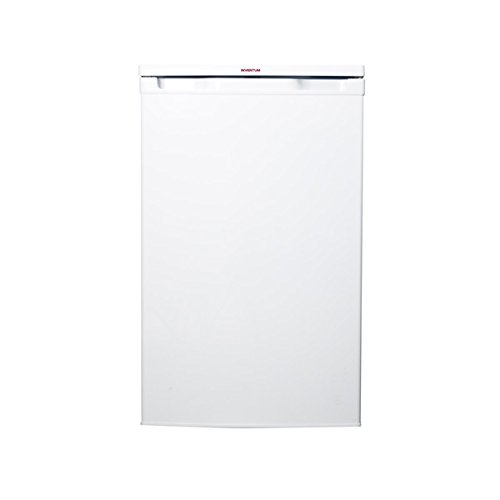
Whakaahua 1: Mua view of the Inventum KK550 freestanding refrigerator. The appliance is white with a single door and a top-mounted control panel area.
Kei roto i nga waahanga matua:
- Waea mana pāmahana
- Whata taea te whakarite
- Nga waahi rokiroki kuaha
- Crisper drawer (if applicable)
3. Tatūnga
3.1 Te Wetewete
- Tangohia nga taonga kapi katoa, tae atu ki te pahuka me te riipene whakapiri.
- Inspect the appliance for any transport damage. If damaged, do not plug it in and contact your retailer.
- Kaua e taea e nga tamariki nga taonga takai.
3.2 Whakanoho
- Place the refrigerator on a firm, level surface away from direct sunlight, heat sources (e.g., oven, radiator), and extreme cold.
- Ensure there is at least 10 cm (4 inches) of space at the back and sides for proper air circulation.
- Adjust the leveling feet at the bottom of the appliance to ensure it is stable and level.
3.3 Whakamahi Tuatahi
- Before plugging in, clean the interior of the refrigerator with a damp he kakahu me te horoi ngawari. Kia maroke rawa.
- After cleaning, allow the appliance to stand for at least 2-4 hours before connecting it to the power supply. This allows the refrigerant to stabilize.
- Plug the refrigerator into a dedicated, grounded power outlet.
- Set the temperature control to a medium setting and allow the refrigerator to cool for several hours (e.g., 4-6 hours) before placing food inside.
4. Mahi
4.1 Te Mana Pawera
The temperature inside the refrigerator is controlled by a thermostat dial, usually located inside the appliance. The dial typically has settings from 1 (warmest) to 5 or 7 (coldest), or a similar scale. Adjust the dial to achieve the desired cooling level.
- Tautuhinga Manakohia: For general use, a medium setting (e.g., 3 or 4) is often sufficient.
- Whakarite ana: Turn the dial towards a higher number for colder temperatures and towards a lower number for warmer temperatures. Allow several hours for the temperature to stabilize after adjustment.
4.2 Nga Aratohu Pupuri Kai
- Kaua e taumaha rawa: Avoid packing food too tightly, as this can restrict air circulation and reduce cooling efficiency.
- Cover food: Always cover food to prevent drying out and odor transfer.
- Hot food: Allow hot food to cool down to room temperature before placing it in the refrigerator to avoid increasing the internal temperature and energy consumption.
- Door storage: Use door shelves for items that require less critical cooling, such as condiments and drinks.
5. Tiaki
5.1 Te horoi
Ka awhina te horoi i nga wa katoa ki te pupuri i te akuaku me te pai.
- I mua i te horoi: Wewetehia te taputapu mai i te putanga hiko.
- roto: Clean the interior with a solution of warm water and a mild, non-abrasive detergent. Rinse with clean water and dry thoroughly. Do not use harsh chemicals or abrasive cleaners.
- Waho: Horoia nga mata o waho ki te ngohengohe, damp kakahu. Mo nga piro maro, whakamahia he horoi ngawari.
- Hiri Kuaha: Horoi i nga wa katoa te keehini kuaha kia pai ai te hiri.
5.2 Whakakore hukapapa
This refrigerator model typically requires manual defrosting when ice buildup on the evaporator reaches approximately 5 mm (0.2 inches) thick.
- Whakaritenga: Unplug the refrigerator. Remove all food items and place them in a cooler. Remove all shelves and drawers.
- Whakatakaa: Leave the refrigerator door open. Place towels on the floor to catch melting ice. You can speed up the process by placing bowls of hot water inside (do not use sharp objects to chip ice).
- Whai muri i te Whakarewa: Clean and dry the interior thoroughly. Replace shelves and drawers. Plug the refrigerator back in and allow it to cool for a few hours before returning food.
5.3 Mana Outage
Ina he mana outage, keep the refrigerator door closed as much as possible to maintain the internal temperature. Food should remain safe for several hours depending on the ambient temperature and how full the refrigerator is.
6. Te Raru
I mua i te whakapiri atu ki te ratonga kiritaki, tirohia nga take me nga otinga e whai ake nei:
| Raruraru | Take pea | Rongoā |
|---|---|---|
| Kaore te pouaka pouaka e mahi. | Karekau he hiko; kore te taura hiko i mono; pupuhi pupuhi. | Tirohia te hononga hiko; tirohia te fiusi/wāwāhi ara iahiko o te whare. |
| Kaore i te makariri te pouaka pouaka. | Temperature setting too high; door opened too frequently; door not closed properly; excessive food load; poor ventilation. | Adjust temperature setting; ensure door is closed tightly; reduce food load; ensure adequate space around the appliance. |
| Nga haruru rereke. | Appliance not level; objects vibrating against the appliance; normal operating sounds (compressor, refrigerant flow). | Adjust leveling feet; ensure no objects are touching the appliance; normal operating sounds are expected. |
| Te wai i runga i te papa. | Drain hole blocked; defrost water overflowing. | Clear the drain hole; ensure proper defrosting procedure is followed. |
7. Whakatakotoranga
| Āhuahira | Whakatakotoranga |
|---|---|
| Tauira | KK550 |
| Momo | Refrigerator Freestanding |
| Te kaha | 133 rita |
| Nga Ahinga Hua (W x D x H) | 55 x 58 x 85 cm |
| ASIN | B014PIB9ZM |
| Te Rā o te Wātea Tuatahi | Pipiri 11, 2022 |
8. Pūtāhui me te Tautoko
Warranty information for the Inventum KK550 refrigerator is typically provided with the purchase documentation or can be found on the manufacturer's official webpae. Tena koa pupurihia to tohu mo te hoko mo nga kereme whakamana.
For technical support, spare parts, or service requests, please contact Inventum customer service directly. Contact details can usually be found on the product packaging, the manufacturer's website, or your purchase invoice.