
1. Kupu Whakataki
The Kinesis Freestyle2 is an ergonomic keyboard designed to enhance comfort and productivity by adapting to individual body types and preferences. Its unique split design allows for adjustable separation, splay, and tenting, promoting natural hand, wrist, and forearm positions to reduce muscle tension and strain.
This keyboard features a standard Windows layout, including dedicated hotkeys for common functions like Cut, Copy, and Paste, as well as multimedia controls. An embedded numeric 10-key further supports productivity. The Freestyle2 utilizes low-force membrane key switches with tactile feedback, engineered to minimize finger fatigue and impact during typing.
The Freestyle2 is a plug-and-play device, requiring no special software or drivers for operation with Windows 7-10, Linux, and Chrome operating systems.
2. Tatūnga
2.1. Ihirangi mokete
- Kinesis Freestyle2 USB Wired Keyboard (Standard Windows Layout)
- Detachable Pivot Tether (for adjustable splay)
- Aratohu Timata Tere
2.2. Te hono i te Papapātuhi
- Kimihia he tauranga USB e waatea ana i runga i to rorohiko.
- Plug the USB cable from the Freestyle2 keyboard into the USB port.
- The keyboard is plug-and-play and should be recognized automatically by your operating system (Windows 7-10, Linux, Chrome). No additional drivers are typically required.
2.3. Adjusting Keyboard Separation and Splay
The Freestyle2 keyboard consists of two independent modules connected by a cable, allowing for flexible positioning.
- Wehewehenga: Gently pull the two keyboard modules apart to achieve your desired separation, up to 9 inches. This allows you to position your hands and wrists in a more natural, shoulder-width alignment.
- Splay: The detachable pivot tether, located at the top center of the keyboard, allows you to adjust the splay angle of the modules. This helps to keep your wrists straight and reduce ulnar deviation. Experiment with different angles to find the most comfortable position.
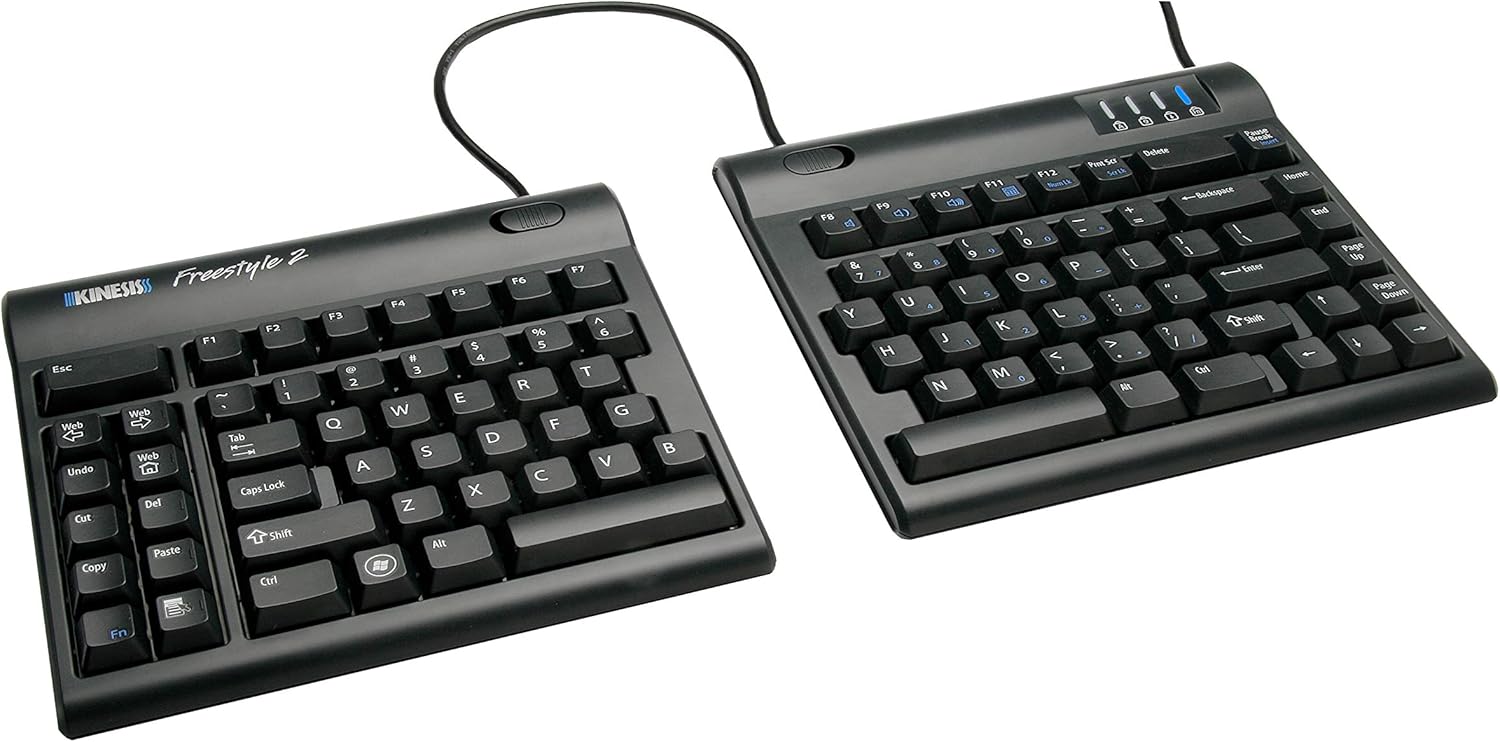
Image: The Kinesis Freestyle2 ergonomic keyboard showing its split design with 9-inch separation.

Image: The two modules of the Kinesis Freestyle2 keyboard separated on a desk, demonstrating how this positioning helps maintain straight wrists.

Image: The Kinesis Freestyle2 keyboard with optional cushioned palm supports, illustrating the adjustable splay angle using the pivot tether.
3. Nga Tohutohu Whakahaere
3.1. Standard Layout and Hotkeys
The Freestyle2 keyboard features a standard QWERTY Windows layout. On the left module, dedicated hotkeys are provided for common functions:
- Web: Ka whakatuwhera i to taunoa web pūtirotiro.
- Wete: Performs the undo action.
- Tapahia: Cuts selected text or items.
- Tārua: Copies selected text or items.
- Whakapiri: Pastes copied or cut text/items.
- Del: Deletes characters or selected items.
The keyboard also includes multimedia keys for volume control and playback, typically accessed via the Fn key in combination with function keys (F1-F12).

Whakaahua: He runga-iho view of the Kinesis Freestyle2 keyboard, highlighting its standard Windows layout and the dedicated hotkeys on the left module.
3.2. Embedded Numeric 10-Key
An embedded numeric 10-keypad is integrated into the right module of the keyboard. This allows for numerical data entry without requiring a separate keypad. Refer to the Quick Start Guide for specific key combinations to activate and use the embedded numeric keypad.

Image: A user's hands typing on the separated Kinesis Freestyle2 keyboard modules, with an optional external numeric keypad positioned between them.

Image: A close-up of a user's hands typing on the Kinesis Freestyle2 keyboard, emphasizing the low-force, tactile key switches designed to reduce finger impact and fatigue.
3.3. Nga Taonga Kōwhiringa
For enhanced comfort, optional accessories such as cushioned palm supports and tenting kits (e.g., VIP3 accessory) are available. These accessories can further optimize wrist and forearm positioning.

Image: The Kinesis Freestyle2 keyboard shown with the VIP3 tenting accessory (AC820), which provides adjustable tenting angles for increased comfort.
4. Tiaki
4.1. Te horoi
To maintain the keyboard's performance and appearance:
- Momotuhia te papapātuhi mai i to rorohiko i mua i te horoi.
- Whakamahia he kakahu ngohengohe, karekau he ngongo paku dampka whakakiia ki te wai, ki te otinga horoi ngawari ranei hei muru i te mata.
- A ape i te whakamahi i nga matū kino, i nga kai horoi, i te rehu wai ranei ki runga papapātuhi.
- Mo te puehu me te para i waenga i nga taviri, whakamahia te hau kōpeke.
5. Te Raru
5.1. Papapātuhi Kaore i te Whakautu
- Me mohio kei te hono pai te taura USB ki te papapātuhi me te rorohiko.
- Whakamātauria te mono i te papapātuhi ki tētahi atu tauranga USB i tō rorohiko.
- Tīmataria anō tō rorohiko.
- Test the keyboard on another computer to determine if the issue is with the keyboard or the computer system.
5.2. Keys Not Functioning Correctly
- Check for any debris or obstructions under the affected keys. Use compressed air to clear if necessary.
- Ensure no software conflicts are present. Try using the keyboard in a different application or a clean boot environment.
- If specific hotkeys or multimedia keys are not working, verify that the Fn key (if applicable) is being used correctly or that no software has remapped the keys.
6. Whakatakotoranga
| Āhuahira | Taipitopito |
|---|---|
| Hunga Hua | 15.94 x 9.25 x 1.26 inihi |
| Taumaha Tūemi | 2 pauna |
| Kaihanga | Kinesis Corporation |
| Tauira Tuemi | KIN-FS2-01US |
| Hangarau Hononga | USB |
| Pūrere Hototahi | Windows 7-10, Linux, Chrome |
| Whakaahuatanga Papapātuhi | Ergonomic, split-design keyboard with standard Windows layout, low-force tactile switches, embedded numeric keypad |
| Nga Whakamahinga Manakohia | Tari |
| Āhuahira Motuhake | Ergonomic |
| Tae | 9 Inch Separation (Black) |
| Te Ra Tuatahi Wātea | Oketopa 3, 2010 |
7. Pūtāhui me te Tautoko
For warranty information and technical support, please refer to the official Kinesis Corporation website or contact their customer service directly. Details regarding product registration, warranty claims, and support resources are typically available through these channels.
Kaihanga: Kinesis Corporation
Mo etahi atu awhina, tirohia te Kinesis Store on Amazon.