
1. Kupu Whakataki
This manual provides essential information for the safe installation, operation, and maintenance of the Pilz PNOZ X3P Safety Relay, model 777314. The PNOZ X3P is designed for monitoring E-STOP pushbuttons, safety gates, and light grids in industrial applications, ensuring personnel and machine safety.
2. Nga Tohutohu Haumaru
WHAKATŪPATO: Failure to follow these safety instructions can result in serious injury or death, and damage to equipment.
- Only qualified personnel familiar with industrial safety standards and electrical systems should install, operate, or maintain this device.
- Disconnect all power before performing any installation, wiring, or maintenance tasks.
- Me whakarite kia u nga waea katoa ki nga waehere hiko o te rohe me te motu.
- Do not bypass or disable safety functions.
- Regularly inspect the device and associated safety components for damage or malfunction.
- Use only genuine PILZ replacement parts.
3. Hua Neke Atuview
The Pilz PNOZ X3P (Model 777314) is a safety relay designed for monitoring safety functions. It features:
- Taumahi: E-STOP, safety gate, light grid monitoring.
- Whirihoranga Hoapā: 3 Normally Open (NO) safety contacts, 1 Normally Closed (NC) auxiliary contact, 1 Semiconductor Output (SO).
- Tukuna Voltage Awhe: 24-240VAC/DC (Coil Voltage: 24V AC/DC).
- Aratau Mahi: Tautuhi aunoa.
- Whānui: 45mm.
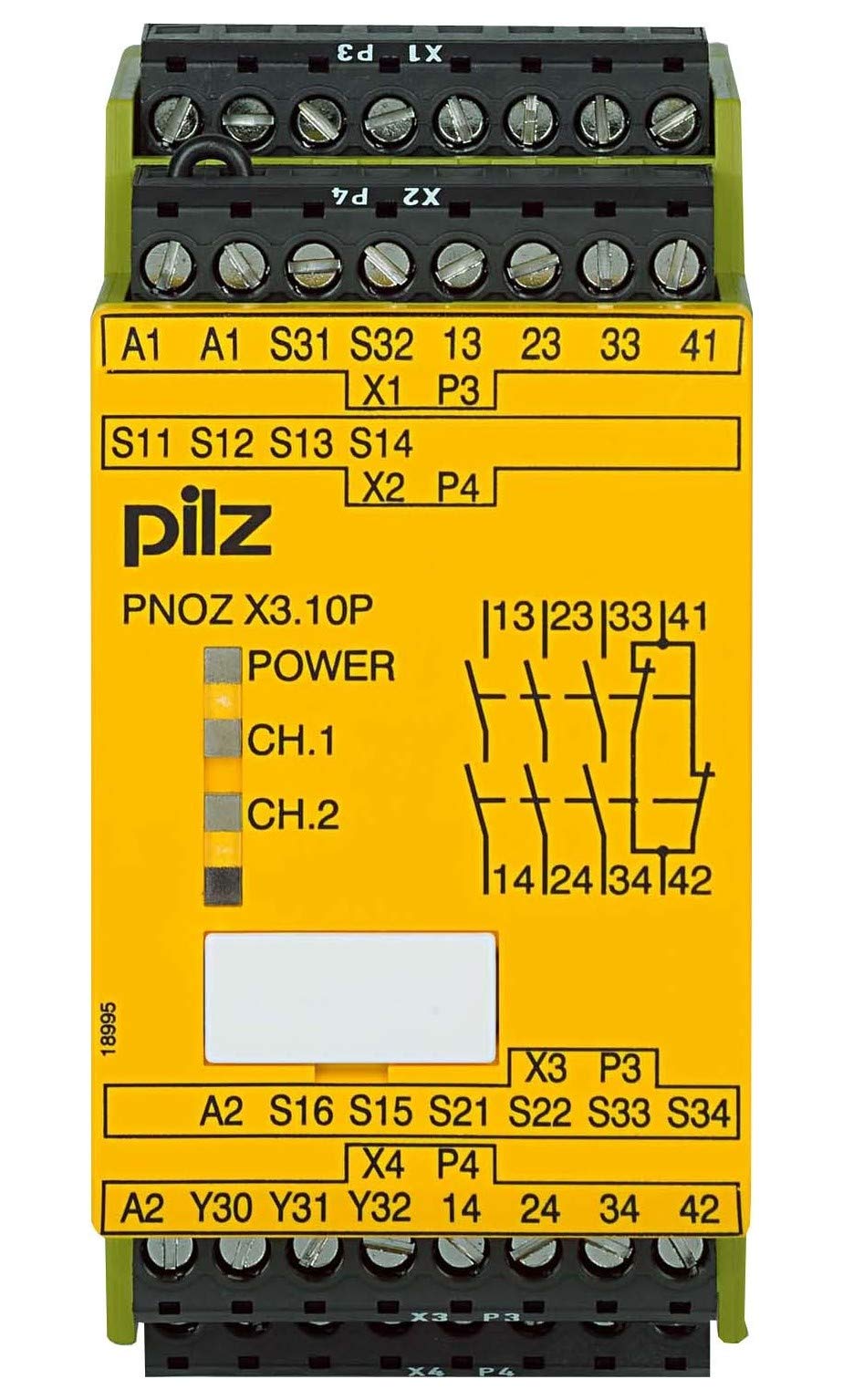
Whakaahua 1: Mua view of the Pilz PNOZ X3P Safety Relay, showing terminals and indicators.
4. Tatūnga me te Tāuta
4.1 Whakapiki
Mount the PNOZ X3P on a 35mm DIN rail in a control cabinet. Ensure adequate ventilation around the device to prevent overheating. Maintain proper clearance from heat-generating components.
4.2 Hononga Hiko
Before making any electrical connections, ensure the main power supply is disconnected and locked out. Refer to the wiring diagrams for correct terminal assignments.
5. Waaho
The PNOZ X3P supports 1-channel or 2-channel wiring for safety inputs. The choice depends on the required safety integrity level (SIL) and performance level (PL).
5.1 Input Wiring (E-STOP, Safety Gate, Light Grid)
- 1-Channel Wiring: Connect the safety device (e.g., E-STOP) to a single input channel. This configuration offers basic safety.
- 2-Channel Wiring: Connect the safety device to two independent input channels. This configuration provides redundancy and higher fault tolerance, suitable for higher safety requirements.
5.2 Output Wiring
The relay provides 3 NO safety contacts for controlling power to hazardous machinery and 1 NC auxiliary contact for signaling purposes. The 1 SO (semiconductor output) can be used for diagnostic feedback to a PLC.
Ensure that the load connected to the safety contacts does not exceed the maximum switching current of 15 Amps and maximum switching voltage o 240 Volts.
Whakaahua 2: Example wiring diagram for a 2-channel E-STOP application. (Actual diagram not provided, refer to product documentation for specific wiring.)
6. Nga Tohutohu Whakahaere
The PNOZ X3P operates in an automatic reset mode. Once the safety input circuit is closed (e.g., E-STOP released, safety gate closed), the safety relay will automatically energize its output contacts, provided no faults are detected.
6.1 Whakanuia
Upon applying power, the relay performs an internal self-test. If the safety inputs are closed and no faults are present, the output contacts will close, and the status indicators will illuminate.
6.2 Safety Function Activation
When a safety input is opened (e.g., E-STOP pressed, safety gate opened), the PNOZ X3P immediately de-energizes its safety output contacts, bringing the monitored machine to a safe state.
6.3 Tautuhi Anō
Due to its automatic reset function, the relay will re-energize its outputs as soon as the safety input circuit is restored and no faults are present. Ensure that the machine can only restart safely after a reset.
7. Tiaki
Regular maintenance is crucial to ensure the continued safe operation of the PNOZ X3P safety relay.
- Tirohanga Ia Wa: Visually inspect the device and its wiring for any signs of damage, loose connections, or contamination.
- Whakamātautau Mahi: Periodically test the entire safety circuit, including the PNOZ X3P, by activating the connected safety devices (E-STOP, safety gate, light grid) to verify their proper function.
- Te horoi: Keep the device free from dust and debris. Use a dry, soft cloth for cleaning. Do not use abrasive cleaners or solvents.
8. Te Raru
If the safety relay does not function as expected, consider the following common issues:
| Raruraru | Take pea | Rongoā |
|---|---|---|
| Outputs do not energize after power-up. |
|
|
| Outputs de-energize unexpectedly. |
|
|
If troubleshooting steps do not resolve the issue, contact PILZ technical support.
9. Whakatakotoranga Hangarau
| Tawhā | Uara |
|---|---|
| Tauira | 777314 |
| Waitohu | PILZ |
| Aratau Mahi | Aunoa |
| Puawai Porakatage | 24 Ngā Waohiko (AC/DC) |
| Whakapā Whakatauranga o nāianei | 6 Amps |
| Morahi Whakawhiti Naianei | 15 Amps |
| Morahi Whakawhiti Voltage | 240 Volts |
| Taumaha Tūemi | 0.64 Pauna |
10. Pūtāhui me te Tautoko
PILZ products are manufactured to high-quality standards and come with a manufacturer's warranty. For specific warranty terms and conditions, please refer to the official PILZ webte paetukutuku, whakapā atu ranei ki to kaitoha o to rohe.
For technical assistance, product support, or to report a malfunction, please contact PILZ customer service. Have your product model (777314) and serial number ready when contacting support.
PILZ Official Webpae: www.pilz.com