1. Introduction
The XFLY-MODEL 1500mm Tasman is a versatile remote-controlled aircraft designed for both beginner and experienced pilots. Its robust construction and unique features make it suitable for various flying conditions, including short takeoff and landing (STOL) operations and advanced 3D aerobatics. This manual provides essential information for the safe assembly, operation, and maintenance of your Tasman RC plane.

Figure 1: The XFLY-MODEL 1500mm Tasman RC Plane, showcasing its distinctive orange and grey livery with large air-filled tires.
Caractéristiques principales :
- Lightweight yet durable composite-reinforced EPO construction: Ensures resilience and longevity.
- Larger wing and functional flaps: Delivers excellent short takeoff and landing (STOL) capabilities, along with advanced 3D maneuverability.
- Unique oversized air-filled tires: Provides superior bounce and rebound resiliency, enabling operations from hard or uneven terrain.
- Realistic-looking LED navigation lights: Enhances visibility and realism during flight.
- Latch-type top hatch: Accommodates 4S 2200-3300mAh batteries, offering a wide range of performance and extended flight times.
2. Précautions de sécurité
Operating remote-controlled aircraft requires adherence to strict safety guidelines to prevent injury or damage. Always prioritize safety during assembly, operation, and maintenance.
Sécurité générale:
- Always operate your RC plane in open areas, away from people, buildings, and obstacles.
- Ne jamais voler à proximité des aéroports ou des espaces aériens réglementés.
- Ensure your batteries are fully charged and properly secured before each flight.
- Perform pre-flight checks thoroughly before every takeoff.
- Ne volez pas en cas de vents forts ou de conditions météorologiques défavorables.
- Maintenez les spectateurs à une distance de sécurité.
Battery Safety (LiPo):
- Use only recommended LiPo batteries (4S 2200-3300mAh).
- Charge LiPo batteries with a compatible LiPo charger only.
- Ne jamais surcharger ni décharger excessivement les batteries LiPo.
- Store LiPo batteries in a fire-safe container and away from flammable materials.
- Vérifiez l'état des piles avant chaque utilisation. Cessez de les utiliser si elles sont endommagées.
3. Assemblage
The Tasman 1500mm is a Plug-N-Play (PNP) model, meaning the motor, ESC, and servos are pre-installed. Minimal assembly is required to get your aircraft ready for flight.
Outils requis (non inclus) :
- Petit tournevis cruciforme
- Couteau de loisir ou lame tranchante
- Foam-safe adhesive (e.g., CA glue with activator, epoxy)
Étapes d'assemblage :
- Installation de l'aile : Carefully slide the main wing onto the fuselage. Ensure the wing spars align and fully insert into their respective slots. Secure the wing using the provided screws. Connect the aileron and flap servo leads to the appropriate extensions in the fuselage.
- Horizontal Stabilizer and Elevator Installation: Attach the horizontal stabilizer to the rear of the fuselage. Connect the elevator pushrod to the control horn. Ensure free movement of the elevator.
- Vertical Stabilizer and Rudder Installation: Mount the vertical stabilizer onto the fuselage. Connect the rudder pushrod to the control horn. Verify smooth operation.
- Landing Gear Assembly: The main landing gear with oversized air-filled tires should be pre-installed. Ensure they are securely fastened. The tail wheel assembly also needs to be checked for proper attachment and steering linkage.
- Propeller and Spinner Installation: Attach the propeller and spinner to the motor shaft according to the instructions provided with the propeller. Ensure the propeller is balanced and installed in the correct orientation for thrust.

Figure 2 : Gros plan view of a servo and its linkage connected to a control surface, illustrating the precision required for proper control setup.
4. Vérifications avant vol
Before every flight, perform the following checks to ensure the safety and proper operation of your Tasman 1500mm.
Vérification des surfaces de contrôle :
- Turn on your transmitter first, then connect the flight battery to the aircraft.
- Verify that all control surfaces (ailerons, elevator, rudder, flaps) move freely and in the correct direction relative to your transmitter inputs.
- Check for any binding or excessive play in the linkages.
Center of Gravity (CG) Setup:
Proper CG is crucial for stable flight. Refer to the diagram below for the recommended CG location. Adjust battery position within the compartment to achieve the correct balance.
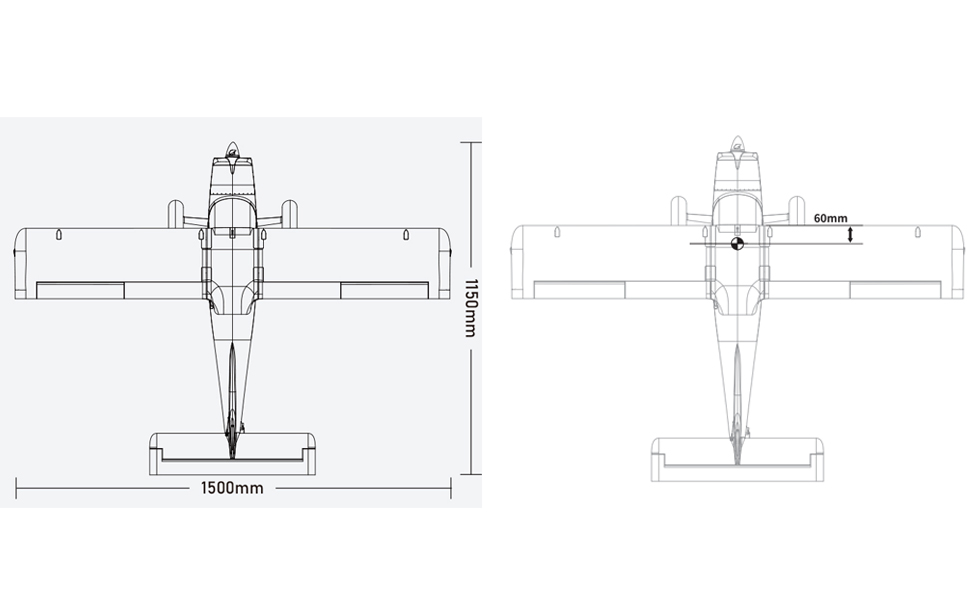
Figure 3: Technical drawing illustrating the dimensions of the Tasman 1500mm and the recommended Center of Gravity (CG) location, approximately 60mm from the leading edge of the wing.
Installation de la batterie :
The Tasman features a large battery compartment accessible via a latch-type top hatch. This allows for easy installation and removal of 4S 2200-3300mAh LiPo batteries.

Figure 4 : View of the spacious battery compartment, designed to securely hold 4S LiPo batteries for optimal performance and flight duration.
5. Mode d'emploi
The Tasman 1500mm is designed for stable and enjoyable flight, with capabilities ranging from gentle cruising to aggressive 3D maneuvers.
Décoller:
- Placez l'appareil sur une surface plane, face au vent si possible.
- Apply throttle smoothly. The large air-filled tires provide excellent traction on various surfaces.
- As speed increases, gently apply up-elevator to lift off. The functional flaps can be deployed for shorter takeoffs.
Vol:
- The Tasman offers stable flight characteristics, making it forgiving for new pilots.
- For advanced maneuvers, utilize the large control surfaces and powerful 4S-compatible outrunner motor.
- The LED navigation lights enhance visibility, especially during dawn or dusk flights.

Figure 5: The Tasman 1500mm in stable flight, demonstrating its excellent aerial presence.
Atterrissage:
- Approach the landing strip into the wind.
- Gradually reduce throttle and deploy flaps as needed to control descent speed.
- Maintain a slight nose-up attitude for a smooth touchdown on the main landing gear, then gently lower the tail.
- The oversized air-filled tires absorb impacts, allowing for landings on rougher terrain.
Video 1: Official XFly Model video showcasing the Tasman 1500mm's flight capabilities, including STOL takeoffs and landings, and various aerobatic maneuvers. This video highlights the plane's versatility and performance.
6. Entretien
Regular maintenance ensures the longevity and optimal performance of your Tasman 1500mm.
Soins généraux:
- Clean the aircraft after each flight, removing dirt, grass, or debris.
- Inspect all control surfaces, linkages, and hinges for wear or damage.
- Vérifiez le serrage de toutes les vis et fixations.
Pneus gonflés à l'air :
The unique air-filled tires may require occasional pressure checks. Use a small pump suitable for RC tires to maintain optimal inflation for cushioning and rebound.

Figure 6: Close-up of the oversized air-filled tires, highlighting their robust design for various terrains.
Moteur et ESC :
- Ensure the motor is free of debris and spins smoothly.
- Check all electrical connections for secure fit and no signs of corrosion or damage.
- The powerful 4S-compatible outrunner motor and 40A ESC are designed for reliable performance.
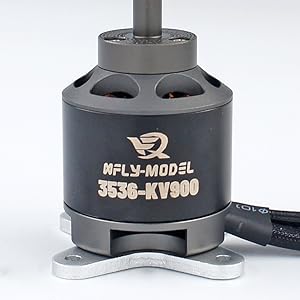

Figure 7: The XFLY-MODEL 3536-KV900 outrunner motor (left) and the 40A Electronic Speed Controller (ESC) (right), key components of the power system.
7. Dépannage
This section addresses common issues you might encounter with your Tasman 1500mm.
| Problème | Cause possible | Solution |
|---|---|---|
| L'aéronef ne répond pas aux commandes. | Transmitter off, battery disconnected, receiver not bound, damaged wiring. | Ensure transmitter is on. Check battery connection. Re-bind receiver to transmitter. Inspect and repair wiring. |
| Motor not spinning or low power. | Low battery, loose motor/ESC connections, damaged motor/ESC. | Charge battery. Check all connections. Replace damaged components. |
| Flaps not working. | Loose servo connection, damaged servo, incorrect radio setup. | Check servo wire connections (especially Y-connectors). Verify flap settings on transmitter. Replace faulty servo. |
| Air-filled tires not holding air. | Crevaison, valve desserrée. | Inspect for punctures and repair with a suitable patch. Tighten valve stem. If severely damaged, replace tire. |
| Aircraft is unstable in flight. | Incorrect CG, control surface trim, damaged airframe. | Adjust CG. Trim control surfaces. Inspect airframe for damage and repair. |
8. Spécifications
Detailed specifications for the XFLY-MODEL 1500mm Tasman RC Plane:
| Fonctionnalité | Détail |
|---|---|
| Envergure | 1500 mm (59.1 pouce) |
| Matériel | Composite-reinforced EPO |
| Moteur | 4S-compatible outrunner (XFLY-MODEL 3536-KV900) |
| ÉCHAP | 40A (XFLY-MODEL ESC 40A) |
| Hélice | 2 lames |
| Batterie recommandée | Li-Po 4S 2200-3300mAh |
| Pneus | Oversized Air-Filled |
| Caractéristiques | Functional flaps, LED navigation lights, STOL & 3D capabilities |
| Poids de l'article | 9.23 livres |
| Dimensions du colis | 44.8 x 15.51 x 11.26 pouces |
9. Garantie et assistance
XFLY-MODEL stands behind the quality of its products. For warranty claims, technical support, or replacement parts, please contact XFLY-MODEL customer service through their official channels or the retailer where you purchased the product.
Veuillez conserver votre preuve d'achat pour toute demande de garantie.
Pour plus de ressources et d'informations sur les produits, consultez le site web. XFLY-MODEL Store on Amazon.