
Introduction
This manual provides essential information for the safe and efficient operation, maintenance, and troubleshooting of your Sealey SAC5020A 50L Direct Drive Air Compressor. The compressor features an aluminium cylinder head with a cast iron cylinder for enhanced wear resistance, making it suitable for general-purpose workshop applications. Its pump head is directly coupled to a heavy-duty induction motor, ensuring reliable and quiet operation. The precision-welded receiver tank complies with the Pressure Vessel Directive. It is equipped with a fully automatic pressure cut-out switch and twin gauges to display both tank and working pressures. The unit is supplied with a 3-pin plug.
Consignes de sécurité
Respectez toujours les consignes de sécurité suivantes afin d'éviter les blessures corporelles ou les dommages matériels :
- Lisez et comprenez toutes les instructions avant d’utiliser le compresseur.
- Ensure the compressor is placed on a level, stable surface in a well-ventilated area.
- Portez un équipement de protection individuelle (EPI) approprié, notamment une protection oculaire et une protection auditive.
- Ne pas faire fonctionner le compresseur en mode damp ou en milieu humide, ou en présence de liquides ou de gaz inflammables.
- Always disconnect the compressor from the power supply before performing any maintenance or adjustments.
- Ne jamais diriger d'air comprimé vers des personnes ou des animaux.
- Regularly inspect the air tank for signs of corrosion or damage. Do not use a damaged tank.
- Avant toute utilisation, assurez-vous que tous les raccords sont bien fixés et étanches.
- Ne modifiez pas le compresseur ni ses dispositifs de sécurité.
Déballage et installation
Carefully remove the compressor from its packaging. Inspect the unit for any signs of shipping damage. If damage is found, contact your supplier immediately.
Identification et dimensions des composants

Figure 1 : Overall dimensions of the Sealey SAC5020A 50L Direct Drive Air Compressor. The image shows the compressor with its tank, motor, handle, wheels, and control panel, indicating a width of 705mm, a height of 600mm, and a depth of 300mm.
Familiarize yourself with the main components of your compressor. Refer to Figure 1 for an overview of the unit's dimensions and general layout.
Assemblée
- Fixez les roues : Securely attach the wheels to the compressor base using the provided hardware.
- Attachez la poignée : Mount the transport handle to the designated points on the compressor body.
- Positionnement : Place the compressor on a firm, level surface. Ensure there is adequate space around the unit for ventilation.
Connexion électrique
Connect the compressor to a suitable grounded power outlet. Ensure the power supply matches the voltage and frequency specifications of the compressor (typically 230V, 50Hz for this model). The unit is fitted with a 3-pin plug.
Initial Run-in Procedure
Before first use, or after extended storage, perform a brief run-in:
- Open the air outlet valve completely to allow air to escape freely.
- Switch on the compressor and let it run for approximately 15-20 minutes without building pressure. This helps to lubricate internal components.
- Switch off the compressor and close the air outlet valve.
Mode d'emploi
Controls and Gauges

Figure 2 : Gros plan view of the twin pressure gauges. One gauge displays the tank pressure, and the other displays the regulated working pressure.
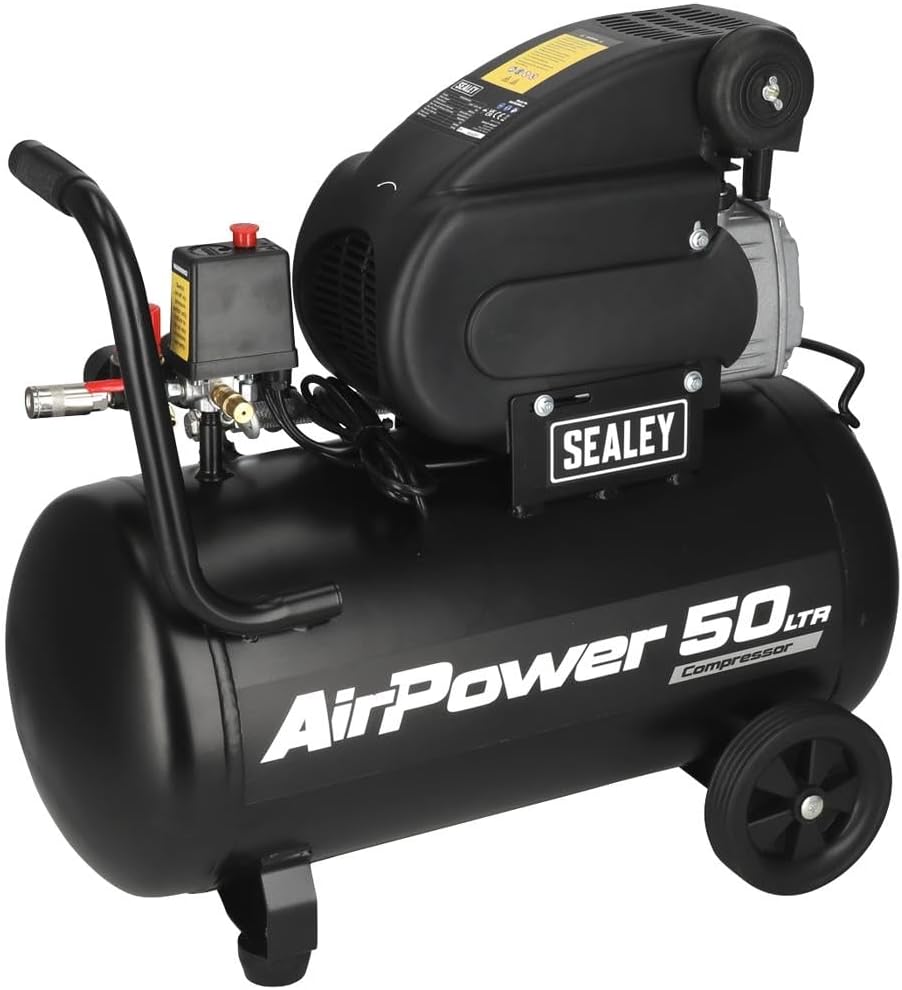
Figure 3 : The pressure cut-out switch (black box with yellow warning label) and the red pressure regulator knob, along with the quick-connect air outlet.
- Pressostat : The black box (Figure 3) automatically turns the compressor on and off to maintain tank pressure.
- Manomètre de réservoir : Displays the current pressure inside the air tank (Figure 2).
- Working Pressure Gauge: Displays the pressure of the air being supplied to your tools, adjustable via the regulator (Figure 2).
- Régulateur de pression: The red knob (Figure 3) allows you to adjust the working pressure. Turn clockwise to increase pressure, counter-clockwise to decrease.
- Quick-Connect Air Outlet: For attaching air hoses and tools (Figure 3).
Démarrage du compresseur
- Assurez-vous que la vanne de vidange située au bas du réservoir est fermée.
- Branchez le compresseur sur une prise de courant appropriée.
- Turn the main power switch to the "ON" position. The compressor will start to build pressure.
- Once the tank reaches its maximum pressure, the compressor will automatically shut off.
Connecting and Using Air Tools
- Connect your air hose to the quick-connect air outlet.
- Attach your air tool to the other end of the hose.
- Adjust the working pressure using the red regulator knob to suit the requirements of your air tool. Monitor the working pressure gauge.
- Begin using your air tool. The compressor will cycle on and off automatically to maintain pressure as needed.
Fermeture
- Mettez l'interrupteur principal sur la position « ARRÊT ».
- Disconnect the air hose and tools.
- Slowly open the drain valve at the bottom of the tank to release any condensed moisture and residual air pressure. Close the valve once the tank is empty.
Entretien
Un entretien régulier garantit la longévité et le fonctionnement sûr de votre compresseur d'air.
Quotidien/Après chaque utilisation
- Évacuer les condensats : After each use, or daily if used frequently, open the drain valve at the bottom of the air tank to release accumulated moisture. This prevents rust and corrosion inside the tank.
Weekly/Monthly
- Inspecter le filtre à air : Check the air filter for dirt and debris. Clean or replace if necessary to ensure proper airflow to the pump.
- Vérifiez les fuites : Listen for any air leaks around fittings, hoses, and valves. Tighten connections as needed. A soapy water solution can help identify small leaks.
- Inspecter les tuyaux et les raccords : Examine air hoses for cracks, cuts, or wear. Replace damaged hoses immediately. Ensure all quick-connect fittings are functioning correctly.
- Inspecter le cordon d’alimentation : Check the power cord for any damage, fraying, or exposed wires.
Annuellement
- Inspection du réservoir : Visually inspect the air tank for any signs of external corrosion, dents, or damage. If any damage is found, do not use the compressor and seek professional inspection.
- Vérification de la soupape de sécurité : Briefly pull the ring on the safety relief valve to ensure it operates freely and reseats properly.
For any maintenance beyond these basic steps, it is recommended to consult a qualified service technician.
Dépannage
Cette section propose des solutions aux problèmes courants que vous pourriez rencontrer avec votre compresseur d'air.
| Problème | Cause possible | Solution |
|---|---|---|
| Le compresseur ne démarre pas. |
|
|
| Le compresseur fonctionne en continu ou par cycles trop fréquents. |
|
|
| Pression d'air faible à la sortie. |
|
|
| Bruit ou vibration excessif. |
|
|
Caractéristiques
| Fonctionnalité | Détail |
|---|---|
| Marque | Sealey |
| Numéro de modèle | SAC5020A |
| Source d'énergie | AC |
| Puissance maximale | 2 chevaux |
| Puissance du moteur | 2 chevaux |
| Volume du réservoir | 50 litres |
| Capacité de débit d'air | 6.8 pieds cubes par minute (CFM) |
| Poids de l'article | 32980 Grams (approx. 33 kg) |
| Dossier spécial | Fonctionnement silencieux |
| Composants inclus | 50ltr Direct Drive Compressor 2hp |
| Utilisations recommandées | Bolting, Drilling, Spraying, Sanding, Grinding, Tire Inflation |
Informations sur la garantie
This Sealey product is covered by a manufacturer's warranty against defects in materials and workmanship. The specific terms and duration of the warranty may vary by region and purchase date. Please retain your proof of purchase for warranty claims.
For detailed warranty information, please refer to the warranty card included with your product or visit the official Sealey website.
Assistance et contact
Should you require technical assistance, spare parts, or have any questions regarding your Sealey SAC5020A air compressor, please contact Sealey customer support or your authorized dealer.
Officiel de Sealey Website: www.sealey.co.uk
Please have your model number (SAC5020A) and serial number (if applicable) ready when contacting support.