
Introducción
This manual provides comprehensive instructions for the setup, operation, and maintenance of your ASUS ROG Strix 27” 5K HDR Gaming Monitor (Model: XG27JCG). Please read this manual thoroughly before using the monitor to ensure proper functionality and to maximize your user experience.
The ROG Strix XG27JCG is a 27-inch 5K (5120 x 2880) Fast IPS display designed for high-performance gaming and detailed visual tasks. It features a 180Hz (overclocked) refresh rate, 0.3ms GTG response time, and a Dual Mode function allowing switching between 5K 180Hz and QHD 330Hz. Advanced features include G-SYNC Compatible technology, VESA DisplayHDR 600, and ROG Gaming A.I. Technology.
Video: Encimaview of the ASUS ROG Strix XG27JCG 27-inch 5K monitor, highlighting its key features and design.
¿Qué hay en la caja?
Verifique que todos los componentes estén presentes en el embalaje antes de continuar con la instalación.
- ASUS ROG Strix XG27JCG Monitor
- Cable DisplayPort
- Guía de inicio rápido
- Bolsa ROG
- Pegatina ROG
- ROG tripod stand
- Tarjeta de garantía
- Cable de alimentación
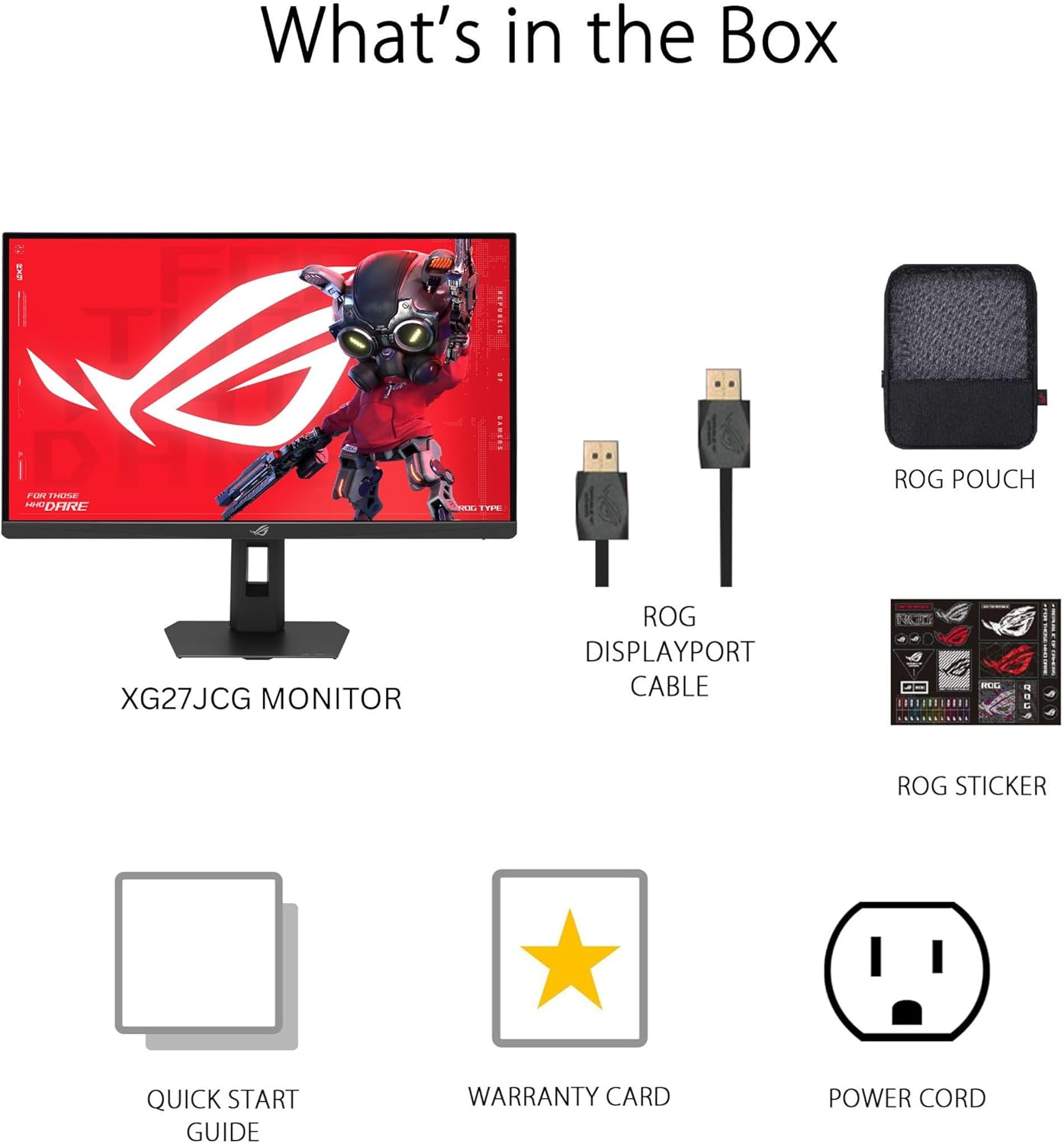
Imagen: Contents of the monitor packaging, showing the monitor, DisplayPort cable, ROG pouch, ROG sticker, Quick Start Guide, Warranty Card, and Power Cord.
Instrucciones de instalación
1. Montaje del soporte
Carefully remove the monitor from its packaging. Attach the stand base to the stand neck, securing it with the provided screw. Then, attach the assembled stand to the back of the monitor until it clicks into place. Ensure all connections are firm.
2. Conexión a una computadora
The monitor supports DisplayPort 1.4 (DSC), HDMI 2.1, and USB-C connectivity. Choose the appropriate cable for your system.
- Puerto de pantalla: Conecte un extremo del cable DisplayPort a la entrada DisplayPort del monitor y el otro extremo a la salida DisplayPort de su computadora.
- HDMI: Connect one end of an HDMI 2.1 cable to the monitor's HDMI input and the other end to your computer's HDMI output.
- USB-C: Connect a USB-C cable to the monitor's USB-C port and to a compatible USB-C port on your computer. This connection also supports 15W power delivery.

Imagen: Trasero view of the monitor's connectivity ports, including HDMI 2.1, DisplayPort 1.4, USB Type-C, and a Headphone Jack.
3. Conexión de alimentación
Conecte el cable de alimentación a la entrada de alimentación del monitor y luego conecte el otro extremo a una toma de corriente.
4. Encendido inicial
Press the power button located on the monitor to turn it on. The monitor will automatically detect the input source. If no image appears, ensure all cables are securely connected and the computer is powered on.
Instrucciones de funcionamiento
Menú de visualización en pantalla (OSD)
Use the joystick and buttons on the back of the monitor to navigate the OSD menu. The OSD allows you to adjust various settings such as brightness, contrast, color, input source, and gaming features.
Display Modes and Refresh Rate
The monitor features a Dual Mode function, allowing you to switch between two primary display configurations:
- 5K (5120 x 2880) at 180Hz (OC): Provides ultra-sharp, immersive visuals suitable for cinematic content and detailed work.
- QHD (2560 x 1440) at 330Hz: Offers extremely high frame rates and responsive gaming action, ideal for competitive esports.
Switching between modes can be done via the OSD menu or a dedicated hotkey, if configured.

Imagen: Visual representation of the monitor's Dual Mode, allowing users to switch between 5K 180Hz and QHD 330Hz for different gaming experiences.
ROG Gaming A.I. Technology
This monitor includes AI-powered features designed to enhance your gaming experience:
- Potenciador de sombra dinámico: Automatically brightens dark areas of the game world without overexposing bright areas, improving visibility of hidden enemies or details.
- Mira dinámica: Provides an on-screen crosshair that can adapt to the game environment, ensuring it remains visible against various backgrounds.
- Visualización de IA: Optimizes visual settings based on the game content for improved clarity and detail.

Imagen: Examples of Dynamic Crosshair and Dynamic Shadow Boost in action, showing how these features enhance visibility in games.
Centro de widgets de visualización
The DisplayWidget Center software provides seamless control over monitor settings directly from your Windows or macOS operating system. This utility allows for easy adjustment of GameVisual modes, MultiScreen configurations, and system settings without using the OSD buttons.

Imagen: Screenshot of the DisplayWidget Center software, demonstrating its user interface for adjusting monitor settings.
Ergonomía y ajustes
The monitor stand offers multiple adjustment options to optimize your viewcomodidad:
- Inclinación: De +20° a -5°
- Girar: De +40° a -40°
- Pivote: +90° to -90° (for portrait mode)
- Ajuste de altura: 0 a 110 mm
Adjust the monitor to an ergonomic position that reduces strain on your neck and eyes. Ensure the top of the screen is at or slightly below eye level.

Imagen: Diagram illustrating the monitor's ergonomic adjustments, including tilt, swivel, pivot, and height.
Mantenimiento
Limpieza del monitor
- Siempre apague el monitor y desenchufe el cable de alimentación antes de limpiarlo.
- Utilice un paño suave y sin pelusa ligeramente seco.ampLimpiar con agua o un limpiador de pantalla suave, no abrasivo.
- No rocíe el limpiador directamente sobre la pantalla. Aplíquelo primero sobre el paño.
- Avoid using alcohol-based cleaners, ammonia, or abrasive materials, as these can damage the screen surface.
Cuidados generales
- Mantenga el monitor alejado de la luz solar directa, del calor excesivo y de la humedad.
- Asegúrese de que haya una ventilación adecuada alrededor del monitor para evitar el sobrecalentamiento.
- Evite colocar objetos pesados sobre el monitor o sus cables.
Solución de problemas
| Problema | Posible solución |
|---|---|
| No hay imagen en la pantalla |
|
| La imagen está borrosa o distorsionada. |
|
| Screen flickers or shows artifacts |
|
| No sound from headphones (if connected to monitor) |
|
Presupuesto
| Característica | Detalle |
|---|---|
| Marca | Asus |
| Número de modelo | XG27JCG |
| Tamaño de pantalla | 27 pulgadas |
| Resolución | 5120 x 2880 (5K UHD) |
| Tipo de panel | Casi IPS |
| Frecuencia de actualización | 180 Hz (OC) / QHD 330Hz (Dual Mode) |
| Tiempo de respuesta | 0.3 ms (tiempo de respuesta) |
| Relación de aspecto | 16:9 |
| Relación de contraste | 600:1 |
| Viewángulo de ing | 178 grados (H/V) |
| Compatibilidad con HDR | Pantalla VESA HDR 600 |
| Gama de colores | 97% DCI-P3 |
| Sincronización adaptativa | AMD FreeSync Premium Pro, G-SYNC Compatible |
| Conectividad | 1x DisplayPort 1.4 (DSC), 2x HDMI 2.1, 1x USB-C (with 15W PD), Headphone Jack |
| Consumo de energía | 40 vatios |
| Dimensiones del artículo (Pr. x An. x Al.) | 8.59" de profundidad x 24.2" de ancho x 20.1" de alto |
| Peso del artículo | 6.9 libras |
| Ajustes ergonómicos | Tilt (+20° ~ -5°), Swivel (+40° ~ -40°), Pivot (+90° ~ -90°), Height (0~110mm) |
Garantía y soporte
This ASUS ROG Strix XG27JCG monitor comes with a 3 año de garantía. For warranty claims, technical support, or service inquiries, please contact ASUS customer support. Refer to the included Warranty Card for detailed terms and conditions.
You can find additional support resources, drivers, and FAQs on the official ASUS support websitio: www.asus.com/support/