
Introducción
Thank you for choosing the Powerhorse Propane Hot Water Pressure Washer. This powerful and efficient machine is designed for heavy-duty cleaning tasks, utilizing both gas power and a propane burner to deliver hot water for superior cleaning performance. This manual provides essential information for the safe and effective operation, maintenance, and troubleshooting of your pressure washer. Please read this manual thoroughly before operating the unit and keep it for future reference.
Información de seguridad
Operating a pressure washer requires adherence to strict safety guidelines to prevent injury or damage. Always wear appropriate personal protective equipment (PPE), including eye protection, hearing protection, and sturdy footwear. Never point the spray gun at people, animals, or electrical outlets. Ensure the work area is clear of obstructions and well-ventilated, especially when operating the propane burner. Disconnect the spark plug wire before performing any maintenance. Keep children and pets away from the operating unit.
Configuración
Before first use, ensure all components are present and undamaged. Refer to the packing list provided with your unit. Assembly is required for certain parts.
1. Desembalaje y montaje
Carefully remove all components from the packaging. Attach the wheels, handle, and any other accessories as per the assembly diagrams in your quick start guide. Ensure all bolts and fasteners are securely tightened.

Image: The Powerhorse Propane Hot Water Pressure Washer fully assembled, showcasing its robust frame, engine, pump, and propane burner unit.
2. Conexión del suministro de agua
Connect a garden hose (minimum 5/8 inch diameter) to the water inlet on the pressure washer pump. Ensure the water source provides sufficient flow (at least 4 GPM) and pressure. Use a clean water source to prevent damage to the pump. Turn on the water supply fully before starting the engine to purge air from the system.
3. Connecting Propane Tank
Place a standard 20 lb (or larger) propane tank onto the designated platform on the pressure washer. Connect the propane hose from the burner unit to the propane tank valve. Ensure all connections are tight and check for leaks using a soapy water solution before operation.

Imagen: Un lado view of the Powerhorse pressure washer, highlighting the propane tank securely mounted and connected to the burner system.
4. Adding Engine Oil and Fuel
Fill the engine crankcase with the recommended type and amount of engine oil (refer to the engine manual for specifics). Fill the fuel tank with fresh, unleaded gasoline. Do not overfill. Always use a fuel stabilizer if storing the unit for extended periods.
Instrucciones de funcionamiento
Siga estos pasos para un funcionamiento seguro y eficaz de su hidrolavadora.
1. Arrancar el motor
- Asegúrese de que el suministro de agua esté completamente abierto y que la manguera del jardín esté conectada.
- Squeeze the spray gun trigger to purge air from the pump and high-pressure hose until a steady stream of water emerges.
- Coloque el interruptor del motor en “ON”.
- Abra la válvula de combustible.
- Apply choke if the engine is cold.
- Pull the recoil starter handle firmly until the engine starts. Once started, gradually open the choke.
2. Using the Hot Water Function
The propane burner heats water up to 150°F for enhanced cleaning of grease and grime.

Image: The Powerhorse pressure washer in operation, demonstrating its ability to heat water up to 150°F for effective cleaning.
- With the engine running and water flowing, open the propane tank valve.
- Locate the burner ignition switch/button and activate it. The burner should ignite, and you will hear a distinct flame sound.
- Allow a few minutes for the water to heat up to the desired temperature.
- Adjust the temperature control knob if available, to fine-tune the water temperature.

Image: A close-up of the control panel on the Powerhorse pressure washer, showing the adjustable temperature settings for customized cleaning.
3. Cleaning Techniques and Nozzles
Select the appropriate nozzle for your cleaning task. Different colored nozzles provide varying spray patterns and pressures. Always start with a wider spray pattern and lower pressure on an inconspicuous area to avoid damaging the surface. Maintain a safe distance from the cleaning surface.

Image: A person effectively cleaning the side of a trailer with the Powerhorse pressure washer, demonstrating its powerful spray.
4. Apagado
- Turn off the burner ignition.
- Cierre la válvula del tanque de propano.
- Apague el interruptor del motor.
- Cierre el suministro de agua.
- Apriete el gatillo de la pistola rociadora para liberar cualquier presión restante en el sistema.
- Desconecte la manguera de jardín y la manguera de alta presión.
Mantenimiento
El mantenimiento regular es crucial para la longevidad y el rendimiento óptimo de su hidrolavadora.
1. Mantenimiento del motor
Regularly check and change the engine oil as recommended in the engine manual. Clean or replace the air filter periodically, especially in dusty conditions. Inspect the spark plug and replace if necessary. Ensure the engine cooling fins are free of debris.
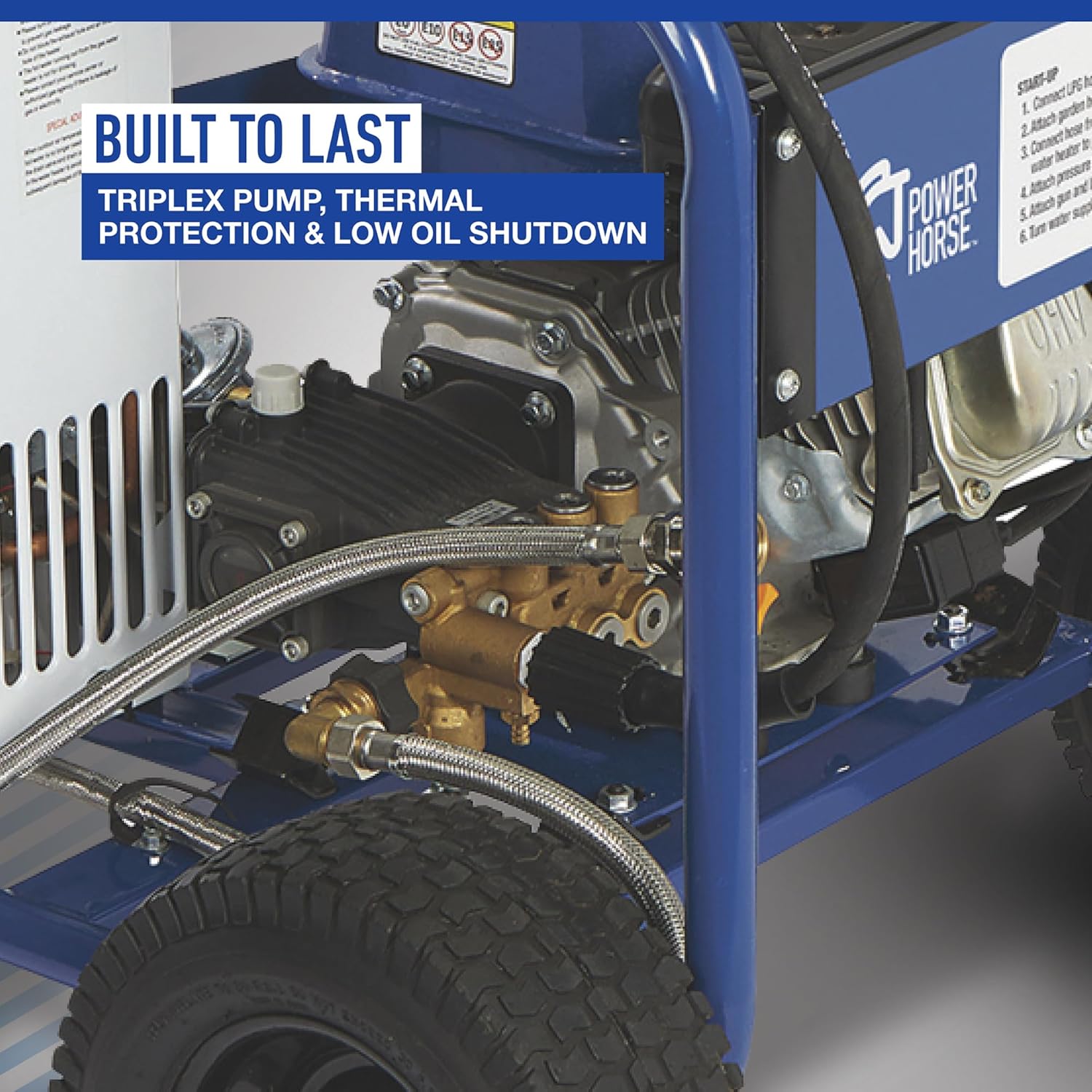
Imagen: Un detalle view of the Powerhorse pressure washer's robust triplex pump and 212cc OHV engine, highlighting components critical for maintenance.
2 Mantenimiento de la bomba
After each use, flush the pump with clean water. For extended storage, use a pump protector or antifreeze solution to prevent freezing and corrosion. Inspect the high-pressure hose for kinks, cuts, or abrasions. Clean the nozzle tips regularly to prevent blockages.
3. Almacenamiento
Store the pressure washer in a dry, protected area, away from extreme temperatures. If storing for more than 30 days, drain the fuel tank and carburetor, or use a fuel stabilizer. Apply pump protector as described above.
Solución de problemas
Esta sección aborda problemas comunes que podrías encontrar.
| Problema | Posible causa | Solución |
|---|---|---|
| El motor no arranca | No fuel; Spark plug issue; Choke not set correctly; Engine switch OFF | Add fuel; Check/replace spark plug; Adjust choke; Turn engine switch ON |
| Sin presión de agua | Suministro de agua cortado; Manguera doblada; Boquilla obstruida; Aire en la bomba | Turn on water; Straighten hose; Clean nozzle; Purge air from pump |
| No hay agua caliente | Propane tank empty/closed; Burner ignition failure; Low water flow | Check propane; Inspect ignition system; Ensure adequate water supply |
| El motor funciona de forma irregular | Combustible rancio; Filtro de aire sucio; Filtro de combustible obstruido | Drain and refill with fresh fuel; Clean/replace air filter; Replace fuel filter |
Si los problemas persisten después de intentar estas soluciones, comuníquese con el servicio de atención al cliente.
Presupuesto
| Característica | Especificación |
|---|---|
| Marca | Caballo de potencia |
| Número de modelo | 3600 PSI HOT WATER |
| Fuente de poder | Gas-powered with Propane Burner |
| Presión máxima | 3600 PSI |
| Caudal máximo | 2.6 GPM |
| Motor | Powerhorse 212cc OHV Engine |
| Heated Water Temperature | Hasta 150°F |
| Longitud de la manguera | 30 pies |
| Peso del artículo | 176.5 libras |
| Dimensiones del producto (L x An x Al) | 37" de largo x 23.03" de ancho x 36.22" de alto |
| Código Postal | 840321755025 |
Información de garantía
This Powerhorse pressure washer is covered by a manufacturer's warranty. For specific details regarding warranty coverage, terms, and conditions, please refer to the warranty card included with your product or visit the official Powerhorse webSitio. Conserve su comprobante de compra para cualquier reclamación de garantía.
Atención al cliente
For technical assistance, parts, or service, please contact Powerhorse customer support. Contact information can typically be found on the product packaging, the manufacturer's website, or your purchase documentation. When contacting support, please have your model number and serial number ready.