
1. Einleitung
The Walfront MPPT Solar Charge Controller is designed to efficiently manage power flow from your solar panels to your battery bank, optimizing charging performance for off-grid solar systems. This manual provides essential information for the safe and effective installation, operation, and maintenance of your 50A MPPT solar charge controller.

Image 1.1: Walfront MPPT Solar Charge Controller 50A. This image shows the front view of the orange and black controller, featuring an LCD screen displaying PV, Battery, and Load information, along with 'ESC' and 'SET' buttons.
2. Hauptmerkmale
- High Efficiency MPPT Tracking: Features MPPT tracking efficiency greater than 99% and a maximum conversion efficiency of up to 98%, maximizing energy harvest from solar panels.
- Wide 180V PV Input and Auto Voltage-Erkennung: Supports a maximum solar input voltage of 180V (at 25℃) and automatically recognizes 12V, 24V, 36V, and 48V battery systems. Compatible with battery voltages von 9 V bis 64 V.
- Clear LCD Display and Smart Protection: Built-in LCD provides real-time system data (voltage, current, operating status). Includes temperature compensation and multiple protection features for safe operation.
- Low No-Load Loss and Reliable Performance: No-load loss of ≤0.4W conserves energy. Designed for reliable operation in temperatures from -10℃ to 65℃ and altitudes up to 3000 meters.
- Einfach zu installieren und zu verwenden: Auto-recognition feature simplifies setup. Compact design allows for straightforward mounting.

Image 2.1: Automatic Voltage Identification. This image highlights the controller's ability to automatically identify 12V, 24V, 36V, and 48V systems, shown with various solar panel application examples.
3. Sicherheitshinweise
Please read all instructions carefully before installation and operation. Failure to follow these safety guidelines may result in personal injury, damage to the controller, or other equipment.
- Ensure all wiring is correctly polarized and securely connected. Loose connections can cause overheating and damage.
- Schließen Sie immer zuerst die Batterie, dann das Solarpanel und zuletzt den Verbraucher an. Trennen Sie die Verbraucher in umgekehrter Reihenfolge.
- Schließen Sie die Solarmodulgruppe nicht an den Laderegler an, wenn keine Batterie angeschlossen ist.
- Stellen Sie sicher, dass die Systemlautstärketage of the solar panel and battery are compatible with the controller's specifications.
- Installieren Sie den Controller in einem gut belüfteten Bereich, fern von brennbaren Materialien und direkter Sonneneinstrahlung.
- Avoid touching live terminals. Use insulated tools during installation.
- This device is not waterproof. Protect it from moisture and water exposure.
4. Packungsinhalt
Bitte überprüfen Sie, ob alle unten aufgeführten Artikel in Ihrem Paket enthalten sind:
- 1 x Walfront MPPT Solar Charge Controller (50A)
- 4 x Schrauben
- 4 x Dehnschrauben
- 1 x Benutzerhandbuch (dieses Dokument)
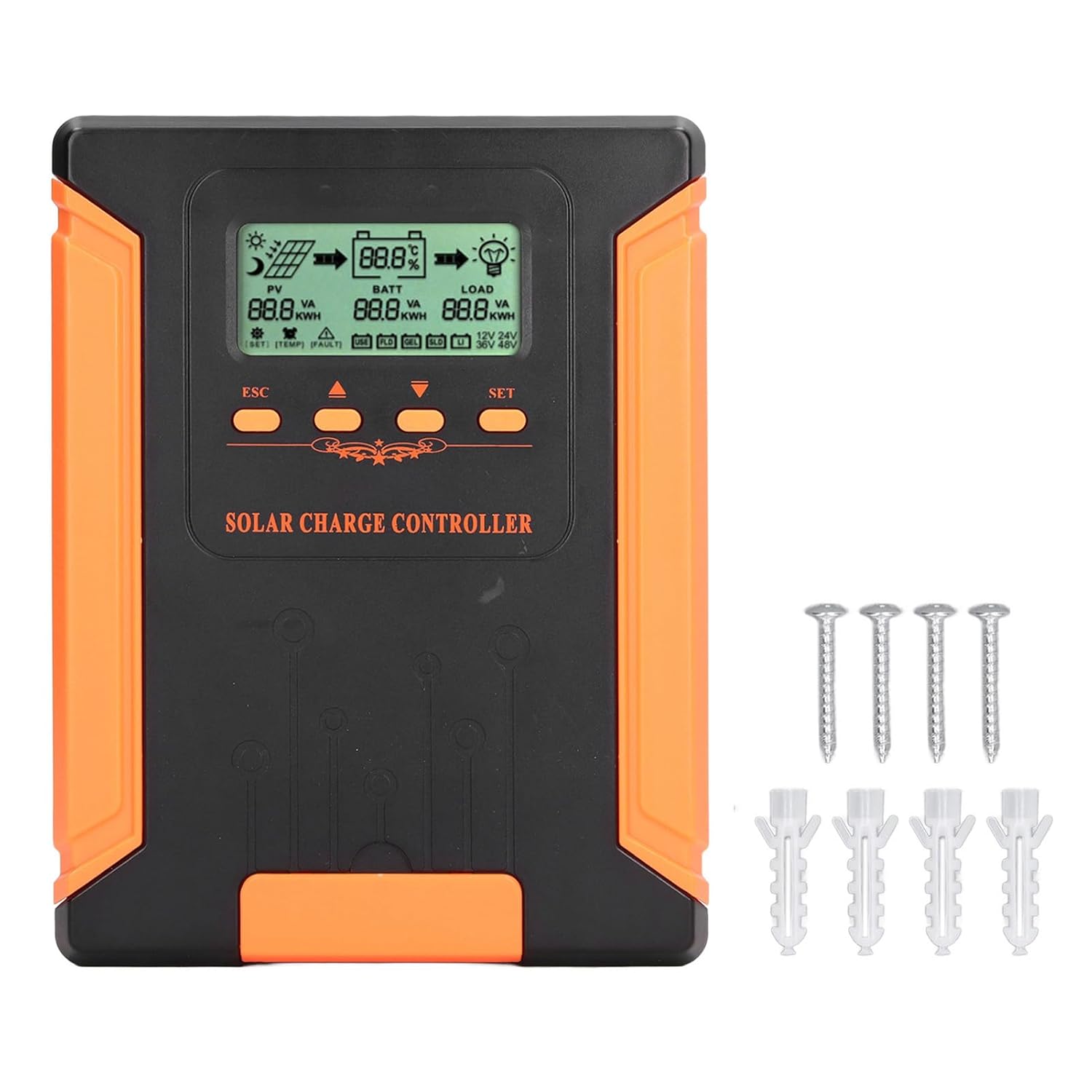
Image 4.1: Package Contents. This image displays the solar charge controller alongside the mounting screws and expansion screws provided in the package.
5. Einrichtung und Installation
Follow these steps for proper installation of your solar charge controller.
5.1 Montage des Controllers
- Wählen Sie einen trockenen, gut belüfteten Ort, der vor direkter Sonneneinstrahlung, hohen Temperaturen und Feuchtigkeit geschützt ist.
- Ensure there is sufficient space around the controller for heat dissipation, especially around the cooling fins.
- Mount the controller vertically on a solid surface using the provided screws.
5.2 Kabelverbindungen
Refer to the wiring diagrams below for correct connection sequence. Always connect in the following order:
- Schließen Sie die Batterie an: Connect the battery to the controller's battery terminals. Ensure correct polarity (+ to + and - to -). The controller will automatically detect the battery voltage.
- Schließen Sie das Solarpanel an: Schließen Sie die Solarmodulgruppe an die PV-Anschlüsse des Ladereglers an. Achten Sie auf die richtige Polarität.
- Gleichstromlast anschließen (optional): Connect the DC load to the controller's load terminals. Ensure correct polarity.
To disconnect the system, follow the reverse order: disconnect load, then solar panel, then battery.

Image 5.1: Basic System Connection Diagram. This diagram illustrates the connection order: 1. Battery Assembly, 2. Solar Panel Assembly, 3. DC Load. It also shows an AC Load and Inverter connected to the Battery Assembly.

Image 5.2: Detailed System Wiring Diagram. This diagram provides a more comprehensive view of a solar power system, including solar panels, battery, inverter (AC Output/Input), and various AC loads like laptops, lights, air conditioners, televisions, and fans.
6. Bedienungsanleitung
The controller features an LCD display and control buttons for monitoring and configuration.
6.1 LCD Display
The LCD screen provides real-time information about your solar system, including:
- PV (Photovoltaic) Status: Eingangsvolumentage, current, and power from solar panels.
- BATT (Battery) Status: Akku voltage, charging current, and state of charge.
- LOAD Status: Output current and power to the DC load.
- Systemlautstärketage: Automatically detected battery system voltage (12V/24V/36V/48V).
- Fehleranzeigen: Displays fault codes or warnings if issues occur.
6.2 Steuertasten
The controller has three buttons: ESC, Up/Down arrows, and SET.
- ESC-Taste: Used to exit current menu or cancel an operation.
- Auf/Ab-Tasten: Used to navigate through menu options or adjust parameter values.
- Set-Taste: Used to enter a menu, confirm a selection, or save changes to parameters.

Image 6.1: Control Buttons. This close-up image shows the 'ESC', 'Up arrow', 'Down arrow', and 'SET' buttons on the controller's front panel.
7. Wartung
Regelmäßige Wartung gewährleistet optimale Leistung und Langlebigkeit Ihres Solarladereglers.
- Reinigung: Periodically clean the controller's exterior with a dry cloth. Ensure the cooling fins are free from dust and debris to maintain proper heat dissipation.
- Verbindungen: Check all wiring connections regularly to ensure they are tight and free from corrosion.
- Inspektion: Inspect the controller for any signs of physical damage, overheating, or unusual odors.
- Umfeld: Stellen Sie sicher, dass die Installationsumgebung trocken und gut belüftet bleibt.

Image 7.1: Cooling Fins. This close-up shows the cooling fins on the top of the controller, which are crucial for heat dissipation and require regular cleaning.
8. Fehlerbehebung
Sollten Sie Probleme mit Ihrem Controller haben, beachten Sie bitte die folgenden häufig auftretenden Probleme und Lösungen:
| Problem | Mögliche Ursache | Lösung |
|---|---|---|
| Die Anzeige des Controllers ist ausgeschaltet. | Keine Batterie angeschlossen oder Batteriespannungtage zu niedrig. | Ensure battery is connected correctly and has sufficient charge (above 9V). |
| No charging current from PV | Solar panels not connected, insufficient sunlight, or PV polarity reversed. | PV-Anschlüsse und Polarität prüfen. Für ausreichend Sonnenlicht sorgen. PV-Spannung prüfen.tage liegt im Bereich. |
| Laden funktioniert nicht | Load disconnected, load current too high, or load polarity reversed. | Check load connections and polarity. Ensure load current does not exceed controller's rating. |
| Akku nicht vollständig geladen | Insufficient solar input, undersized solar array, or battery issues. | Increase solar panel capacity or check for shading. Inspect battery health. |
9. Technische Daten
Below are the technical specifications for the Walfront MPPT Solar Charge Controller 50A.
| Parameter | Spezifikation |
|---|---|
| Systemlautstärketage | 12V / 24V / 36V / 48V Auto |
| Nennladestrom | 50 A |
| No Load Loss | ≤ 0.4 W |
| Solar Maximum Input Voltage | 180V (at 25℃), 150V (at -25℃) |
| Batterie Voltage Reichweite | 9 bis 64 V |
| Maximale Leistungspunkt-Voltage Reichweite | Batterie Voltage +2V bis 150V |
| Umwandlungseffizienz | ≤ 98 % |
| MPPT-Tracking-Effizienz | >99 % |
| Temperaturkompensationskoeffizient | -2mv/℃/2V (default value) |
| Arbeitstemperatur | -10℃ bis 65℃ |
| Schutzgrad | IP21 |
| Höhe | ≤3000 Meter / 9842.5ft |

Image 9.1: Model Comparison Table. This table provides a comparison of rated charging current and solar panel maximum input power for CM-50 (50A) and CM-60 (60A) models across different system voltages.
10. Garantie und Support
Informationen zu Garantie und technischem Support finden Sie in der Ihnen beim Kauf ausgehändigten Dokumentation oder wenden Sie sich an Ihren Händler. Bewahren Sie Ihren Kaufbeleg als Kaufnachweis auf.