
Introduction to the Unimog 406 / 416 Series
The Unimog (Universal-Motor-Gerät) 406 and 416 series represent a significant era in the development of highly versatile, all-wheel-drive utility vehicles. Produced by Daimler-Benz from 1963 to 1989, these models were engineered for a wide range of applications, from agriculture and forestry to military and municipal services. Their robust design and exceptional off-road capabilities established the Unimog as a benchmark for specialized transport and work vehicles.
Ovaj vodič pruža prekoview of the key characteristics, operational aspects, and historical significance of these enduring Unimog series.
Key Features and Design
The 406 and 416 series Unimogs were distinguished by several innovative design features that contributed to their legendary performance:
- Portal Axles: These axles allowed the wheels to be lower than the axle center, providing exceptional ground clearance.
- All-Wheel Drive: Permanent or selectable all-wheel drive ensured maximum traction in challenging terrains.
- Blokade diferencijala: Front and rear differential locks enhanced traction control in slippery conditions.
- Flexible Frame: A unique flexible ladder frame allowed for significant chassis articulation, maintaining ground contact for all wheels over uneven surfaces.
- Power Take-Off (PTO) Systems: Multiple PTO points (front, rear, and side) enabled the operation of a wide array of implements and attachments.
- Short Overhangs: Designed with minimal front and rear overhangs for excellent approach and departure angles.

Image: A Unimog 406/416, likely from the early production years, depicted in a winter setting. This image highlights the vehicle's robust build and its utility in diverse environments, even for tasks like transporting goods such as milk cans.
Operativne sposobnosti
The Unimog 406 and 416 series were renowned for their adaptability and operational versatility. They could function as:
- Agricultural Tractors: Capable of plowing, tilling, and towing heavy farm equipment.
- Forestry Vehicles: Used for timber transport, logging, and trail maintenance.
- Municipal Service Vehicles: Employed for snow plowing, road sweeping, gritting, and general maintenance.
- Construction Vehicles: Utilized for material transport, site preparation, and equipment hauling.
- Expedition and Off-Road Vehicles: Their extreme off-road capability made them popular for exploration and challenging terrain.
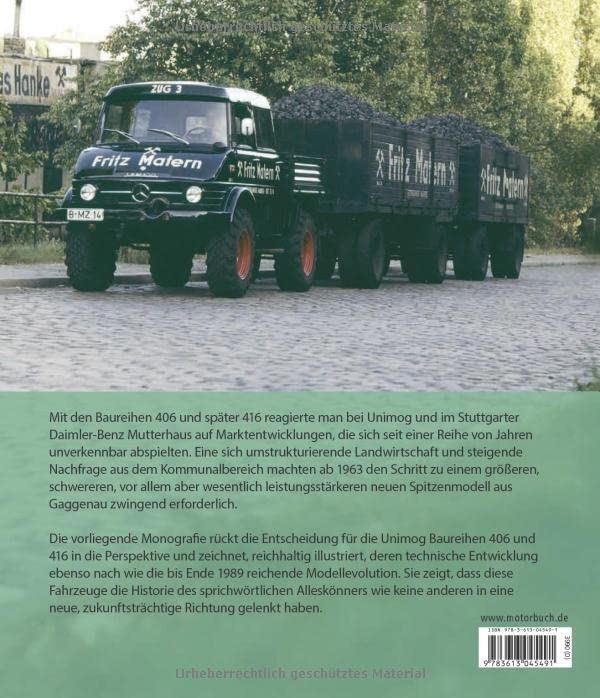
Image: A Unimog 406/416, possibly a longer wheelbase 416 model, demonstrating its heavy-duty towing capacity with a multi-axle trailer loaded with coal. This illustrates its use in industrial and transport applications.
Maintenance and Longevity
The Unimog 406 and 416 series were built with durability and ease of maintenance in mind, contributing to their long service life. Regular maintenance, as outlined in the original service manuals, was crucial for optimal performance. Key maintenance areas included:
- Provjera tekućina: Engine oil, transmission fluid, axle oils, and coolant levels.
- Greasing Points: Regular lubrication of chassis components, universal joints, and steering linkages.
- Pregled kočionog sistema: Checking brake fluid, pads/shoes, and lines.
- Pritisak u gumama: Maintaining correct tire pressure for various loads and terrains.
- Zamjena filtera: Air, fuel, and oil filters as per service intervals.
Many vehicles from these series remain operational today, a testament to their robust engineering and the availability of parts and specialized knowledge within the Unimog community.
Technical Specifications (General)
While specific specifications varied by year and variant, the 406 and 416 series shared core characteristics:
| Feature | Opis |
|---|---|
| Tip motora | Mercedes-Benz Diesel engines (OM 314, OM 352, etc.) |
| Izlazna snaga | Varied from approximately 65 HP to 125 HP depending on model and year. |
| Prijenos | Fully synchronized manual transmissions, often with multiple forward and reverse gears, and crawler gears. |
| Drive Type | 4x4 All-Wheel Drive with selectable differential locks. |
| Međuosovinsko rastojanje | Multiple options, typically ranging from 2380 mm (406) to 2900 mm (416). |
| Najveća brzina | Dependent on gearing, typically up to 80-90 km/h. |
| Kapacitet nosivosti | Significant, varying by model and configuration, often several tons. |
For detailed specifications of specific variants, refer to specialized Unimog literature and historical documentation.
Historical Context and Evolution
The period from 1963 to 1989 saw the Unimog 406 and 416 series evolve to meet changing demands in agriculture, industry, and public services. Initially developed as a robust agricultural tractor, the Unimog quickly found applications across various sectors due to its unique combination of speed, off-road capability, and implement-carrying capacity.
The 406 series, introduced in 1963, was the first heavy-duty Unimog, featuring a larger engine and more robust chassis than its predecessors. The 416 series, a longer-wheelbase variant of the 406, offered increased load capacity and stability, making it suitable for heavier tasks and specialized superstructures. Throughout their production run, continuous improvements were made to engines, transmissions, and cabin comfort, solidifying their reputation as indispensable workhorses.
Dodatne informacije i podrška
For those seeking more in-depth knowledge, the book "Unimog - Die Baureihen 406 / 416: 1963-1989" serves as a comprehensive resource. It provides detailed insights into the technical development, model evolution, and historical significance of these vehicles.
Enthusiast communities and specialized workshops worldwide continue to support the maintenance and restoration of these classic Unimog models. Online forums and dedicated clubs offer a wealth of information and peer support for owners and enthusiasts.