
1. Introduction
Thank you for choosing the BENNTOP 6200W 48V Hybrid Solar Inverter. This device is an all-in-one solution designed to efficiently convert 48V DC power into 230V AC power, suitable for a wide range of household appliances and tools. It integrates intelligent MPPT solar charging, a pure sine wave inverter, and a battery charger into a single unit, making it ideal for off-grid and backup power systems. This manual provides essential information for safe installation, operation, maintenance, and troubleshooting to ensure optimal performance and longevity of your inverter.

Figure 1.1: Front view of the BENNTOP 6200W 48V Hybrid Solar Inverter, showcasing its compact design and integrated display.
2. Safety Information
Please read all instructions and warnings carefully before installation and operation. Failure to follow these instructions may result in electric shock, fire, severe injury, or property damage. Keep this manual for future reference.
- Installation must be performed by qualified personnel.
- Ensure all wiring is correctly polarized and securely connected.
- Do not disassemble the inverter. There are no user-serviceable parts inside.
- Avoid exposing the inverter to rain, snow, spray, or any liquids.
- Ensure adequate ventilation around the inverter to prevent overheating.
- Always disconnect all power sources (solar, battery, utility) before performing any maintenance or wiring.
- Wear appropriate personal protective equipment (PPE) during installation and maintenance.
3. Product Overview
3.1 Key Features
- High Power Output: 6200W continuous power, 6500W peak output.
- Pure Sine Wave Output: Provides stable, high-quality AC power (<3% THD) suitable for sensitive electronics, reducing noise and extending appliance lifespan.
- Integrated MPPT Solar Charger: 120A MPPT controller with a wide input voltage range (30-500V DC) and a maximum 500V DC open circuit voltage, optimizing solar energy harvesting.
- Versatile Charging Modes: Supports Solar Priority, Utility Priority, Solar-Utility Hybrid, and Utility or Solar Exclusive charging modes.
- Configurable Output Modes: Offers SUB (Solar-Battery-Utility), USB (Utility-Battery-Solar), and SBU (Solar-Battery-Emergency) output modes.
- Battery Compatibility: Compatible with 48V Lead-acid and Lithium batteries.
- Detachable LCD Display: HD screen for real-time monitoring of power, battery voltage, and charge status, with intelligent fault diagnosis and customizable settings.
- Comprehensive Protection: Includes overload, overvoltage, short-circuit, overcurrent, and overtemperature protections, with automatic restart and cold start functions.
- Optional WiFi Module: Allows for mobile control and real-time alerts (module sold separately).

Figure 3.1: Illustration of pure sine wave output, demonstrating its suitability for sensitive appliances like refrigerators, computers, and air conditioners.
3.2 Component Identification
Familiarize yourself with the inverter's components and connection points before installation.

Figure 3.2: Detailed view of the inverter, highlighting the AC input, inverter load, main switcher, LCD indicator, battery, PV input, cooling fans, removable LCD operation panel, WiFi module/network port, LCD external network port, switch for LCD and WiFi, utility power input, main output, second output, solar input, battery connector, and earth output.
4. Installation and Setup
4.1 Mounting
- Choose a dry, well-ventilated area away from direct sunlight, heat sources, and flammable materials.
- Ensure the mounting surface is strong enough to support the inverter's weight (approx. 10 kg).
- Allow sufficient clearance around the inverter for proper airflow, especially for the cooling fans.
- Mount the inverter vertically to optimize cooling.
4.2 Wiring Connections
Follow the wiring diagram carefully. All connections must be tight and secure to prevent loose connections and potential hazards.
- Battery Connection: Connect the 48V battery bank to the designated battery terminals. Ensure correct polarity (positive to positive, negative to negative). The inverter is compatible with Lead-acid (AGM/GEL) and Lithium batteries.
- Solar Panel Connection: Connect your solar array to the PV input terminals. Ensure the PV open circuit voltage and power do not exceed the inverter's maximum ratings (Max. 500V DC open circuit, 6200W).
- AC Input (Utility Grid/Generator): Connect the utility grid or a generator to the AC input terminals.
- AC Output (Load): Connect your household appliances or load to the AC output terminals.
- Grounding: Connect the inverter to an earth ground using a suitable grounding wire.
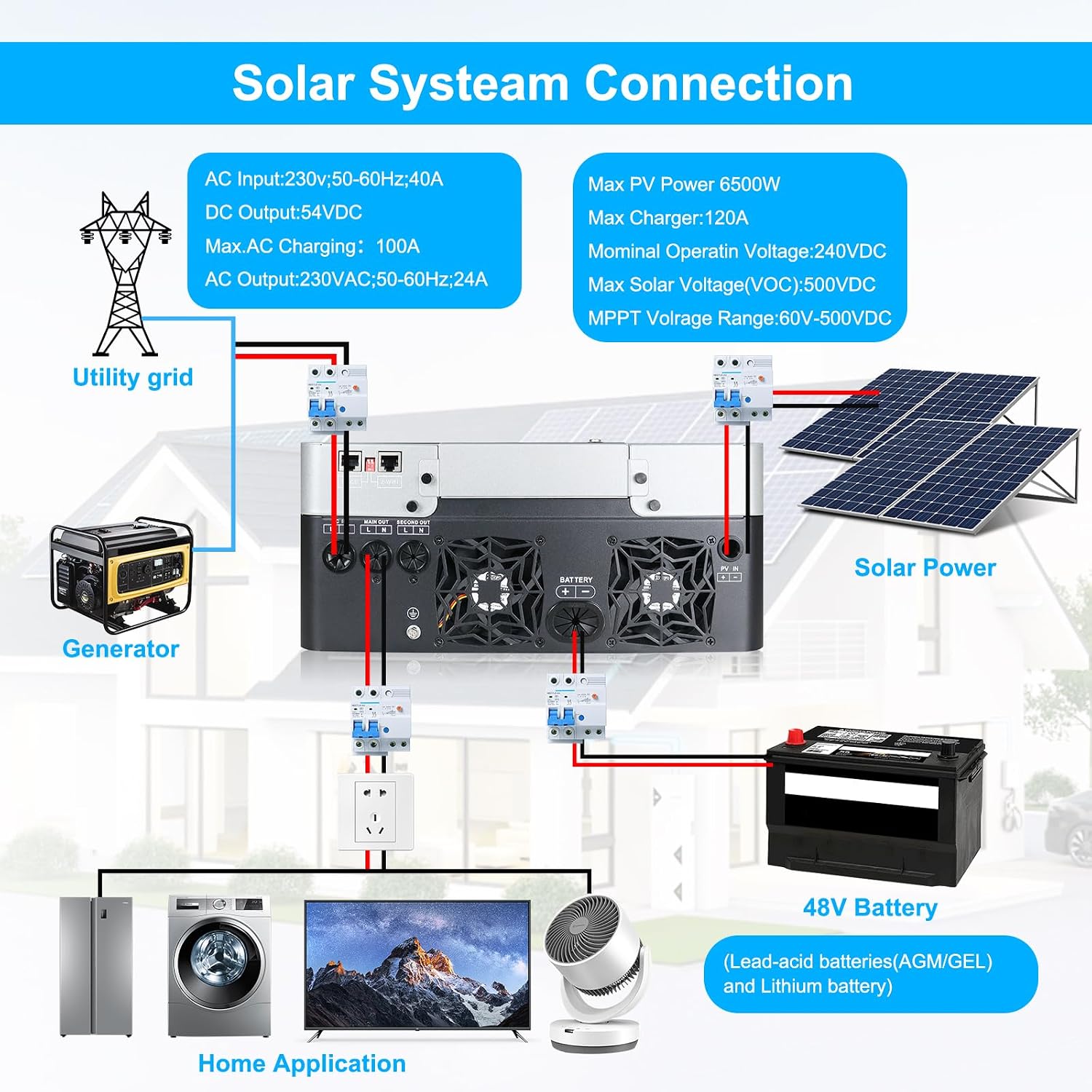
Figure 4.1: Comprehensive wiring diagram illustrating connections for the utility grid, generator, solar power, 48V battery, and home applications to the hybrid inverter.

Figure 4.2: The inverter is compatible with multiple 48V battery types, including AGM, GEL, FLD, and Lithium batteries. The image also highlights the cooling fans for efficient heat dissipation.
5. Operating Modes
The BENNTOP 6200W 48V Hybrid Solar Inverter offers flexible operating modes to suit various energy management needs.
5.1 Charging Modes
You can configure the inverter to prioritize different power sources for battery charging:
- Solar Priority: Solar power is the primary source for charging. Utility power is used only if solar power is insufficient.
- Utility Priority: Utility power is the primary source for charging. Solar power is used only if utility power is unavailable.
- Solar-Utility Hybrid: Both solar and utility power are used for charging, optimizing efficiency.
- Utility or Solar Exclusive: Allows selection of either utility or solar as the sole charging source.
5.2 Load Output Modes
The inverter provides three configurable modes for supplying power to your loads:
- SUB (Solar-Battery-Utility): Prioritizes solar power, then battery power, and finally utility power for the load.
- USB (Utility-Battery-Solar): Prioritizes utility power, then battery power, and finally solar power for the load.
- SBU (Solar-Battery-Emergency): Prioritizes solar power, then battery power. Utility power is used only as a last resort or for emergency backup.

Figure 5.1: Visual representation of the four charging modes (Only Solar Charging, Utility Priority, PV Priority, Solar+Utility Charging) and three load output modes (Solar Priority, Utility Priority, SBU Priority).
6. LCD Display and Settings
The inverter features a detachable HD LCD screen that provides real-time operational data and allows for parameter configuration.
6.1 Display Information
The LCD displays critical information such as:
- Input/Output Voltage and Frequency
- Battery Voltage and Charge/Discharge Current
- Solar PV Input Voltage and Power
- Load Percentage and Power Consumption
- Operating Mode Status
- Fault Codes and Warnings
6.2 Parameter Settings
Use the buttons on the LCD panel to navigate menus and adjust settings, including:
- Battery type and charging parameters (e.g., bulk, float voltage)
- AC output voltage and frequency
- Charging source priority
- Load source priority
- Alarm settings
6.3 Optional WiFi Module
An optional WiFi module (purchased separately) can be connected to the inverter to enable remote monitoring and control via a mobile application. This provides real-time data, alerts, and the ability to adjust settings from your smartphone or tablet.

Figure 6.1: Illustration of the intelligent APP control feature, showing a smartphone connected to the inverter via an optional WiFi module for remote monitoring and management.
7. Maintenance
Regular maintenance ensures the long-term reliability and efficiency of your BENNTOP Hybrid Solar Inverter.
- Cleaning: Periodically clean the inverter's exterior with a dry cloth. Ensure ventilation openings and cooling fans are free from dust and debris.
- Connections: Annually check all electrical connections (solar, battery, AC input/output) for tightness and corrosion. Re-tighten if necessary.
- Environment: Ensure the operating environment remains within specified temperature and humidity ranges. The inverter operates efficiently between -10°C and 50°C.
- Battery Inspection: Follow the battery manufacturer's maintenance guidelines for your specific battery type.

Figure 7.1: The inverter is designed for efficient operation across a wide temperature range, from -10°C to 50°C, maximizing solar energy utilization.
8. Troubleshooting
This section provides solutions to common issues. For complex problems, contact technical support.
| Problem | Possible Cause | Solution |
|---|---|---|
| Inverter not turning on | No battery connection; Battery voltage too low; Power switch off. | Check battery connections; Charge battery; Turn on power switch. |
| No AC output | Overload; Short circuit; Inverter fault; Output breaker tripped. | Reduce load; Check for short circuits; Restart inverter; Reset breaker. |
| Low solar charging | Shaded panels; Dirty panels; Incorrect PV wiring; MPPT fault. | Clear shading; Clean panels; Verify PV connections; Check MPPT settings. |
| Error code on LCD | Specific fault detected. | Refer to the inverter's detailed error code list in the full manual or contact support. |
9. Specifications
Technical specifications for the BENNTOP 6200W 48V Hybrid Solar Inverter.
| Parameter | Value |
|---|---|
| Brand | BENNTOP |
| Model Number | 6200W48V |
| Power (Rated) | 6200 Watts |
| Peak Output Power | 6500 Watts |
| System Voltage | 48 Volts |
| Input Voltage (DC) | 48 Volts |
| Output Voltage (AC) | 230 Volts (AC) |
| Electrical Output Waveform | Pure Sine Wave |
| Max. PV Array Open Circuit Voltage | 500V DC |
| MPPT Voltage Range | 60V-500V DC |
| Max. Solar Charge Current | 120A |
| Max. AC Charging Current | 100A |
| Efficiency | A+ |
| Item Weight | 10 Kilograms |
| Recommended Uses | Office, Home, Vehicle |
| Energy Specifications Met | CE |
| Country of Origin | China |
10. Warranty and Support
10.1 Warranty Information
The BENNTOP 6200W 48V Hybrid Solar Inverter comes with a manufacturer's warranty. Please refer to the warranty card included with your product or contact BENNTOP customer service for specific details regarding warranty duration and terms.
10.2 Technical Support
For technical assistance, troubleshooting beyond this manual, or inquiries about parts and service, please contact BENNTOP customer support. Contact information can typically be found on the product packaging, the BENNTOP website, or through your point of purchase.
When contacting support, please have your product model number (6200W48V) and purchase date readily available.