
1. Introduction
This manual provides essential information for the safe and effective use of the Generic TDT-8930 ET-2320 4S 30A Lithium Iron Phosphate (LiFePO4) Battery Management System (BMS). The BMS is designed to protect 4-series LiFePO4 battery packs, ensuring their longevity and safe operation by managing charging, discharging, and balancing processes. Please read this manual thoroughly before installation and operation.
2. Safety Information
- Electrical Safety: Always disconnect power before making or breaking connections. Work in a dry environment.
- Battery Handling: LiFePO4 batteries can store significant energy. Incorrect wiring can lead to short circuits, fire, or explosion.
- Polarity: Observe correct polarity for all connections. Reversing polarity can damage the BMS and batteries.
- Tools: Use insulated tools to prevent accidental short circuits.
- Ventilation: Ensure adequate ventilation when working with batteries.
- Professional Installation: If you are unsure about any step, seek assistance from a qualified professional.
3. Product Overview
The TDT-8930 ET-2320 is a 4-series (4S) Battery Management System specifically designed for LiFePO4 battery packs. It provides essential protection functions to maintain battery health and safety.
Key Features:
- 4-Series Configuration: Suitable for 4 LiFePO4 cells connected in series (nominal 12.8V).
- 30A Continuous Discharge Current: Supports applications requiring up to 30 Amperes of continuous current.
- Balance Function: Helps equalize the voltage of individual cells within the pack, improving overall battery life and performance.
- Protection Functions: Includes overcharge protection, over-discharge protection, overcurrent protection, and short circuit protection.
Components:
- 1 x TDT-8930 ET-2320 4S 30A LiFePO4 BMS Module
- 1 x Connecting Wire (Balance Lead)
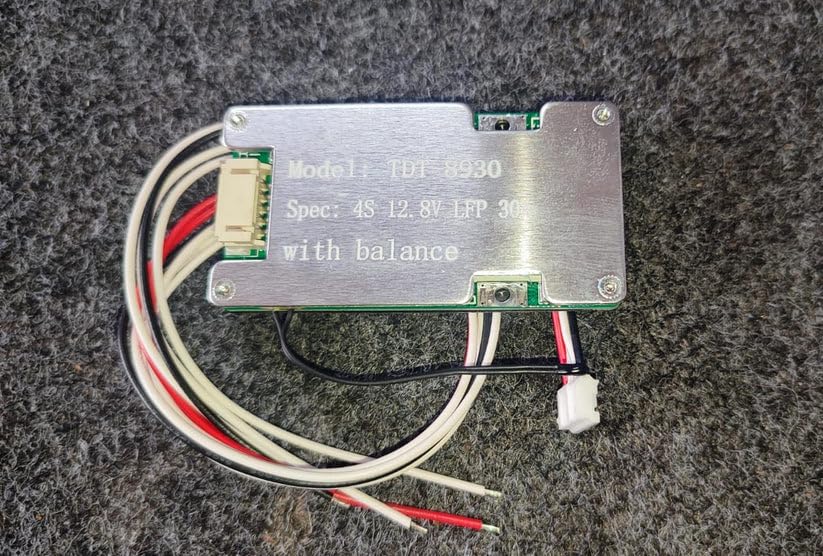
Image: Generic TDT-8930 ET-2320 4S 30A LiFePO4 BMS module. This image shows the compact circuit board with various connection points and the included balance lead for cell voltage monitoring.
4. Setup and Wiring
Careful wiring is crucial for the correct operation and safety of the BMS and battery pack. Follow these steps precisely.
Wiring Diagram (Conceptual):
The BMS typically has the following connection points:
- B-: Negative terminal of the entire battery pack.
- B1, B2, B3: Individual cell positive terminals (balance points).
- B+: Positive terminal of the entire battery pack (often connected directly to the last cell's positive).
- P-: Negative terminal for both charge and discharge (load/charger negative).
- P+: Positive terminal for both charge and discharge (load/charger positive), connected directly to B+.
Connection Steps:
- Prepare Cells: Ensure all 4 LiFePO4 cells are at approximately the same voltage before connecting them to the BMS.
- Connect Balance Wires: Connect the thin balance wires from the BMS to the positive terminals of each cell in sequence. Start from the lowest voltage point (B-) and connect B1 to Cell 1 positive, B2 to Cell 2 positive, B3 to Cell 3 positive, and the highest balance wire to Cell 4 positive (which is also B+). Ensure the balance lead is securely plugged into the BMS.
- Connect B-: Connect the main negative terminal of the battery pack (Cell 1 negative) to the B- pad on the BMS.
- Connect B+: Connect the main positive terminal of the battery pack (Cell 4 positive) to the B+ pad on the BMS. (Note: On some BMS designs, B+ is a direct connection and not routed through the BMS board itself, but rather the balance lead's highest voltage wire serves this purpose for monitoring).
- Connect P-: Connect the negative terminal of your load/charger to the P- pad on the BMS.
- Connect P+: Connect the positive terminal of your load/charger directly to the B+ terminal of the battery pack.
Important: Always connect the balance wires first, then the main B- wire. Disconnect in reverse order (main B- first, then balance wires).
5. Operating the BMS
Once correctly wired, the BMS operates automatically to protect the battery pack.
- Charging: Connect a compatible 4S LiFePO4 charger (typically 14.4V - 14.6V) to the P+ and P- terminals. The BMS will monitor cell voltages and terminate charging if any cell exceeds its overcharge voltage threshold.
- Discharging: Connect your load to the P+ and P- terminals. The BMS will monitor cell voltages and terminate discharge if any cell falls below its over-discharge voltage threshold. It will also protect against excessive current draw (overcurrent) and short circuits.
- Balancing: The passive balance function works to equalize cell voltages, typically during the charging cycle when cells reach a certain voltage. This helps prevent individual cells from becoming overcharged or undercharged relative to others.
6. Maintenance
The TDT-8930 ET-2320 BMS requires minimal maintenance, but periodic checks are recommended.
- Visual Inspection: Periodically inspect all wiring and connections for signs of wear, corrosion, or loose contacts.
- Cleanliness: Keep the BMS module clean and free from dust, dirt, and moisture. Use a dry, soft cloth for cleaning.
- Environmental Conditions: Ensure the BMS operates within its specified temperature range and avoid exposure to extreme humidity or corrosive environments.
- Battery Health: Monitor the overall health of your battery pack. A well-functioning BMS helps, but the underlying battery cells also require proper care.
7. Troubleshooting
If you encounter issues, consider the following common troubleshooting steps:
- No Output/Input:
- Check all wiring connections for looseness or incorrect polarity.
- Verify that individual cell voltages are within the normal operating range (not over-discharged or overcharged). The BMS may have activated a protection mode.
- Check for short circuits on the output (P-).
- Balancing Issues:
- Ensure balance wires are correctly connected and making good contact.
- Note that passive balancing is slow and works best when cells are near full charge. Significant cell imbalance may require external balancing or individual cell charging.
- Overcurrent Protection Tripping:
- Reduce the load current to below 30A.
- Ensure the load is not experiencing a momentary surge that exceeds the BMS's limit.
If problems persist after troubleshooting, contact the seller or manufacturer for further assistance.
8. Specifications
| Feature | Specification |
|---|---|
| Model Number | TDT-8930, ET-2320 |
| Battery Type | Lithium Iron Phosphate (LiFePO4) |
| Series Configuration | 4S (4 Series) |
| Nominal Voltage | 12.8V (for 4S LiFePO4) |
| Continuous Discharge Current | 30A |
| Balance Function | Yes |
| Protection Functions | Overcharge, Over-discharge, Overcurrent, Short Circuit |
| Item Weight | 150 Grams |
| Manufacturer | iBAT Solutions |
| Country of Origin | India |
9. Warranty and Support
For warranty information and technical support, please refer to the specific terms provided by your retailer or contact the manufacturer directly.
- Manufacturer: iBAT Solutions
- Contact: Refer to your purchase documentation or the seller's contact information for support.


