Introduction
This manual provides detailed instructions for the proper use and maintenance of your Generic M519 OBD2 Scanner. This diagnostic tool is designed to help you monitor your vehicle's health, read and clear engine fault codes, and access real-time data streams. Please read this manual thoroughly before operating the device to ensure safe and effective use.
What's in the Box
- OBD2 Scanner (M519 Unit)
- Connection Cable (OBDII to Device)
Setup
- Locate the OBDII Port: The OBDII (On-Board Diagnostics II) port is typically located under the dashboard on the driver's side of your vehicle. Refer to your vehicle's owner's manual if you cannot find it.
- Connect the Scanner: With the vehicle's ignition off, firmly plug the connection cable into the OBDII port of your vehicle and then connect the other end to the M519 scanner.
- Power On: Turn the vehicle's ignition to the "ON" position (do not start the engine). The scanner will automatically power on and initiate communication with the vehicle's onboard computer.
- Initial Scan: The scanner will perform an initial system check. Follow any on-screen prompts.
Operating Instructions
Navigating the Menu
The M519 scanner features a user-friendly interface with clear navigation buttons. Use the directional arrows (Up, Down, Left, Right) to move through menu options and the "OK" button to confirm selections. "EXIT" typically returns to the previous screen.

Image: The M519 scanner's main interface displaying 12 key diagnostic functions, including engine fault diagnosis, data stream, battery voltage, and I/M readiness.
Key Diagnostic Functions
- Read/Clear Engine Fault Codes: Access the "Engine Fault Diagnosis" or "Read Codes" option to retrieve Diagnostic Trouble Codes (DTCs) stored in the vehicle's ECU. Select "Erase Codes" to clear them after repairs. The scanner has a built-in library of over 40,000 fault codes.
- Live Data Stream: View real-time operational parameters from the vehicle's sensors, such as engine RPM, vehicle speed, oxygen sensor readings, and coolant temperature. This helps in diagnosing intermittent issues.
- I/M Readiness Status: Check the status of emission-related monitors to determine if the vehicle is ready for an emissions test.
- Battery Test: Monitor the vehicle's battery voltage to assess its health.
- Freeze Frame Data: Capture a snapshot of vehicle operating conditions at the moment an emission-related fault occurred.
- Oxygen Sensor Test: Retrieve O2 sensor monitoring test results for the most recently completed tests.
- Mode 6 & Mode 8 Diagnostics: Supports advanced diagnostic modes for non-continuously monitored systems and on-board component tests.
- Vehicle Information (VIN): Retrieve the Vehicle Identification Number, Calibration ID, and Calibration Verification Number.

Image: The M519 scanner showing a P0302 trouble code, indicating a misfire. The image also illustrates how the fault light on the dashboard turns off after clearing the code.
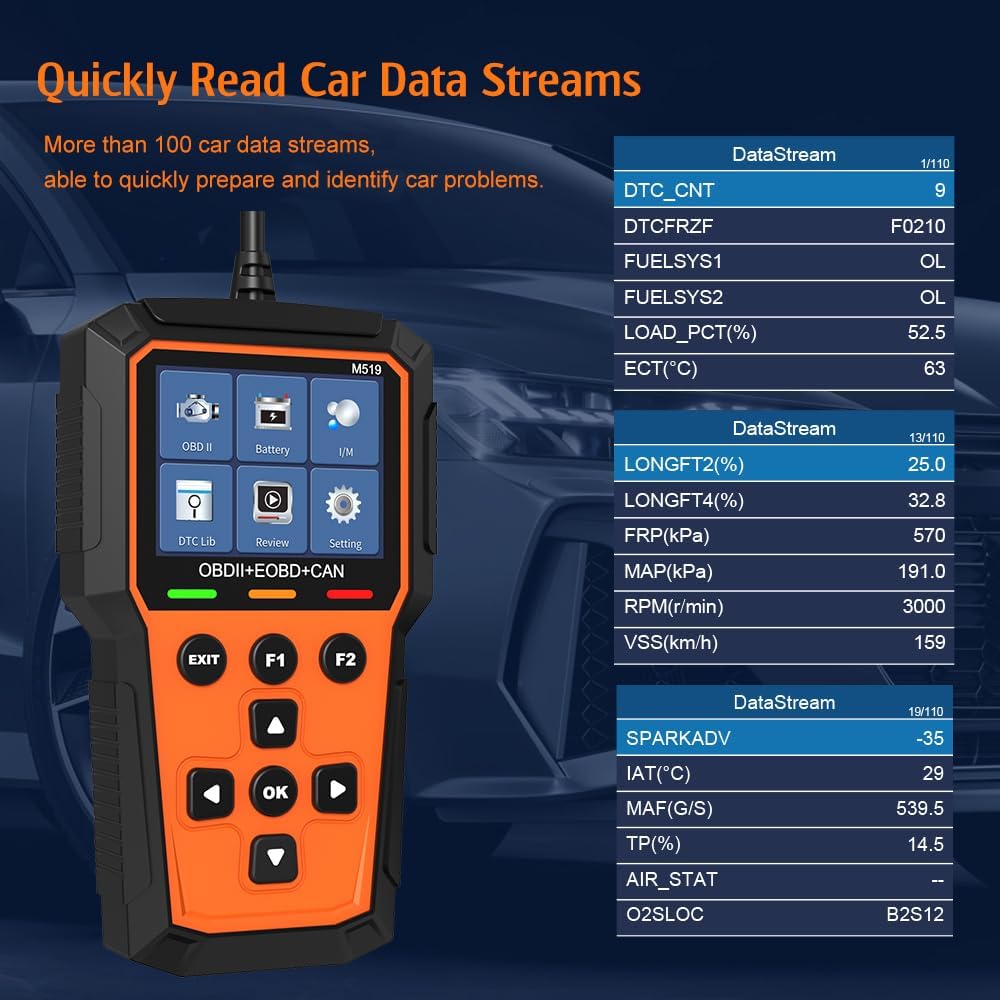
Image: The M519 scanner displaying a live data stream, showing various parameters like DTC count, fuel system status, engine load percentage, engine RPM, and vehicle speed.
Advanced Capabilities
The M519 is built with a high-performance MCU chip, ensuring fast and reliable data processing. This allows for quick diagnostics and efficient operation.

Image: An illustration highlighting the powerful MCU chip technology within the M519 scanner, emphasizing its high frequency, high capacity, and multi-interface capabilities for enhanced performance.
Maintenance
- Cleaning: Use a soft, dry cloth to clean the scanner's screen and body. Do not use abrasive cleaners or solvents.
- Storage: Store the device in a dry, cool place, away from direct sunlight and extreme temperatures.
- Cable Care: Ensure the connection cable is not bent sharply or crimped, as this can damage the internal wiring.
- Software Updates: Periodically check the manufacturer's website for available software updates to ensure optimal performance and compatibility with newer vehicles. The scanner supports upgrades.
Troubleshooting
- Scanner does not power on:
- Ensure the OBDII cable is securely connected to both the vehicle's port and the scanner.
- Verify the vehicle's ignition is in the "ON" position.
- Check the vehicle's fuse for the OBDII port (usually labeled "Cigar" or "Accessory").
- Communication error with vehicle:
- Confirm the vehicle is OBDII compliant (most US vehicles 1996 and newer).
- Ensure the ignition is "ON" and the engine is off.
- Try connecting to a different OBDII compliant vehicle to rule out scanner malfunction.
- Check for any loose connections in the cable.
- Cannot clear fault codes:
- Fault codes can only be cleared if the underlying issue has been resolved. If the problem persists, the code will reappear.
- Ensure the ignition is "ON" and the engine is off when attempting to clear codes.
Specifications
| Feature | Detail |
|---|---|
| Model | M519 |
| Brand | Generic |
| Compatibility | Most 1996+ US vehicles, OBDII, EOBD, CAN protocols (approx. 97% market coverage) |
| Supported Functions | Read/Clear DTCs, Live Data Stream, I/M Readiness, Battery Test, Freeze Frame, O2 Sensor Test, Mode 6/8, VIN Info |
| DTC Library | 40,000+ fault codes built-in |
| Processor | High-performance MCU chip |
| Display | 3.5 Inches |
| Operating System | Windows (internal system, not for user interaction) |
| Language | English |
| Power Source | Vehicle OBDII port (Battery Powered for internal operation) |
| Product Dimensions | 8"L x 4.5"W x 1.5"H (20.32cm L x 11.43cm W x 3.81cm H) |
| Item Weight | 12.3 ounces (approx. 348 grams) |

Image: The M519 OBD2 Scanner with its physical dimensions clearly marked: Width 9.1 cm (3.58 inches), Height 15 cm (5.58 inches), and Depth 2.5 cm (0.98 inches).
Warranty and Support
For warranty information, technical support, or service inquiries, please refer to the contact information provided with your purchase or visit the manufacturer's official website. Keep your purchase receipt as proof of purchase.


