Introduction
Thank you for choosing the Generic FWC556C Atomic Weather Clock. This device provides accurate time synchronized with the WWVB radio signal, displays indoor and outdoor temperatures, and offers a 12-hour weather forecast. Please read this manual thoroughly to ensure proper setup and operation of your new weather clock.
Product Features
- Atomic Time Synchronization: Automatically receives WWVB radio signals for precise time and date, including automatic Daylight Saving Time (DST) adjustments.
- Large LCD Display: Features a 14.6-inch display with 4.05-inch tall time digits for easy readability.
- Indoor and Outdoor Temperature: Monitors temperatures in both Celsius and Fahrenheit using a built-in sensor and a wireless outdoor sensor.
- 12-Hour Weather Forecast: Provides an accurate forecast based on barometric pressure trends, including frost alerts.
- Alarm Clock Function: Includes an alarm with a selectable 1 to 30-minute snooze feature.
- Multiple Time Zones: Selectable PST, MST, CST, EST time zones.
- Calendar Display: Shows day, month, and week.
- Battery Operated: Main unit and wireless sensor are battery-powered for flexible placement.
- Wireless Sensor Range: Outdoor sensor transmits data up to 200 feet (60 meters) with an IPX4 splash-proof rating.

Image: Overview of the multifunctional atomic weather clock display, highlighting atomic time, weather forecast, temperature, battery power, alarm, time zones, calendar, and DST.

Image: Visual representation of the clock's various functions including atomic time, alarm, calendar, weather forecast, indoor/outdoor temperature, Celsius/Fahrenheit, battery power, 12/24H format, and 4 time zones.
Package Contents
- 1 x Atomic Weather Clock (Main Unit)
- 1 x Wireless Outdoor Sensor
- 1 x User Manual (This document)
Note: Batteries are not included. The main unit requires 4 AA batteries, and the wireless sensor requires 2 AAA batteries.
Setup
1. Battery Installation
- Main Unit: Open the battery compartment on the back of the atomic weather clock. Insert 4 new AA batteries, observing the correct polarity (+/-). Close the compartment.
- Wireless Outdoor Sensor: Open the battery compartment on the back of the wireless sensor. Insert 2 new AAA batteries, observing the correct polarity (+/-). Close the compartment.
The clock will power on and begin searching for the WWVB atomic time signal and the outdoor sensor signal.

Image: Diagram showing the battery compartments for the main clock unit (4xAA batteries) and the wireless outdoor sensor (2xAAA batteries).
2. Initial Synchronization and Time Zone Setting
- After battery installation, the clock will automatically attempt to receive the WWVB atomic time signal. This process may take several minutes to several hours, depending on your location and atmospheric conditions.
- During the initial setup, place the main unit near a window or in an open area for better signal reception.
- Once the atomic time signal is received, the clock will display the correct time and date.
- To set your time zone (PST, MST, CST, EST), refer to the operating instructions section for specific button presses.

Image: Illustration showing the atomic clock receiving WWVB radio signals from Colorado, ensuring accurate time, and demonstrating automatic Daylight Saving Time adjustments (Spring Forward and Fall Back).
3. Wireless Outdoor Sensor Placement
- Place the outdoor sensor and the main clock unit together for approximately 15 minutes to establish a strong initial connection.
- After pairing, place the outdoor sensor in a shaded outdoor area, away from direct sunlight and rain. This ensures accurate temperature readings and protects the sensor from harsh weather.
- Ensure the sensor is within the 200-foot (60-meter) transmission range of the main unit. Obstacles like thick walls or metal structures can reduce the effective range.
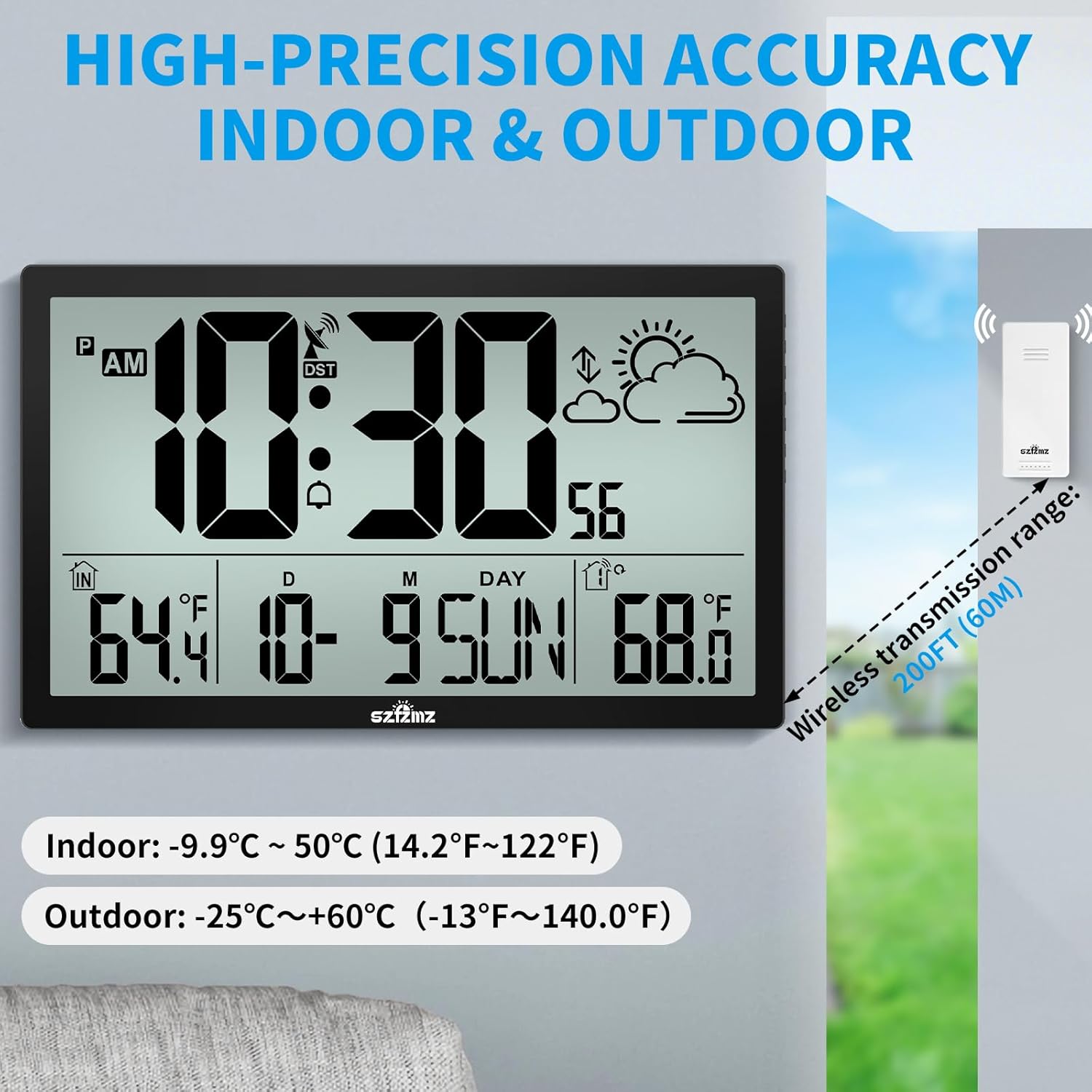
Image: The main clock display showing indoor and outdoor temperatures, with an arrow indicating the wireless transmission range of 200 feet (60 meters) from the outdoor sensor.

Image: Instructions for placing the outdoor sensor and wall clock together for 15 minutes to establish connection, then placing the sensor in a shaded outdoor area.
4. Installation Methods
- Desktop Placement: Use the integrated bracket on the back of the clock to stand it upright on any flat surface.
- Wall Mounting: Utilize the three hanging holes on the back of the clock to securely mount it on a wall using appropriate screws (not included).

Image: Depicts the two installation methods for the clock: standing on a desk using its built-in stand and mounted on a wall.
Operating Instructions
1. Time and Date Display
- The large digits display the current time.
- The date (month/day) and day of the week are shown below the time.
- 12/24 Hour Format: Press the '12/24H' button (location may vary, typically on the back or side) to switch between 12-hour (with AM/PM indicator) and 24-hour (military time) formats.

Image: Demonstrates the ability to switch between standard 12-hour (AM/PM) and 24-hour (military) time formats on the clock display.
2. Temperature Display
- The display shows both indoor ('IN') and outdoor ('OUT') temperatures.
- Celsius/Fahrenheit: Press the '°C/°F' button (location may vary) to toggle between Celsius and Fahrenheit temperature units.
3. Weather Forecast
- The weather forecast icon (e.g., sunny, cloudy, rainy, snowy) indicates the predicted weather for the next 8 hours.
- An ice alert symbol will appear and flash if the outdoor temperature is between 1.0°C to +2.9°C (30.2°F to 37.3°F).

Image: The clock display showing the weather forecast icon, indicating the predicted weather for the next 8 hours, along with various weather condition icons (sunny, slightly cloudy, cloudy, rainy, heavy rainy, snowy).
4. Alarm Clock and Snooze
- Setting the Alarm: Refer to the specific buttons on your device (usually 'ALARM' or 'SET') to enter alarm setting mode. Adjust the hour and minute using the '+' and '-' buttons.
- Activating/Deactivating Alarm: Press the 'ALARM' button to turn the alarm on or off. An alarm icon will appear on the display when active.
- Snooze Function: When the alarm sounds, press the 'SNOOZE' button (often a large button on top) to temporarily silence it. The alarm will sound again after the set snooze duration (1-30 minutes, configurable).
- The alarm sound gradually increases in volume.

Image: A person sleeping while the atomic clock displays an alarm icon and sound waves indicating the alarm is getting louder, highlighting the alarm and snooze features.
5. Daylight Saving Time (DST)
- The clock automatically adjusts for DST based on the WWVB signal.
- You can manually enable or disable the DST function if needed, typically by pressing a dedicated 'DST' button or through the settings menu. Ensure your time zone is correctly set for proper DST operation.

Image: Illustrates the automatic DST update feature with 'Spring Forward' (+1h) and 'Fall Back' (-1h) clock diagrams, emphasizing the ON/OFF option for DST.
Maintenance
- Cleaning: Wipe the clock and sensor with a soft, dry cloth. Do not use abrasive cleaners or solvents.
- Battery Replacement: Replace batteries in both the main unit and the outdoor sensor when the low battery indicator appears on the display. Always replace all batteries at the same time with new ones.
- Sensor Care: Ensure the outdoor sensor remains in a shaded, protected location to prolong its lifespan and maintain accuracy.

Image: Highlights the battery-powered nature of the clock and sensor, indicating extra-long battery use (12 months) and the presence of a low battery indicator on the display.
Troubleshooting
| Problem | Possible Cause | Solution |
|---|---|---|
| Clock not receiving atomic time signal (WWVB icon not solid) | Weak signal due to location, interference, or atmospheric conditions. | Move the clock closer to a window or to a different location. Ensure it is away from electronic devices that may cause interference. Allow up to 24 hours for synchronization. |
| Outdoor temperature not displayed or incorrect | Sensor out of range, low sensor batteries, interference, or sensor exposed to direct sunlight/rain. | Ensure sensor is within 200ft of the main unit. Replace sensor batteries. Relocate sensor to a shaded, protected area. Re-pair the sensor by removing batteries from both units, then reinserting them into the sensor first, then the main unit. |
| Incorrect time or date | Atomic signal not received, incorrect time zone set, or DST setting incorrect. | Verify atomic signal reception. Check and adjust the time zone setting. Ensure DST is set correctly (ON/OFF) for your region. |
| Display is dim or blank | Low main unit batteries. | Replace all 4 AA batteries in the main unit with new ones. |
Specifications
- Model: FWC556C
- Display Type: Digital LCD
- Product Dimensions: 14.6" W x 8.9" H
- Main Unit Power: 4 x AA batteries (not included)
- Outdoor Sensor Power: 2 x AAA batteries (not included)
- Indoor Temperature Range: -9.9°C ~ 50°C (14.2°F ~ 122°F)
- Outdoor Temperature Range: -25°C ~ +60°C (-13°F ~ 140.0°F)
- Wireless Transmission Range: Up to 200 feet (60 meters) in open air
- Outdoor Sensor Water Resistance: IPX4 (splash-proof)
- Material: Plastic
- Mounting Options: Wall mount or desktop stand

Image: The atomic clock display with key dimensions highlighted, showing its overall width of 14.6 inches and height of 8.9 inches, and the height of the time digits at 4.05 inches.
Warranty and Support
Specific warranty information for the Generic FWC556C Atomic Weather Clock is not provided in this manual. For warranty details, technical support, or any questions regarding your product, please contact the seller or manufacturer directly through your purchase platform.