
1. Introduction
This manual provides detailed instructions for the installation, configuration, and operation of the D-Link Guardian 700 Pro Multi-Gig Business Router (DBR-700). The DBR-700 is designed to provide enterprise-level networking capabilities for small and medium businesses, offering high-speed connectivity, robust security features, and simplified management.
Key features include a 2.5GbE WAN port, six 2.5GbE LAN ports, a 2.5GbE SFP uplink for flexible fiber connections, Multi-WAN failover, SPI Firewall, VPN support (IPSec, WireGuard, OpenVPN), and centralized management for up to 15 D-Link Guardian Wi-Fi 6 Smart Access Points (DBR-X3000-AP, sold separately).

Image: The D-Link Guardian 700 Pro Multi-Gig Router (DBR-700) designed for small and medium business environments.
2. Package Contents
Verify that your package contains the following items:
- D-Link Guardian 700 Pro Multi-Gig Business Router (DBR-700)
- Power Adapter
- Quick Installation Guide (QIG)
If any items are missing or damaged, please contact your local D-Link reseller.
3. Hardware Overview
3.1. Front Panel
The front panel of the DBR-700 features status indicators and network ports.

Image: Front view of the DBR-700 router, showing LED indicators, Console port, LAN ports, WAN port, and LAN/WAN SFP port.
- SYS LED: Indicates system status.
- SFP LED: Indicates status of the SFP port.
- Reset Button: Used to reset the device or restore factory defaults.
- Console Port: For command-line interface access.
- LAN Ports (1-6): Six 2.5GbE LAN ports for connecting local network devices.
- LAN/WAN Port: A 2.5GbE port configurable as either a LAN or WAN interface.
- WAN Port: A dedicated 2.5GbE WAN port for internet connectivity.
- LAN/WAN SFP Port: A 2.5GbE/1GbE SFP port for fiber or copper connections, configurable as LAN or WAN.
3.2. Rear Panel
The rear panel includes the power input and power switch.

Image: Rear view of the DBR-700 router, showing the DC 12V/2A power input and On/Off switch.
- DC 12V/2A: Power input connector.
- On/Off Switch: Power control for the device.
4. Installation
Follow these steps for the initial setup of your DBR-700 router:
- Power Connection: Connect the provided power adapter to the DC 12V/2A port on the rear panel of the router and plug it into a power outlet. Turn on the router using the On/Off switch.
- WAN Connection: Connect your internet service provider's modem or main network line to the WAN port on the router using an Ethernet cable. If using fiber, insert the SFP module (sold separately) into the LAN/WAN SFP port and connect the fiber cable.
- LAN Connection: Connect your local network devices (e.g., computers, switches, access points) to the LAN ports (1-6) or the configurable LAN/WAN port using Ethernet cables.
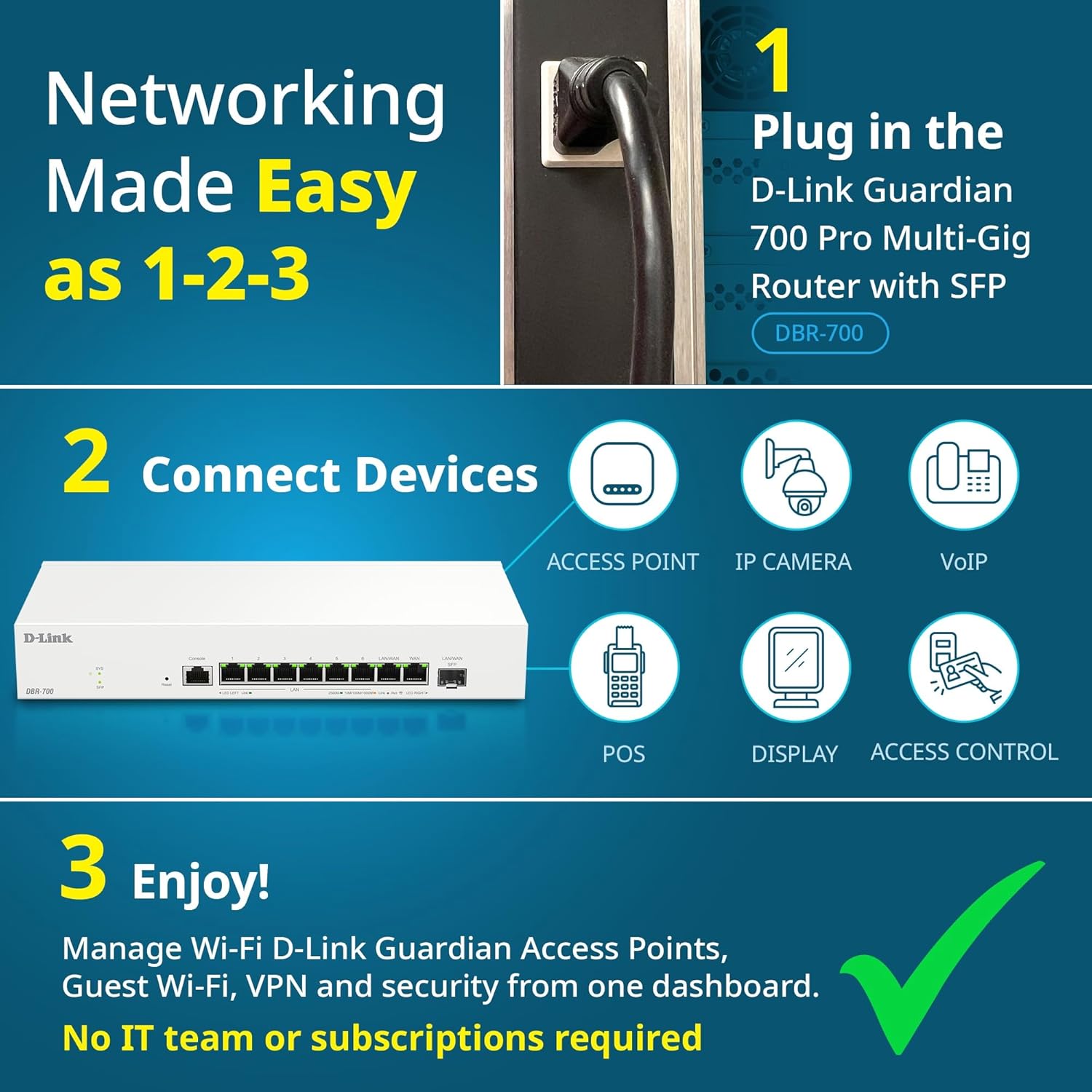
Image: Visual guide for router installation: 1. Plug in the DBR-700 router. 2. Connect devices like access points, IP cameras, VoIP, POS, displays, and access control. 3. Enjoy managed Wi-Fi, Guest Wi-Fi, VPN, and security from one dashboard.
5. Configuration
5.1. Accessing the Web Interface
To configure the DBR-700, access its web-based management interface:
- Ensure your computer is connected to one of the router's LAN ports.
- Open a web browser (e.g., Chrome, Firefox, Edge).
- Enter the router's default IP address (typically
192.168.1.1or similar, refer to the Quick Installation Guide for the exact address) into the address bar and press Enter. - Enter the default username and password when prompted. (Refer to the Quick Installation Guide for default credentials).
5.2. Basic Network Settings
Once logged in, you can configure basic network settings:
- WAN Settings: Configure your internet connection type (e.g., DHCP, Static IP, PPPoE) as provided by your ISP.
- LAN Settings: Adjust the router's internal IP address, subnet mask, and DHCP server settings for your local network.
- Time Settings: Set the correct time zone and synchronize the router's clock.
6. Advanced Features
6.1. Multi-WAN Failover
The DBR-700 supports Multi-WAN with intelligent failover, ensuring business continuity by providing redundant internet connections. If the primary WAN link fails, the router automatically switches to a secondary WAN link.

Image: The DBR-700's ports, illustrating the Primary 2.5GbE WAN, Secondary 2.5GbE LAN/WAN, and SFP Uplink for Multi-WAN failover capabilities.
6.2. VPN Configuration
The router includes built-in VPN support for IPSec, WireGuard, and OpenVPN, enabling secure remote access for employees and branch office connectivity. It supports up to 100 VPN tunnels.
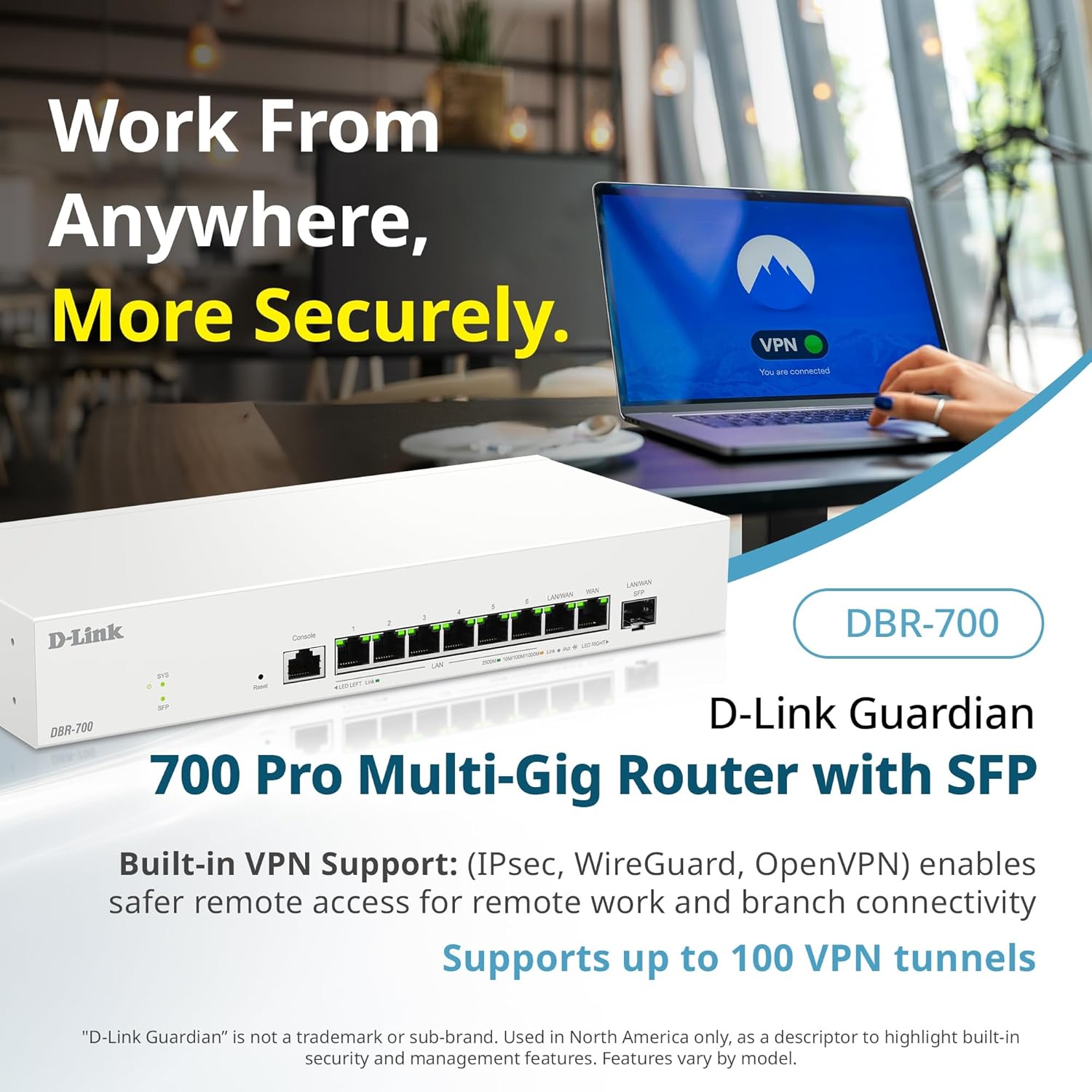
Image: A laptop displaying a 'VPN Connected' status, with the DBR-700 router in the foreground, illustrating secure remote access.
6.3. Centralized Access Point Management
The DBR-700 can discover and manage up to 15 D-Link Guardian Wi-Fi 6 Smart Access Points (DBR-X3000-AP, sold separately) from a single intuitive dashboard. This simplifies Wi-Fi network deployment and management.

Image: A tablet showing the D-Link Wi-Fi management dashboard, demonstrating centralized control over D-Link Guardian Access Points, with the DBR-700 router and a DBR-X3000-AP in the background.
6.4. Guest Wi-Fi Management
Set up and manage guest Wi-Fi networks with a Captive Portal. This allows for branded sign-in pages for guests while keeping business systems separate and secure. Configuration and management are done from the router dashboard.

Image: A smartphone screen showing a customizable guest Wi-Fi login portal, highlighting the DBR-700's ability to manage and customize guest networks.
7. Maintenance
7.1. Firmware Updates
Regularly check for and install firmware updates to ensure optimal performance, security, and access to new features. Firmware updates can typically be found on the D-Link support website for your specific model.
7.2. Factory Reset
If you encounter persistent issues or wish to clear all configurations, you can perform a factory reset. To do this, locate the Reset button on the front panel. With the router powered on, use a paperclip or similar pointed object to press and hold the Reset button for approximately 5-10 seconds until the SYS LED blinks. Release the button, and the router will restart with factory default settings.
8. Troubleshooting
This section addresses common issues you might encounter with your DBR-700 router.
8.1. No Internet Connection
- Check Cables: Ensure all Ethernet cables are securely connected to the correct ports (WAN, LAN).
- Modem Status: Verify that your internet service provider's modem is working correctly and has an active internet connection.
- WAN Configuration: Log into the router's web interface and verify that the WAN settings (e.g., IP address, DNS) are correctly configured according to your ISP's requirements.
- Reboot Devices: Power cycle your modem, then the router, and then your connected devices.
8.2. Cannot Access Web Interface
- IP Address: Ensure your computer is configured to obtain an IP address automatically (DHCP) or has a static IP address within the router's subnet.
- Router IP: Double-check the router's default IP address. It might be printed on a label on the router itself or in the Quick Installation Guide.
- Firewall/Antivirus: Temporarily disable any firewall or antivirus software on your computer that might be blocking access.
- Browser Cache: Clear your web browser's cache and cookies, or try a different browser.
8.3. Slow Network Speeds
- Cable Quality: Ensure you are using high-quality Ethernet cables (Cat5e or Cat6) for multi-gig connections.
- Device Compatibility: Verify that connected devices and network adapters support 2.5GbE speeds.
- ISP Speed: Confirm your internet service plan provides the expected speeds.
- Traffic Management: Check router settings for any Quality of Service (QoS) or bandwidth limits that might be affecting performance.
9. Technical Specifications
| Feature | Specification |
|---|---|
| Brand | D-Link |
| Model Number | DBR-700 |
| WAN Ports | 1x 2.5GbE WAN, 1x 2.5GbE/1GbE SFP (configurable as WAN) |
| LAN Ports | 6x 2.5GbE LAN, 1x 2.5GbE (configurable as LAN) |
| VPN Support | IPSec, WireGuard, OpenVPN (up to 100 tunnels) |
| AP Management | Manages up to 15 D-Link Guardian Wi-Fi 6 Smart Access Points |
| Security Features | SPI Firewall, WPA3 encryption, VLANs |
| Dimensions (LxWxH) | 11.02 x 1.73 x 4.96 inches |
| Item Weight | 2 pounds |
| Voltage | 120 Volts (AC) |
| Color | White |
10. Warranty and Support
For detailed warranty information, technical support, and additional resources, please visit the official D-Link website. You can find product registration, FAQs, firmware downloads, and contact information for customer service.
D-Link Official Website: www.dlink.com
Please have your product model number (DBR-700) and serial number ready when contacting support.


