
Henkion LT-600S Multi-function Network Cable Tester User Manual
Model: LT-600S
1. Introduction
The Henkion LT-600S is a versatile network cable tester designed for comprehensive network diagnostics. It integrates multiple functions including UTP cable testing, cable tracing, optical power measurement (OPM), visual fault locator (VFL), Power over Ethernet (PoE) detection, RJ45 Time Domain Reflectometer (TDR) for cable length measurement, and various network tools. This manual provides detailed instructions for the safe and effective use of your device.
2. Safety Information
- Read all instructions carefully before use.
- Do not attempt to disassemble or modify the device.
- Use only the specified power adapter for charging.
- Avoid exposing the device to extreme temperatures, humidity, or direct sunlight.
- Keep the device away from water and other liquids.
- Handle optical fiber connections with care; avoid direct eye exposure to VFL light.
3. Package Contents
Verify that all items are present in your package:
- Main Tester Unit (Host) x1
- Remote Receiver Unit x1
- Type-C Charging Cable x1
- RJ45 to BNC Connector x1
- Screwdriver x1
- Lanyard x1
- Tool Bag x1
- RJ45 Cable x1
- RJ11 Cable x1
- BNC Alligator Clip x1
- Packing Box x1
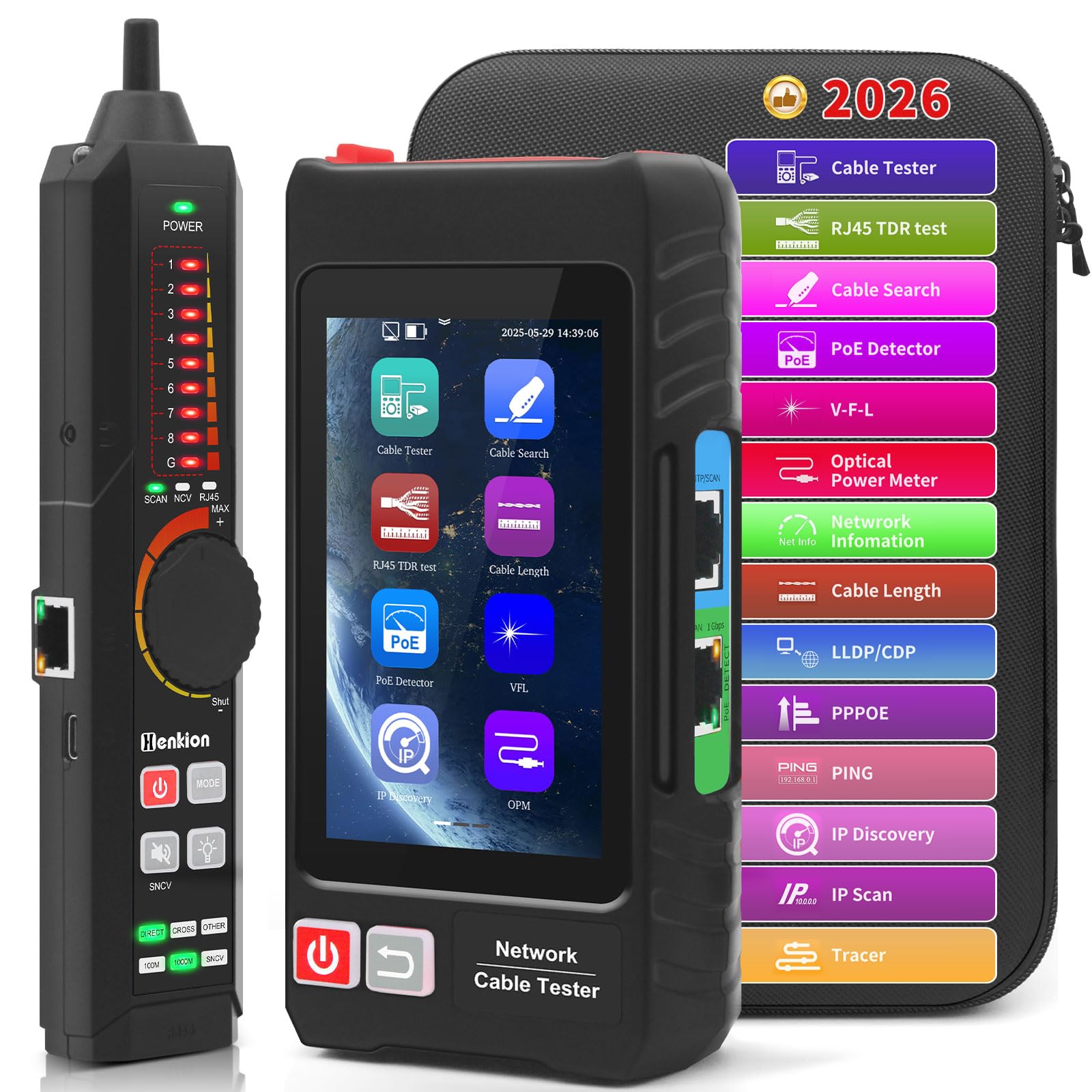
4. Device Overview
The Henkion LT-600S consists of a main tester unit with a 4-inch IPS touch screen and a remote receiver unit. Key components and interfaces are detailed below:

Main Tester Unit:
- 4-inch IPS Touch Screen: Displays test results and navigation menus.
- RJ45 Network Port: For connecting network cables for various tests.
- PD Power Tested Port: For PoE detection.
- Optical Power Meter (OPM) Port: For optical signal power and insertion loss tests.
- Visual Fault Locator (VFL) Port: For identifying fiber optic fault points.
- Type-C Charging Port: For charging the main unit.
- Earphone Port: For audio feedback during cable tracing.
- Navigation Buttons: For menu navigation and selection.
Remote Receiver Unit:
- UTP Cable Test Port: For connecting the other end of the UTP cable during testing.
- UTP Cable Sequence Indicator: LEDs display the cable wire sequence.
- Sensitivity Knob: Adjusts the sensitivity for cable tracing.
- Mode Indicator: Shows the current operating mode (SCAN, NCV, MAX).
- Cable Type Indicator: Displays detected cable type (OPEN, CROSS, OTHER).
- Type-C Charging Port: For charging the remote unit.
5. Setup
5.1 Charging the Device
Both the main tester unit and the remote receiver unit are equipped with rechargeable lithium-ion batteries. Use the provided Type-C cable to charge both units. A full charge ensures extended operation.
5.2 Powering On/Off
Press and hold the power button on each unit to turn it on or off. The main unit's IPS screen will illuminate upon startup.
6. Operating Instructions
6.1 UTP Cable Test
This function tests the connection sequence, type, and remote kit of UTP cables, quickly detecting near-end, mid-end, and far-end fault points of RJ45 cable connectors.
- Connect one end of the RJ45 cable to the RJ45 Network Port on the main unit.
- Connect the other end of the RJ45 cable to the UTP Cable Test Port on the remote receiver unit.
- On the main unit's touch screen, navigate to the "Cable Test" function.
- Initiate the test. The screen will display the connection status, wiremap, and any detected faults.

6.2 Cable Tracer
The digital signal Ethernet cable tracer helps quickly locate target cables (BNC, network, telephone, and other metal cables) from bundles, effectively rejecting noise and false signals.
- Connect the cable to be traced to the main unit.
- Select the "Cable Search" function on the main unit.
- Use the remote receiver unit to scan the cable bundle. The receiver will emit an audible tone, increasing in volume as it approaches the target cable.
- Adjust the sensitivity knob on the remote unit for precise tracking.

Video: Demonstration of cable testing, PoE test, and port flashing using a similar network cable tester (NOYAFA NF-8508).
Video: Overview of a multifunctional network detector (NOYAFA NF-810) showing wiremap, cable scanning, PoE switch detection, and phone line polarity judgment.
6.3 RJ45 TDR Cable Test & Length Measurement
The TDR function allows testing of cable pair status, length, attenuation, reflectivity, impedance, skew, and other parameters. It can measure opens in network cables up to 3000 meters.
- Connect the RJ45 cable to the main unit.
- Select the "RJ45 TDR Test" or "Cable Length" function.
- Start the test. The screen will display detailed parameters and the measured cable length.
- Reports can be created and saved via the FTP function.
6.4 Optical Power Meter (OPM) and Visual Fault Locator (VFL)
The built-in OPM is used for signal power and insertion loss testing of optical equipment. The VFL helps easily and accurately determine the position of optical fiber fault points.
- For OPM: Connect the optical fiber to the OPM port. Select the OPM function to measure optical power.
- For VFL: Connect the optical fiber to the VFL port. Activate the VFL function to emit a red laser light, which helps locate breaks or bends in the fiber.

6.5 PoE Detection
The RJ45 PoE Tester supports IEEE802.3BT/AT/AF and non-standard protocol detection. It displays power supply voltage, power supply pins, and pin polarity.
- Connect the network cable from the PoE source to the PD Power Tested Port.
- Select the "PoE Detect" function.
- The screen will display PoE protocol, voltage, and active pins.

Video: Demonstration of a PoE cable tester in action.
6.6 Network Tools
The device includes a suite of network tools such as IP discovery, IP address scan, PING test, LLDP/CDP detection, Port flashing, and PPPOE dial-up.
- Connect the main unit to the network via the RJ45 Network Port.
- Select the desired network tool from the menu.
- Follow the on-screen prompts to perform the test (e.g., enter an IP address for PING test).
- Port Flashing: This feature helps quickly identify the physical port on a switch or other network device connected to the tester by making its LED flash.

Video: Demonstration of port flashing, PING test, PoE test, cable tracing, and length measurement using a similar network cable tester (NOYAFA NF-8601S).
6.7 PD Power Detection & NCV Detection & FTP
- PD Power Test: Detects if the power output of a PoE switch is normal and identifies the pins used for power supply.
- NCV Scan Function: Non-Contact Voltage detection with sound and light alarms, supporting the distinction between live and neutral wires.
- FTP Function: Enables users to copy test reports and data via network FTP for easy record keeping and analysis.
7. Maintenance
- Clean the device regularly with a soft, dry cloth. Do not use abrasive cleaners or solvents.
- Store the device in its protective tool bag when not in use to prevent damage.
- Ensure the charging ports are free from dust and debris.
- Charge the batteries periodically if the device is stored for a long time to maintain battery health.
8. Troubleshooting
| Problem | Possible Cause | Solution |
|---|---|---|
| Device does not power on. | Low battery or faulty power button. | Charge the device fully. Ensure the power button is pressed correctly. |
| Inaccurate cable test results. | Poor cable connection, damaged cable, or incorrect test mode. | Ensure cables are securely connected. Check cable for physical damage. Verify correct test mode is selected. |
| Cable tracing signal is weak or noisy. | Low sensitivity setting, external interference, or long cable length. | Increase the sensitivity on the remote unit. Move away from strong electromagnetic sources. |
| Screen freezes during firmware update. | Software glitch. | Use a paperclip to press the reset button (if available) or power cycle the device. Avoid interrupting firmware updates. |
9. Specifications
- Model: LT-600S
- Display: 4-inch IPS Touch Screen, 800*480 resolution
- Cable Types Tested: RJ45 UTP, BNC, Telephone, various metal cables
- Cable Test Functions: Wiremap, sequence, type, fault location (near-end, mid-end, far-end)
- TDR Measurement Range: Up to 3000 meters for opens
- PoE Detection: IEEE802.3BT/AT/AF and non-standard protocols (voltage, pins, polarity)
- Optical Power Meter (OPM): Signal power and insertion loss test
- Visual Fault Locator (VFL): Fiber optic fault point determination
- Network Tools: IP discovery, IP address scan, PING, LLDP/CDP, Port flashing, PPPOE dial-up
- Other Functions: NCV detection, FTP data transfer
- Battery: Main Unit: 3.7V 4000mAh Li-ion; Remote Unit: 3.7V 2000mAh Li-ion
- Charging: Type-C
- Item Weight: 620 g
- Dimensions: 24.89 x 18.8 x 4.83 cm (Parcel Dimensions)
- Compliance: UL 61010-1, IEC 61010-2-030, CE Marked, RoHS Compliant
10. Warranty and Support
Henkion products are designed for reliability and performance. For warranty information, technical support, or service inquiries, please refer to the contact information provided with your purchase or visit the official Henkion website. Please retain your proof of purchase for warranty claims.