
Introduction
Thank you for choosing the Upperizon 14-inch 4K OLED Portable Monitor. This manual provides essential information for setting up, operating, and maintaining your new monitor. Please read it thoroughly before use to ensure optimal performance and longevity of the device.
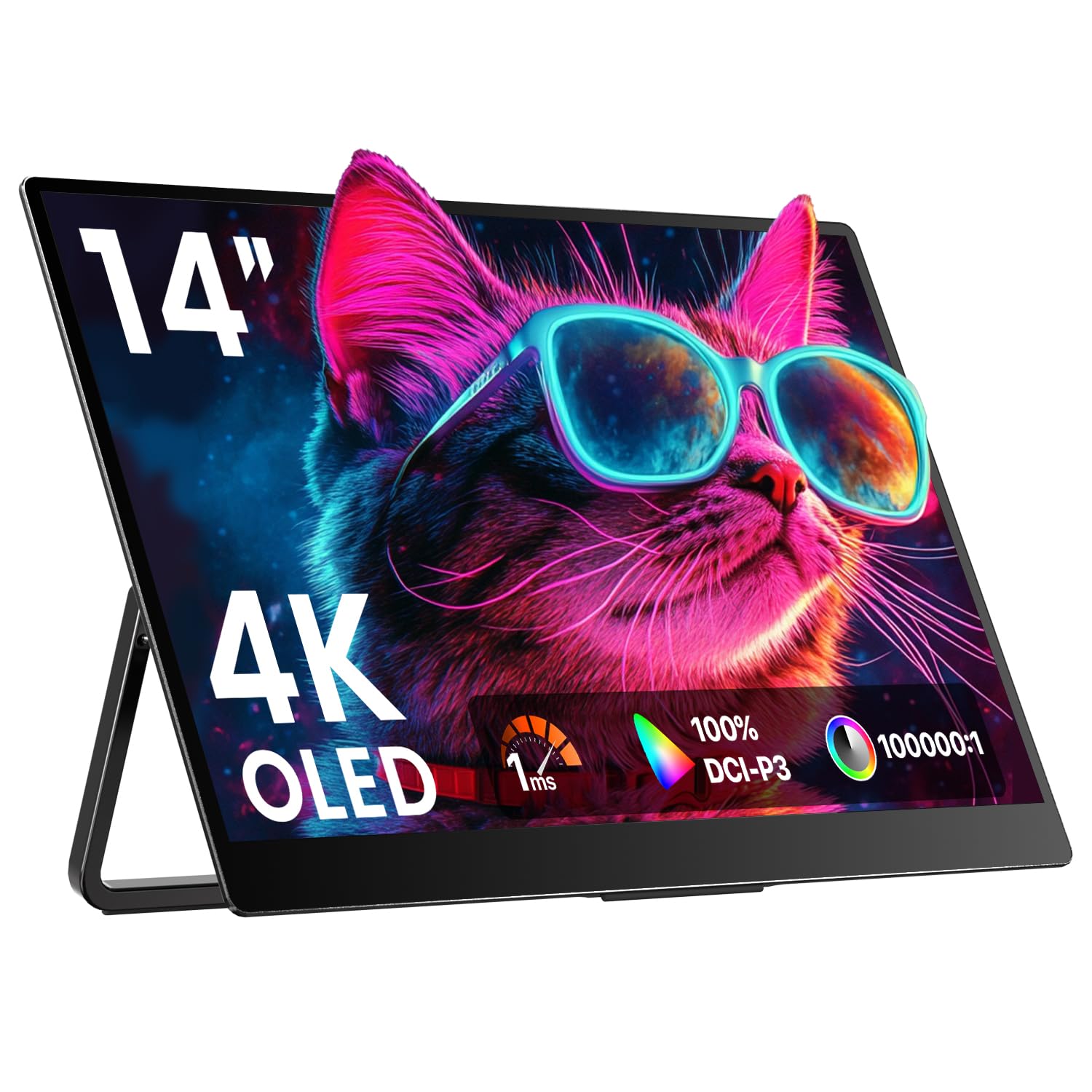
Image: The Upperizon 14-inch 4K OLED Portable Monitor, showcasing its sleek design and integrated kickstand.
What's in the Box
Verify that all items listed below are included in your package. If any items are missing or damaged, please contact customer support.
- 1 × Portable Monitor
- 2 × USB-C to USB-C display cable
- 1 × HDMI cable
- 1 × Power Adapter
- 1 × Sleeve Case

Image: A visual representation of the items included in the product packaging: the 14-inch portable monitor, two USB-C to USB-C cables, one HDMI cable, a power adapter, and a protective sleeve case.
Product Overview
Monitor Features
- OLED Self-Luminous Display: Each pixel emits light independently for deep blacks and vivid colors.
- 4K UHD Resolution (3840x2400): Provides sharp, detailed visuals.
- Pixel-Perfect Color Precision: Factory-calibrated to ΔE < 2, 100% DCI-P3, and 10-bit color depth.
- 1ms Response Time: Reduces motion blur for smooth visuals.
- Built-in Dual Speakers: Delivers integrated audio.
- Ultra-Slim & Lightweight: Designed for portability.
- Integrated Kickstand: Offers adjustable viewing angles from 0° to 180°.
- VESA Mountable: Compatible with 75x75mm VESA mounts (M4*5mm screws).
Ports and Controls
The monitor features various ports and control buttons for connectivity and settings adjustment.

Image: Detailed view of the monitor's side, highlighting two USB-C ports, one HDMI port, and control buttons (Power/Exit, Down/Up, Menu/Confirm).
- USB-C Ports (x2): Full-featured ports for video, audio, and power delivery.
- HDMI Port (x1): For video and audio input from compatible devices.
- Power/Exit Button: Turns the monitor on/off and exits menu options.
- Down/Up Buttons: Navigates menu options and adjusts values (e.g., brightness, volume).
- Menu/Confirm Button: Accesses the On-Screen Display (OSD) menu and confirms selections.
- Audio Jack: For connecting external headphones or speakers.
Setup
Connecting via USB-C (Single Cable Solution)
For devices supporting DisplayPort Alt Mode or Thunderbolt 3/4/5, a single USB-C cable can transmit video, audio, and power.
- Connect one end of the provided USB-C to USB-C cable to a full-featured USB-C port on your device (laptop, MacBook, Surface, etc.).
- Connect the other end of the USB-C cable to either USB-C port on the portable monitor.
- The monitor should automatically detect the signal and display your device's screen.
Important Note: Ensure your device's USB-C port supports DisplayPort Alt Mode or Thunderbolt 3/4/5 for single-cable functionality. If the screen flickers, use the original power adapter provided. Old MacBooks may require a Mini DP to HDMI adapter. Apple M1/M2/M3 chips do not support two external monitors simultaneously.

Image: A laptop connected to the portable monitor using a single USB-C cable, illustrating the plug-and-play setup.
Connecting via HDMI (Two Cable Solution)
For devices with an HDMI output, you will need both an HDMI cable for video/audio and a USB-C cable for power.
- Connect one end of the provided HDMI cable to the HDMI port on your device (PC, PS5, Xbox, etc.).
- Connect the other end of the HDMI cable to the HDMI port on the portable monitor.
- Connect one end of a USB-C to USB-A cable (or USB-C to USB-C if your power source supports it) to one of the USB-C ports on the monitor.
- Connect the other end of the power cable to the provided power adapter, and plug the adapter into a power outlet.
- The monitor should automatically detect the signal.
Important Note: Always use the original power adapter to ensure stable power delivery and prevent screen flickering, especially when using HDMI.

Image: A laptop connected to the portable monitor using an HDMI cable for video and a separate USB-C cable for power, demonstrating the two-cable connection method.
Kickstand and VESA Mounting
The monitor features an integrated kickstand for flexible positioning and is VESA compatible for alternative mounting options.
- Integrated Kickstand: Adjust the kickstand to achieve your desired viewing angle, supporting 0° to 180° rotation.
- VESA Mounting: The monitor has two VESA holes (75x75mm, M4*5mm screws) on the back. This allows for stable mounting on a VESA stand (not included) for both landscape and vertical orientations.
Note: The VESA stand is not included. Portrait mode is not supported when connecting to an iPad or smartphone.

Image: The monitor positioned on a desk, demonstrating the flexibility of its adjustable kickstand for different viewing angles.

Image: A close-up of the VESA mounting holes on the monitor, showing it attached to a VESA-compatible stand for both landscape and portrait orientations.
Operating Instructions
On-Screen Display (OSD) Menu
The OSD menu allows you to adjust various display settings.
- Press the Menu/Confirm button to open the OSD menu.
- Use the Down and Up buttons to navigate through the menu options.
- Press the Menu/Confirm button to select an option or enter a sub-menu.
- Use the Down and Up buttons to adjust values or select sub-options.
- Press the Power/Exit button to go back to the previous menu or exit the OSD.
Quick Adjustments (Brightness & Volume)
You can quickly adjust brightness and volume without entering the full OSD menu.
- Brightness: Press the Up button (without OSD open) to quickly adjust brightness.
- Volume: Press the Down button (without OSD open) to quickly adjust volume.

Image: Illustration of the quick access controls for brightness and volume using the monitor's physical buttons.
HDR Technology
The monitor supports HDR (High Dynamic Range) technology for enhanced contrast and color.
- To enable HDR, navigate to the OSD menu, find the "Other Settings" or "Display" section, and set HDR to "Auto" or "On".
- Ensure HDR is also enabled in your connected device's display settings (e.g., Windows Display Settings, macOS Display Preferences).

Image: A visual guide to enabling HDR through the monitor's OSD menu and the corresponding settings on a connected operating system.
Game Crosshair
For gaming, you can enable a customizable crosshair directly on the monitor.
- Access the OSD menu and locate the "Game" or "Gaming Features" section.
- Toggle the "Crosshair" option to "On" to activate it.

Image: A comparison showing a game scene with the customizable crosshair enabled and disabled, highlighting its function.
Maintenance
Proper maintenance ensures the longevity and optimal performance of your monitor.
- Cleaning the Screen:
- Turn off the monitor and disconnect it from power.
- Gently wipe the screen with a soft, lint-free cloth.
- For stubborn marks, lightly dampen the cloth with water or a screen-specific cleaning solution. Do not spray liquid directly onto the screen.
- Avoid using harsh chemicals, abrasive cleaners, or alcohol-based solutions, as these can damage the OLED panel.
- Cleaning the Casing:
- Wipe the monitor casing with a soft, dry cloth.
- Avoid getting moisture into any openings.
- Storage:
- When not in use, especially during travel, store the monitor in the provided sleeve case to protect it from scratches and impacts.
- Store in a cool, dry place away from direct sunlight and extreme temperatures.
- Handling:
- Avoid placing heavy objects on the monitor.
- Do not apply excessive pressure to the screen.
- Handle the monitor by its edges, not by the screen itself.
Troubleshooting
If you encounter issues with your monitor, refer to the following common problems and solutions.
| Problem | Possible Cause | Solution |
|---|---|---|
| No signal / Black screen |
|
|
| Screen flickering |
|
|
| No sound from speakers |
|
|
| Image is blurry or distorted |
|
|
If the problem persists after trying these solutions, please contact Upperizon customer support.
Specifications
| Feature | Detail |
|---|---|
| Model Number | Y14UHO |
| Screen Size | 14 Inches |
| Panel Type | OLED |
| Resolution | 3840 x 2400 Pixels (4K UHD) |
| Aspect Ratio | 16:10 |
| Contrast Ratio | 100,000:1 |
| Color Gamut | 100% DCI-P3 |
| Color Depth | 10-bit (1.07 billion colors) |
| Brightness | 350 Candela (nits) |
| Response Time | 1ms |
| Refresh Rate | 60Hz |
| Connectivity | 2 x USB-C (Full-featured), 1 x HDMI |
| Audio | Built-in Dual Speakers, 1 x 3.5mm Audio Jack |
| Mounting | Integrated Kickstand, VESA Compatible (75x75mm) |
| Product Dimensions | 0.47 x 12.28 x 8.38 inches |
| Item Weight | 1.33 lbs (604 g) |
Warranty and Support
Your Upperizon portable monitor is backed by a manufacturer's warranty.
- Warranty Period: The product comes with a 2-year warranty. Please refer to the warranty card included in your package or the official Upperizon website for specific terms and conditions.
- Returns: Products purchased from Amazon are eligible for return within 30 days of receipt, subject to Amazon's return policy.
- Customer Support: For technical assistance, troubleshooting beyond this manual, or warranty claims, please contact Upperizon customer support. Contact information can typically be found on the official Upperizon website or through your purchase platform.