1. Introduction
This manual provides essential information for the safe and efficient operation, installation, and maintenance of your ZTTQSYJZ VT501 Decentralized Heat Recovery Ventilator. Please read this manual thoroughly before using the product and retain it for future reference.
The VT501 is designed to improve indoor air quality by providing balanced ventilation with heat recovery, effectively replacing stale indoor air with fresh outdoor air while minimizing energy loss. It helps to manage indoor humidity, reduce condensation, and ensure a comfortable living environment.
2. Product Overview
2.1 Key Features
- Indoor Air Quality Improvement: Replaces stale indoor air with fresh outdoor air.
- Energy-Efficient Ventilation: Utilizes a ceramic heat exchange core to temper incoming air, reducing HVAC load.
- Balanced Air Exchange: Delivers equal volumes of fresh and exhaust air, preserving indoor temperature and humidity.
- Versatile Climate Performance: Suitable for use in various climates, including hot, humid, cold, or dry conditions.
- User-Friendly Controls: Offers convenient whole-house ventilation management through airflow, supply, and exhaust settings.
- Low Noise Operation: Designed for quiet performance.
- Effective Humidity Control: Helps eliminate condensation and prevent excessive indoor humidity.
2.2 Components
The ZTTQSYJZ VT501 consists of several key components working together to provide efficient ventilation and heat recovery. Refer to the diagram below for an exploded view of the unit's structure.

Image 2.2.1: Exploded view of the VT501 Decentralized Heat Recovery Ventilator, showing its internal components including the panel, EC motor, mounting plate, pre-filters, ceramic heat exchange core, and extendable ducting.
- Panel: The visible outer cover of the unit.
- EC Motor: Energy-efficient motor for air movement.
- Mounting Plate: Secures the unit to the wall.
- Pre-filter: Initial filtration layer to capture larger particles.
- Ceramic Heat Exchange Core: The core component responsible for heat and moisture recovery.
- Extendable Ducting: Allows for flexible installation depth.
- HEPA Filter: High-efficiency particulate air filter for fine particle removal (integrated or as an additional filter).
3. Setup and Installation
The ZTTQSYJZ VT501 is designed for self-installation. Professional installation is recommended if you are not familiar with electrical wiring or wall penetration. Ensure all local building codes and electrical regulations are followed.
3.1 Site Selection
Choose a suitable location for installation, typically an exterior wall in the room requiring ventilation. Consider areas such as living rooms, bedrooms, offices, or toilets. Ensure there is sufficient space for the unit and access for maintenance.

Image 3.1.1: Examples of suitable installation locations for the VT501, including living rooms, bedrooms, offices, and toilets, demonstrating its versatility for different indoor environments.
3.2 General Installation Steps (Summary)
- Prepare the Opening: Create a circular opening in the exterior wall according to the unit's dimensions (refer to Section 6 for exact measurements).
- Install Ducting: Insert the extendable ducting through the wall opening.
- Mount the Unit: Secure the mounting plate to the wall, ensuring it is level.
- Connect Wiring: Connect the electrical wiring according to the provided wiring diagram (not included in this manual, refer to packaging or manufacturer's website). Ensure power is disconnected before wiring.
- Assemble Components: Insert the ceramic heat exchange core and filters into the ducting.
- Attach Panel: Secure the outer panel to the unit.
- Test Operation: Once installed, power on the unit and test its functions.
Note: Detailed installation instructions, including specific wiring diagrams and mounting hardware details, are typically provided with the product packaging. Always consult these specific instructions for your model.
4. Operation
The ZTTQSYJZ VT501 can be controlled via a remote control or a dedicated mobile application (WF models). The unit operates in cycles of air extraction and air supply to ensure continuous fresh air and heat recovery.

Image 4.0.1: The VT501 Decentralized Heat Recovery Ventilator shown with its accompanying remote control and a smartphone displaying the mobile application interface for convenient operation.
4.1 Basic Operation Cycle
The ventilator operates in alternating cycles to recover heat. During the extraction phase, warm indoor air passes through the ceramic core, transferring its heat to the core. During the supply phase, fresh outdoor air passes through the now warm ceramic core, absorbing heat before entering the room.

Image 4.1.1: A diagram illustrating the cyclical operation of the VT501, showing air extraction (warm air out, heating ceramic core) and air supply (fresh air in, warmed by ceramic core) phases, with temperature examples and a 65-second cycle duration.
- Air Extraction: Warm indoor air is extracted, passing through the ceramic heat exchange core and transferring heat to it. (Example: +20°C / 68°F indoor air heats the core).
- Air Supply: Fresh outdoor air is drawn in, passing through the heated ceramic core, recovering heat before entering the room. (Example: -7°C / 19°F outdoor air is warmed to +17°C / 62.6°F).
- Each phase typically lasts for a set duration (e.g., 65 seconds) before reversing.
4.2 Control Functions
The remote control and mobile app provide access to various settings:
- Power On/Off: Activates or deactivates the unit.
- Fan Speed Adjustment: Controls the airflow rate (e.g., low, medium, high).
- Mode Selection: Choose between different operating modes (e.g., heat recovery, supply only, exhaust only).
- Timer Settings: Program the unit to operate for specific durations.
- Filter Status Indicator: Alerts when filters need cleaning or replacement.
- Wi-Fi Connectivity (WF models): Connects to your home network for app control.
Refer to the specific instructions provided with your remote control or the mobile application for detailed button functions and app navigation.
5. Maintenance
Regular maintenance ensures the optimal performance and longevity of your ZTTQSYJZ VT501 ventilator. Always disconnect power to the unit before performing any maintenance.
5.1 Filter Cleaning and Replacement
The unit is equipped with pre-filters and a ceramic HEPA filter. These filters capture dust and particles, and their efficiency decreases over time if not maintained.
- Pre-filters: Check and clean these filters every 1-3 months, depending on air quality and usage. They can typically be vacuumed or gently washed with water and mild detergent, then thoroughly dried before reinstallation.
- Ceramic Heat Exchange Core: The ceramic core should be inspected periodically (e.g., every 6-12 months). It can often be cleaned by vacuuming or rinsing with water. Ensure it is completely dry before reinstallation to prevent mold growth.
- HEPA Filter: HEPA filters are generally not washable and should be replaced according to the manufacturer's recommendations, typically every 6-12 months. Refer to your product's specific filter replacement guidelines.
Procedure:
- Disconnect power to the unit at the circuit breaker.
- Carefully remove the front panel of the ventilator.
- Extract the filters and ceramic core.
- Clean or replace as necessary.
- Reassemble all components, ensuring they are correctly seated.
- Restore power to the unit.
5.2 Exterior Cleaning
Wipe the exterior surfaces of the unit with a soft, damp cloth. Do not use abrasive cleaners or solvents, as these can damage the finish.
6. Troubleshooting
If you encounter issues with your ZTTQSYJZ VT501, refer to the following common troubleshooting steps. If the problem persists, contact customer support.
| Problem | Possible Cause | Solution |
|---|---|---|
| Unit does not power on. | No power supply; circuit breaker tripped; loose wiring. | Check power connection. Reset circuit breaker. Verify wiring connections (consult a professional if unsure). |
| Low airflow. | Clogged filters; blocked air ducts; incorrect fan speed setting. | Clean or replace filters. Check for obstructions in ducts. Increase fan speed setting. |
| Unusual noise during operation. | Loose components; fan obstruction; motor issue. | Ensure all components are securely fastened. Check for debris obstructing the fan. If noise persists, contact support. |
| Ineffective heat recovery. | Dirty ceramic core; incorrect mode setting. | Clean the ceramic heat exchange core. Ensure the unit is in heat recovery mode. |
7. Specifications
The following table details the technical specifications and dimensions of the ZTTQSYJZ VT501 Decentralized Heat Recovery Ventilator.
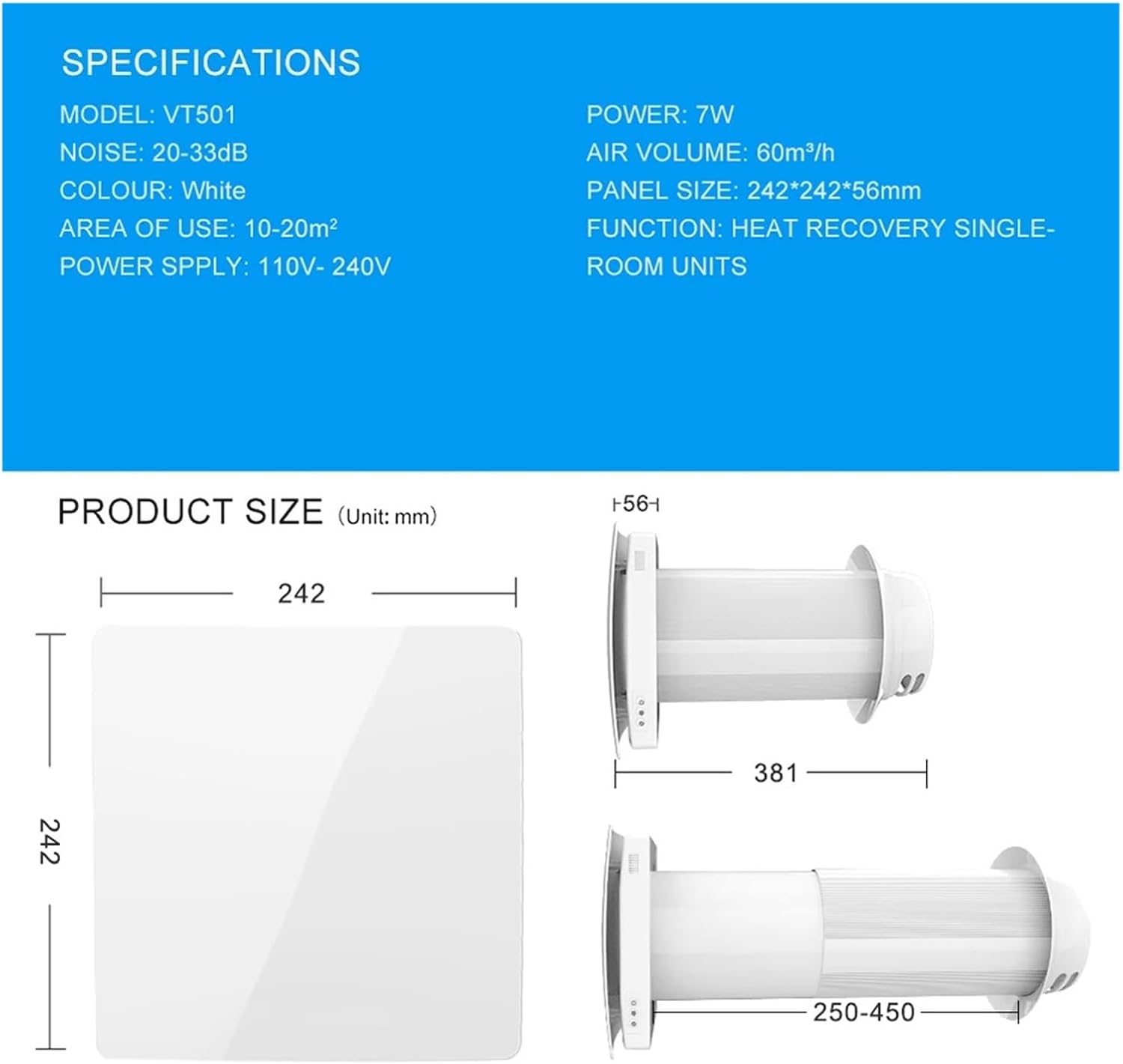
Image 7.0.1: Detailed specifications for the VT501, including model, noise level, power, air volume, panel size, area of use, power supply, and function, alongside a diagram illustrating the unit's dimensions (242x242mm panel, 381mm total length, 250-450mm extendable ducting).
| Specification | Value |
|---|---|
| Model | VT501 |
| Noise Level | 20-33 dB |
| Power Consumption | 7 W |
| Air Volume | 60 m³/h |
| Panel Size (L x W x D) | 242 x 242 x 56 mm |
| Area of Use | 10-20 m² |
| Power Supply | 110V-240V |
| Function | Heat Recovery Single-Room Unit |
| Item Weight | 11.02 pounds (approx. 5 kg) |
| Package Dimensions | 0.39 x 0.39 x 0.39 inches (Note: This appears to be a placeholder value and may not reflect actual package size.) |
8. Warranty and Support
For information regarding warranty coverage, technical support, or replacement parts, please refer to the documentation included with your product or contact the seller/manufacturer directly. Keep your purchase receipt as proof of purchase.
Manufacturer: ZTTQSYJZ
For further assistance, please visit the ZTTQSYJZ brand store on Amazon or contact your point of purchase.