Introduction
Thank you for choosing the GEARGO RV Tire Pressure Monitoring System. This system is designed to enhance your driving safety by providing real-time monitoring of your RV's tire pressure and temperature. Equipped with solar and USB charging capabilities, advanced sensors, and multiple alarm modes, it ensures you are always informed about your tire conditions. Please read this manual thoroughly before installation and operation to ensure proper use and optimal performance.
Package Contents
Upon opening your GEARGO TPMS package, please verify that all components listed below are present and in good condition:
- 1 x TPMS Monitor Display Unit (Solar-Powered)
- 4 x External Tire Pressure Sensors (labeled FL, FR, RL, RR)
- 1 x USB Charging Cable
- 1 x Anti-theft Nut Wrench
- 4 x Anti-theft Nuts
- 1 x Adhesive Pad for Monitor Mounting
- 1 x User Manual
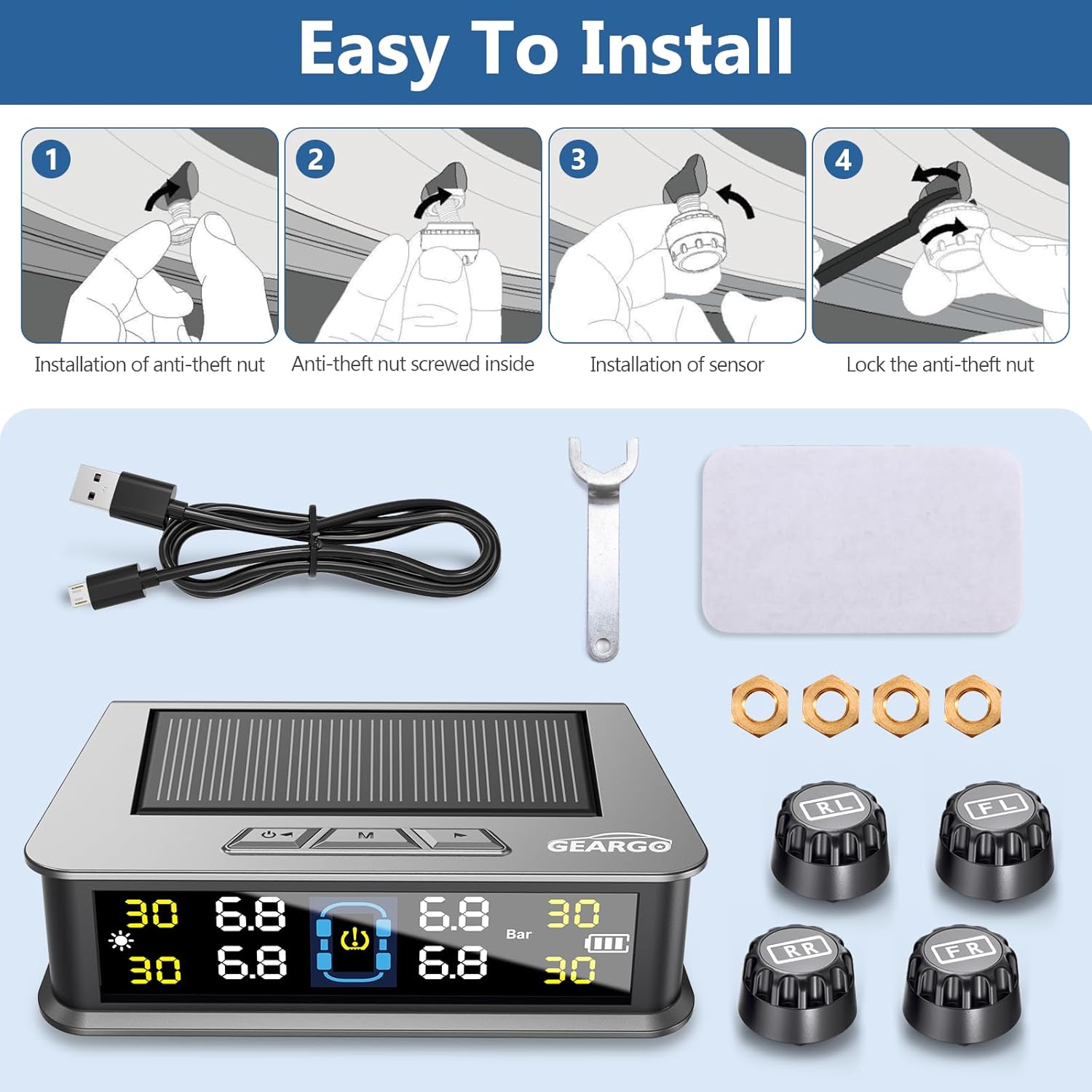
Setup and Installation
1. Charging the Monitor Unit
The TPMS monitor unit can be charged via its integrated solar panel or through the provided USB cable. For initial use, it is recommended to fully charge the unit using the USB cable.
- Solar Charging: Place the monitor on your dashboard where it can receive direct sunlight. The solar panel will continuously charge the internal battery.
- USB Charging: Connect the supplied USB cable to the monitor's charging port and to a USB power source (e.g., car charger, computer USB port).

2. Installing the Sensors
The four external sensors are clearly labeled for their respective tire positions: FL (Front Left), FR (Front Right), RL (Rear Left), and RR (Rear Right). Follow these steps for installation:
- Unscrew the original valve cap from the tire valve stem.
- Screw an anti-theft nut (provided) onto the valve stem, traveling clockwise until it reaches the very bottom of the tire valve.
- Screw the corresponding sensor onto the valve stem quickly. It is normal to have a slight air leakage during this process. Continue screwing until the sensor is firmly seated.
- Using the anti-theft nut wrench, tighten the anti-theft nut counter-clockwise against the sensor to secure it. This prevents unauthorized removal and ensures no air leakage.
Important: Always turn on the main unit before installing the sensors. The system will automatically pair with the sensors once they are installed and the vehicle is in motion.
3. Mounting the Monitor Unit
Choose a flat, clean surface on your dashboard that allows for clear visibility of the display and exposure to sunlight for solar charging. Use the provided adhesive pad to secure the monitor unit.
Operating Instructions
1. Power On/Off
- Manual On/Off: Long press the "on/off" button for 3 seconds to turn the monitor on or off.
- Auto On/Off: The monitor features an intelligent auto on/off function. It will automatically turn on when the car is started and turn off within three minutes after the car is turned off.
2. Display Interface Overview
The intelligent color LCD screen provides real-time data for all four tires. The display automatically adjusts its backlighting based on ambient light conditions for optimal visibility.

- Solar Charging Indicator: Shows when the unit is charging via solar power.
- Tire Position: Indicates which tire's data is being displayed (FL, FR, RL, RR).
- Tire Pressure Value: Real-time pressure reading for each tire (PSI or Bar).
- Tire Temperature Value: Real-time temperature reading for each tire (°C or °F).
- Battery Power: Indicates the monitor unit's battery level.
- Pressure Units: Displays the current pressure unit (PSI or Bar).
- Temperature Units: Displays the current temperature unit (°C or °F).

3. Alarm Modes and Threshold Settings
The system provides 6 distinct alarm modes to alert you to potential tire issues. Upon initial pairing, the system uses the current pressure as a reference point, allowing for easy customization of alarm thresholds.
- High/Low Pressure Alarm: Alerts when tire pressure exceeds or falls below set thresholds.
- High Temperature Alarm: Warns if tire temperature becomes excessively high.
- Disconnection Alarm: Indicates a sensor has lost connection with the monitor.
- Low Battery Alarm: Alerts when a sensor's battery is low.
- Sensor Fault Alarm: Notifies of a malfunction in a tire sensor.
- Fast Leak Alarm: Detects rapid air loss from a tire.
The monitor is equipped with voice broadcasting for critical alerts, allowing drivers to quickly understand the problem without diverting attention from the road.
4. Switching Units
To switch between pressure units (PSI/Bar) or temperature units (°C/°F), refer to the detailed instructions in the included physical user manual. Typically, this involves pressing and holding specific buttons on the monitor for a few seconds.
Maintenance
1. Sensor Battery Replacement
The external sensors are designed for low power consumption and long lifespan. When a sensor's battery is low, the monitor will display a low battery alarm. To replace the battery:
- Unscrew the sensor from the tire valve stem.
- Using the anti-theft nut wrench, carefully unscrew the top cover of the sensor.
- Remove the old battery (CR1632 lithium battery) and insert a new one, ensuring correct positive and negative orientation.
- Screw the top cover back onto the sensor and re-install the sensor on the tire valve stem, securing it with the anti-theft nut.
It is recommended to replace batteries for all sensors at the same time to avoid frequent replacements.
2. Cleaning and Storage
- Wipe the monitor and sensors with a soft, dry cloth. Avoid using abrasive cleaners or solvents.
- Ensure the solar panel on the monitor is clean and unobstructed for efficient charging.
- When storing the system for extended periods, ensure the monitor battery is fully charged.
Troubleshooting
| Problem | Possible Cause | Solution |
|---|---|---|
| Monitor not turning on. | Low battery; Auto-off activated. | Charge the monitor via USB. Start the vehicle to activate auto-on. |
| No tire data displayed. | Sensors not installed; Sensors not paired; Sensor battery low. | Ensure sensors are correctly installed. Drive for a few minutes to allow pairing. Check and replace sensor batteries if needed. |
| Inaccurate pressure readings. | Sensor not fully tightened; Sensor malfunction. | Re-tighten sensors with the wrench. If issue persists, contact customer support. |
| Alarm sounds frequently. | Tire pressure/temperature outside set thresholds; Thresholds set too narrowly. | Check tire pressure/temperature. Adjust alarm thresholds if necessary (refer to manual for specific steps). |
Specifications
| Feature | Detail |
|---|---|
| Model | TPMS-A (for general model), TPMS-B-4 Sensors (specific variant) |
| Pressure Monitoring Range | 0-99 PSI (0-6.8 Bar) |
| Temperature Monitoring Range | -4°F to 176°F (-20°C to 80°C) for external sensors |
| Display Type | Color LCD with automatic brightness adjustment |
| Charging Options | Solar and USB (Type-C) |
| Alarm Modes | 6 (High/Low Pressure, High Temperature, Disconnection, Low Battery, Sensor Fault, Fast Leak) |
| Voice Prompt | Yes, for critical alerts |
| Auto On/Off | Yes, with vehicle ignition |
| Item Weight | 7 ounces (0.2 Kilograms) |
| Product Dimensions | 1 x 1 x 1 inches (approximate, for main unit) |
Warranty and Support
GEARGO offers a warranty for this product. Customers can register for a 5-year warranty. For detailed warranty terms, technical support, or any inquiries regarding your TPMS, please refer to the contact information provided in the physical user manual or visit the official GEARGO website.
Customer Service: For assistance, please contact GEARGO customer support. Contact details are typically found on the last page of your physical manual or on the product packaging.


