
1. Introduction
Thank you for purchasing the GOOSKY Legend S2 MAX RC Helicopter. This manual provides essential information for the safe operation, setup, maintenance, and troubleshooting of your new RC helicopter. Please read this manual thoroughly before operating the aircraft to ensure proper function and to maximize your flying experience. This model is designed for hobbyists aged 16 and above.
2. Product Overview
2.1 Key Features
- Advanced Dual Brushless Motor System: Features front and rear dual brushless motors for powerful thrust, smooth 3D stunt flying, and inverted flight capabilities.
- Intelligent Flight Control & Easy Operation: Equipped with ELRS telemetry, S-FHSS protocol, and GTS control system for stable, precise maneuvers. Supports optional Bluetooth tuning via app for customized flight performance.
- Durable Carbon Fiber & Aerodynamic Design: Constructed with a lightweight yet ultra-strong carbon-plastic composite frame and optimized rotor blades for superior durability and agility.
- Long-Lasting & Safe Battery: Includes a high-voltage 2S LiPo battery with overcharge/discharge protection, providing extended flight time (up to 10-12 minutes per charge).
- Sturdy & Low-Maintenance Build: Modular ESC terminal and redesigned landing skid simplify repairs, making it a high-performance yet manageable helicopter.
2.2 Component Identification
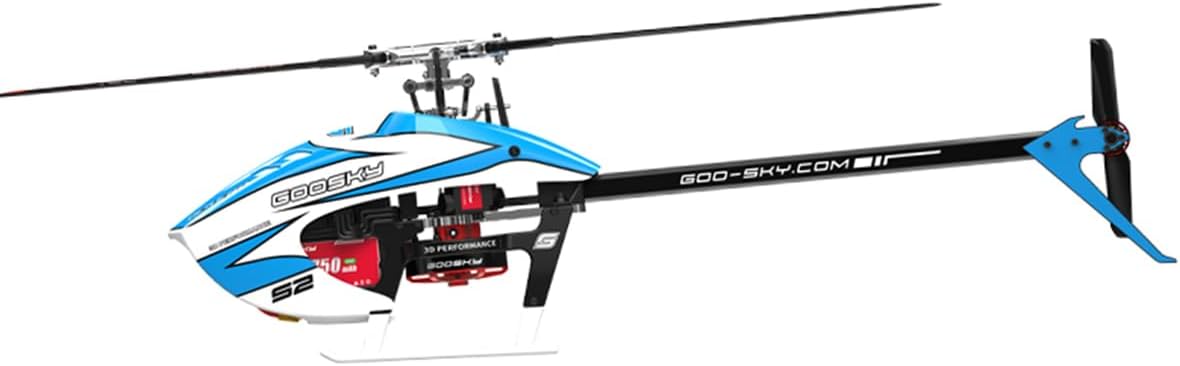
Figure 2.2.1: GOOSKY Legend S2 MAX RC Helicopter (Blue variant). This image displays the overall design of the helicopter, highlighting its sleek fuselage and rotor system.

Figure 2.2.2: GOOSKY S2 Max "BE A LEGEND" promotional image. This image showcases the helicopter in a purple color scheme, emphasizing its high-performance capabilities.

Figure 2.2.3: Dimensional overview of the GOOSKY S2 MAX. This diagram provides key measurements including main rotor diameter (44.4 cm), tail rotor diameter (8.85 cm), and height (13.8 cm).

Figure 2.2.4: Main Rotor and Tail Rotor Highlights. This image details the design and craftsmanship of the main rotor blades and the all-new tail rotor, engineered for improved performance and reduced noise.

Figure 2.2.5: Flight Control, ESC, and Motor Components. This image highlights the brand-new flight control design with ELRS protocol support, the split-type ESC, and the newly designed high power density motor, offering a 20% increase in power output.

Figure 2.2.6: Structural Enhancements. This image illustrates the reduced screw count (30% reduction for easier maintenance), the upgraded 7.4V BEC, and the integrated carbon-plastic fuselage side panel for enhanced durability.

Figure 2.2.7: ESC Terminals and Landing Skid. This image shows the brand-new integrated ESC terminals for stable and easy maintenance, along with the newly designed landing skid for improved stability.
3. Specifications
| Specification | Detail |
|---|---|
| Brand Model | Goosky S2 MAX |
| Material | High Strength Composite Engineering Materials |
| Main Rotor Length | 19.5 cm |
| Main Rotor Diameter | 44.4 cm |
| Tail Rotor Diameter | 8.85 cm |
| Takeoff Weight | 360 g |
| Body Battery | 11.1V 750mAh 8.325Wh |
| Flight Time | Approx. 10 minutes (normal), 4 minutes (intense) |
| Product Weight | 1260 g (2.78 pounds) |
| Product Dimensions | 44 x 7.4 x 13.8 cm (17.32 x 2.91 x 5.43 inches) |
| Recommended Age | 16 years and up |
| Item Model Number | P3XFPG9143585J3QYJ |
| Country of Origin | China |
4. Package Contents
The RTF (Ready-to-Fly) version of the GOOSKY Legend S2 MAX RC Helicopter package includes the following items:
- Aircraft (1)
- EPP Gift Box (1)
- Battery (1)
- Several Spare Screws
- Servo Arm (3)
- Main Shaft (1)
- Feathering Shaft (1)
- APP Bluetooth Module (1)
- Charger (1)
- Transmitter (1)
5. Setup
5.1 Battery Charging
- Connect the provided charger to a suitable power source.
- Connect the helicopter's battery (11.1V 750mAh LiPo) to the charger.
- Ensure the battery is charged fully before the first flight. Refer to the charger's instructions for specific charging indicators and times.
- Always supervise battery charging and disconnect once fully charged to prevent overcharging.
5.2 Transmitter Preparation
- Install the necessary batteries into the transmitter (refer to transmitter manual for battery type and installation).
- Familiarize yourself with the transmitter's controls (throttle, cyclic, collective, rudder). This RTF version is set for Right-Hand Control (Mode 2).
5.3 Binding the Helicopter and Transmitter
Your RTF package should come pre-bound. If re-binding is necessary, follow these general steps:
- Ensure both the helicopter and transmitter are powered off.
- Place the helicopter on a flat, stable surface.
- Turn on the transmitter while holding the bind button (if applicable).
- Power on the helicopter. The indicator lights on the helicopter and transmitter should show a successful bind (refer to specific binding instructions in the included quick start guide or transmitter manual).
5.4 Pre-Flight Checks
- Inspect the helicopter for any visible damage, loose screws, or bent parts.
- Ensure all rotor blades are securely attached and free to move.
- Verify the battery is fully charged and securely installed.
- Check that all control surfaces respond correctly to transmitter inputs (e.g., cyclic moves swashplate, collective changes blade pitch, rudder controls tail rotor).
- Perform a range check of the radio system in an open area.
6. Operating Instructions
6.1 Flight Environment
- Fly in open, clear areas away from people, animals, buildings, and power lines.
- Avoid flying in windy conditions, especially for initial flights.
- Maintain a clear line of sight to the helicopter at all times.
6.2 Basic Flight Controls (Mode 2 - Right-Hand Control)
- Left Stick (Throttle/Rudder):
- Up/Down: Controls collective pitch/throttle for altitude.
- Left/Right: Controls rudder for yaw (nose direction).
- Right Stick (Aileron/Elevator):
- Up/Down: Controls elevator for pitch (forward/backward movement).
- Left/Right: Controls aileron for roll (left/right movement).
6.3 Takeoff and Landing
- Takeoff: Place the helicopter on a flat surface. Slowly increase throttle until the helicopter lifts off smoothly. Make small, precise adjustments to maintain stability.
- Landing: Gently reduce throttle while maintaining control. Aim for a soft, controlled descent. Once on the ground, fully reduce throttle to stop the rotors.
6.4 3D Stunt Flying
The GOOSKY Legend S2 MAX is capable of advanced 3D stunts and inverted flight. This requires significant practice and skill. It is highly recommended to practice on a flight simulator before attempting complex maneuvers with the actual helicopter. Ensure you are in a large, clear area when practicing 3D flight.
The GTS control system and ELRS telemetry provide precise control for these advanced maneuvers. Utilize the optional Bluetooth tuning via the app to customize flight performance to your preference and skill level.
7. Maintenance
Regular maintenance ensures the longevity and optimal performance of your GOOSKY Legend S2 MAX helicopter.
- After Each Flight:
- Inspect for any visible damage, cracks, or loose connections.
- Check rotor blades for nicks or damage. Replace if necessary.
- Ensure all screws are tight, especially on critical components like the main rotor head and tail assembly.
- Allow the battery to cool before recharging.
- Periodic Maintenance:
- Clean the helicopter with a soft, dry cloth. Avoid water or solvents.
- Check for smooth movement of all linkages and servos. Lubricate moving parts with appropriate RC-grade lubricant if needed.
- Inspect wiring for fraying or damage.
- Verify the integrity of the carbon-plastic composite frame.
- Battery Care:
- Store LiPo batteries in a cool, dry place, ideally in a fire-safe bag.
- Do not overcharge or over-discharge batteries.
- If a battery is puffed or damaged, dispose of it safely according to local regulations.
8. Troubleshooting
| Problem | Possible Cause | Solution |
|---|---|---|
| Helicopter does not respond to transmitter. | Not bound, low transmitter/helicopter battery, power switch off. | Ensure both are powered on. Re-bind if necessary. Charge/replace batteries. |
| Helicopter vibrates excessively. | Damaged/unbalanced rotor blades, bent main shaft/feathering shaft, loose screws. | Inspect and replace damaged blades. Check and replace bent shafts. Tighten all screws. |
| Short flight time. | Battery not fully charged, aging battery, aggressive flying. | Ensure full charge. Consider battery replacement if old. Adjust flying style. |
| Helicopter drifts during hover. | Trims not adjusted, minor damage, wind. | Adjust transmitter trims. Inspect for subtle damage. Fly in calmer conditions. |
| Motors not spinning. | ESC issue, motor connection issue, flight controller issue. | Check all motor and ESC connections. Ensure ESC is properly initialized. Consult advanced troubleshooting guides if problem persists. |
9. Safety Information
WARNING: Failure to follow these safety guidelines may result in injury, property damage, or damage to the helicopter.
- Adult Supervision: This product is recommended for users aged 16 and up. Adult supervision is highly recommended for younger users.
- Operating Environment: Always operate the helicopter in open, unobstructed areas. Keep away from people, pets, power lines, trees, and water.
- Rotor Blades: The rotor blades spin at very high speeds and can cause serious injury. Keep hands, face, and loose clothing away from the rotors when the helicopter is powered on.
- Battery Safety:
- Use only the specified charger and battery.
- Never leave charging batteries unattended.
- Do not puncture, disassemble, or expose batteries to extreme temperatures or direct sunlight.
- If a battery becomes swollen or damaged, discontinue use immediately and dispose of it properly.
- Moisture: Do not expose the helicopter or its electronic components to moisture or rain.
- Modifications: Do not modify the helicopter or its components. Unauthorized modifications can lead to malfunction and void any potential warranty.
- Pre-Flight Check: Always perform a thorough pre-flight check before each flight.
- Respect Local Laws: Be aware of and comply with all local laws and regulations regarding RC aircraft operation.