
1. Introduction
Thank you for choosing the Y&H 20A MPPT Solar Charge Controller. This device is designed to efficiently manage power flow from your solar panels to your battery bank, ensuring optimal charging and extending battery life. It features advanced Maximum Power Point Tracking (MPPT) technology for high efficiency and is compatible with 12V/24V systems and various battery types, including AGM, Gel, Flooded, and Lithium batteries.
2. Safety Information
- Ensure all connections are tight and correct to prevent damage or injury.
- Do not attempt to repair or modify the controller yourself. Refer to qualified personnel.
- Install the controller in a well-ventilated area, away from direct sunlight, high temperatures, and moisture.
- Always connect the battery first, then the solar panel, and finally the load. Disconnect in reverse order.
- Wear appropriate personal protective equipment (PPE) when working with electrical systems and batteries.
- Ensure the battery voltage matches the system voltage (12V or 24V) set on the controller.
3. Product Overview
The Y&H 20A MPPT Solar Charge Controller incorporates high-performance DSP for precise solar power tracking and features a large LCD for real-time system monitoring. It supports multiple battery types and offers comprehensive protection features.
Key Features:
- High Precision MPPT: Built-in high-performance DSP tracks solar panel power generation with high accuracy, optimizing battery performance with a three-stage charging method and increasing energy recovery efficiency.
- Wide Battery Compatibility: Supports sealed, gel, and flooded lead-acid batteries, as well as lithium iron phosphate and ternary lithium batteries.
- 12V/24V Automatic Recognition: Automatically identifies 12V/24V systems. Open circuit voltage less than 75V, battery voltage range 8V to 32V. Maximum charging power is 240W for 12V systems and 480W for 24V systems.
- Large LCD Display: Easy-to-read display shows charging current, battery voltage in real-time, and includes a power statistics recording function for system status monitoring.
- Comprehensive Protection & Load Control: Built-in overvoltage, overcurrent, short circuit, and overheat protection. Load control offers light-sensing mode, 2-setting clock mode, charge-only mode, and timer mode.
Component Identification:
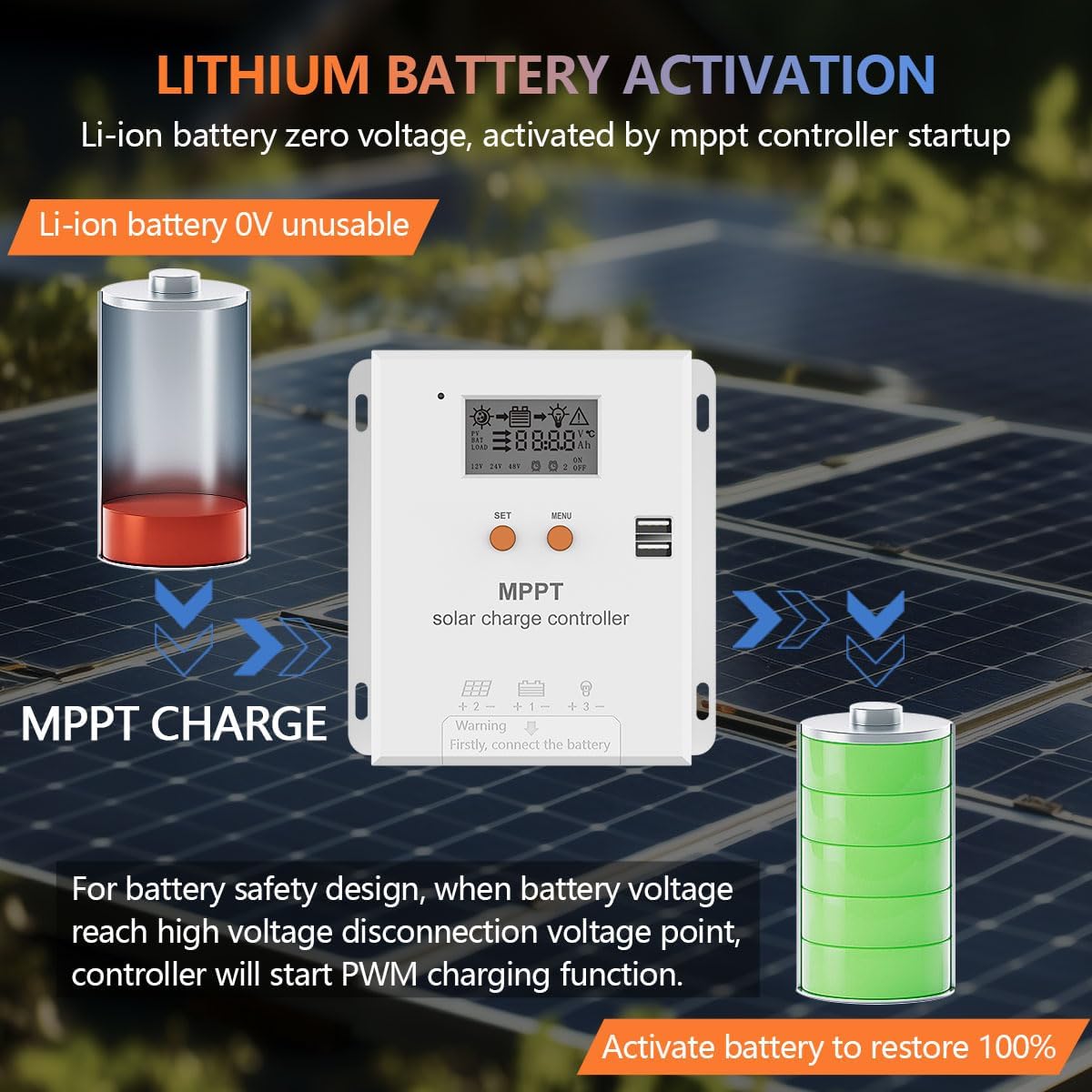
Image: Port Introduction. This diagram illustrates the various ports and buttons on the Y&H MPPT Solar Charge Controller, including the LCD display, set button, menu button, USB outputs, battery terminals, photovoltaic array terminals, and optional temperature sensor interface.
- LCD Display
- Set Button
- Menu Button
- USB Output (x2)
- Battery Terminal
- Photovoltaic Array Terminals
- Temperature Sensor Interface (Optional)
4. Setup and Installation
Installation Environment:
The controller should be installed in a well-ventilated place. Avoid direct sunlight and high temperatures. Do not install in locations where water can enter the controller.

Image: Dimensions & Cables. This image provides the physical dimensions of the controller and general guidelines for cable connections, emphasizing proper ventilation and avoiding water exposure.
Wiring Steps:
Follow these steps carefully for proper wiring. Incorrect wiring can damage the controller or other components.

Image: How to Wire. This diagram illustrates the correct sequence for connecting the battery, solar panel, and load to the charge controller.
- Open the cover: Unscrew and remove the terminal cover to access the wiring ports.
- Connect the Battery: First, connect the battery to the controller's battery terminals (marked with a battery symbol). Ensure correct polarity (+ to + and - to -).
- Connect the Solar Panel: Next, connect the solar panel to the controller's PV input terminals (marked with a solar panel symbol). Ensure correct polarity.
- Connect the Load (Optional): Finally, connect your DC load to the controller's load terminals (marked with a light bulb symbol). Ensure correct polarity.
The controller will automatically detect 12V or 24V systems. Ensure your battery bank voltage matches the system voltage.

Image: 12V/24V System Wiring. This image demonstrates typical wiring setups for both 12V and 24V battery systems with solar panels and a load.
5. Operating Instructions
LCD Display Interface:
The large LCD display provides real-time information about your system. Press the "MENU" button to view parameters and cycle through different screens. Press the "SET" button to enter settings mode and adjust parameters.
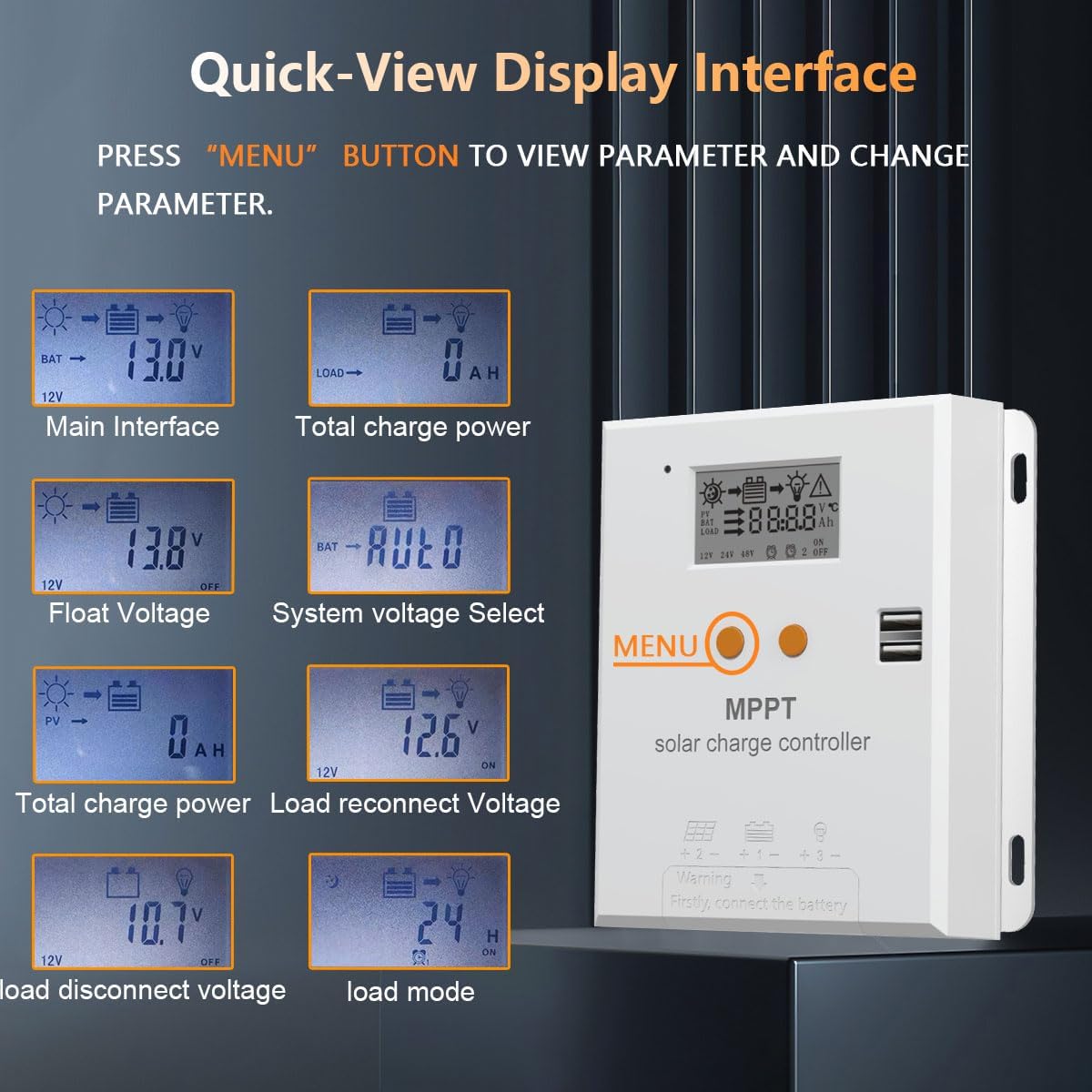
Image: Quick-View Display Interface. This image shows examples of the information displayed on the LCD, such as main interface, total charge power, float voltage, system voltage select, load reconnect voltage, and load disconnect voltage.
Load Working Modes:
The controller offers several load working modes to suit different applications:
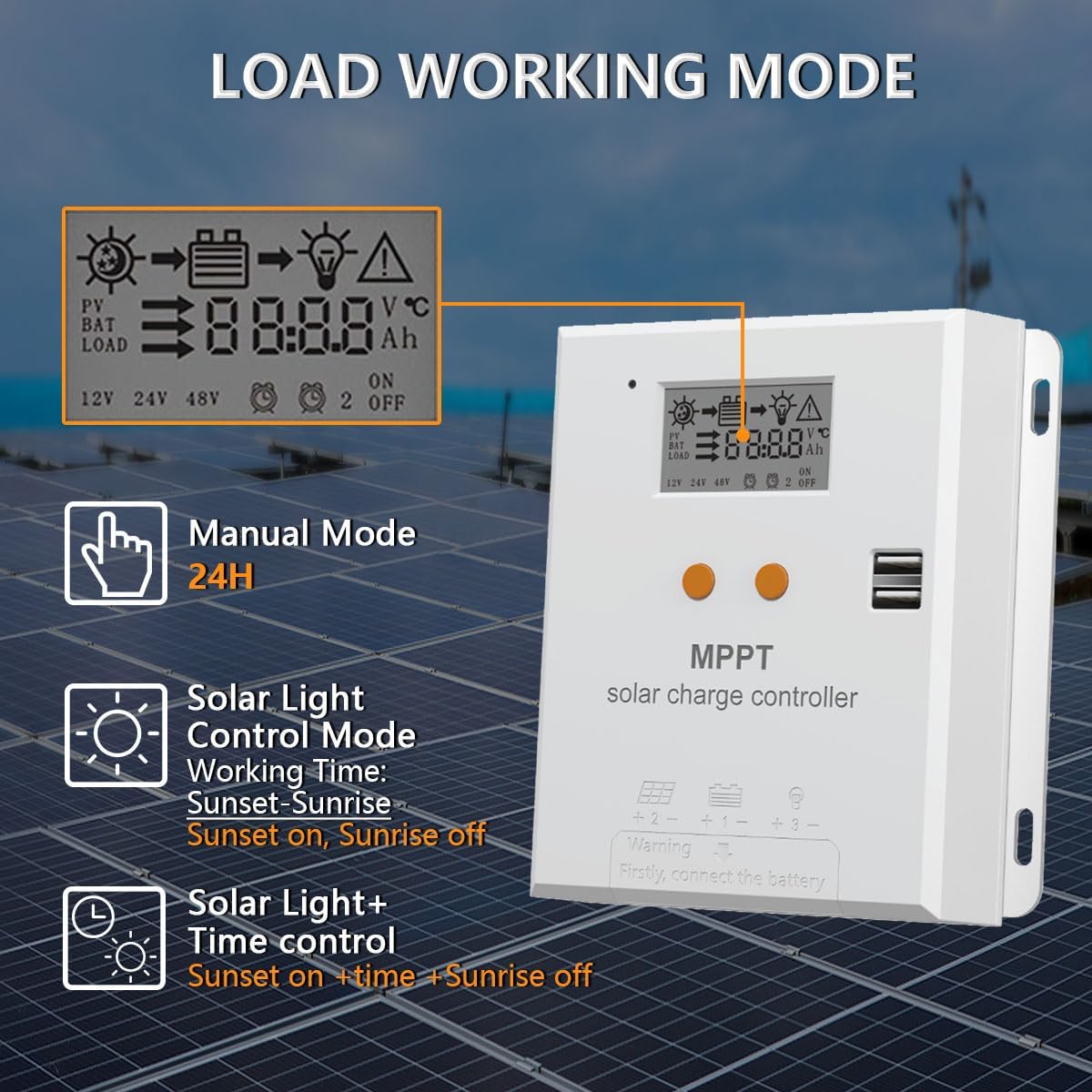
Image: Load Working Mode. This image details the Manual Mode (24H), Solar Light Control Mode (Sunset-Sunrise), and Solar Light + Time Control modes.
- Manual Mode (24H): The load output is continuously on for 24 hours.
- Solar Light Control Mode: The load turns on at sunset and off at sunrise.
- Solar Light + Time Control Mode: The load turns on at sunset and stays on for a set number of hours, then turns off.
- Charge-Only Mode: The controller focuses solely on charging the battery, with no load output.
Lithium Battery Activation:
For lithium batteries with zero voltage, the MPPT controller can activate them upon startup. For battery safety, when the battery voltage reaches a high voltage disconnection point, the controller will initiate a PWM charging function to activate the battery and restore it to 100%.

Image: Lithium Battery Activation. This image illustrates how the MPPT controller can activate a zero-voltage lithium-ion battery and restore it to full charge.
6. Maintenance
- Regularly inspect all wiring connections for tightness and corrosion.
- Keep the controller clean and free from dust and debris. Use a dry cloth for cleaning.
- Ensure the ventilation openings are not blocked to prevent overheating.
- Periodically check battery terminals for corrosion and clean if necessary.
- Monitor the LCD display for any error codes or unusual readings.
7. Troubleshooting
| Problem | Possible Cause | Solution |
|---|---|---|
| No display/Controller not powering on | Battery not connected or low voltage; reverse polarity. | Check battery connections and voltage. Ensure correct polarity. Charge battery if too low. |
| Battery not charging | Solar panel not connected; low solar input; incorrect battery type setting; faulty wiring. | Check solar panel connections and ensure sufficient sunlight. Verify battery type setting. Inspect all wiring. |
| Load not working | Load disconnected; battery low voltage protection; load mode setting incorrect; overcurrent protection. | Check load connections. Ensure battery voltage is above the low voltage disconnect point. Adjust load mode. Reduce load or check for short circuit. |
| Overcharging battery | Incorrect battery type setting; faulty controller. | Verify the battery type setting matches your battery. If the issue persists, contact support. |
| High temperature warning | Poor ventilation; excessive ambient temperature; heavy load. | Ensure adequate airflow around the controller. Relocate to a cooler area if possible. Reduce load. |
8. Specifications
| Parameter | Value |
|---|---|
| Model Number | NC-20A-JP |
| Rated Charge Current | 20A |
| System Voltage | 12V/24V Auto |
| Max PV Input Voltage | <75VDC |
| Battery Voltage Range | 8V-32V |
| Max Charge Power (12V) | 240W |
| Max Charge Power (24V) | 480W |
| Display Type | LCD |
| Compatible Battery Types | AGM, Gel, Flooded, Lithium (LiFePO4, Ternary Lithium) |
| Protection Features | Overvoltage, Overcurrent, Short Circuit, Overheat |
| UPC | 704334203396 |
9. Warranty and Support
Y&H products are designed for reliability and performance. For warranty information, technical support, or service inquiries, please refer to the contact information provided with your purchase or visit the official Y&H website. Please have your model number (NC-20A-JP) and purchase details ready when contacting support.