
RENOGY REGO 60A Max Power
RENOGY REGO 12V 60A DC-DC Battery Charger User Manual
Model: 60A Max Power
1. Introduction
This manual provides detailed instructions for the installation, operation, and maintenance of your RENOGY REGO 12V 60A DC-DC Battery Charger. This smart charger is designed to efficiently charge various battery types, including LiFePO4, AGM, Gel, and Flooded batteries, making it suitable for RV, marine, and truck applications. Please read this manual thoroughly before use to ensure proper function and safety.

Image: The RENOGY REGO 12V 60A DC-DC Battery Charger, a compact and robust unit.
2. Safety Information
Always observe the following safety precautions to prevent personal injury or damage to the charger and connected equipment:
- Ensure all connections are secure and correctly polarized before operation.
- Do not operate the charger in wet conditions unless specifically designed for it (this unit is IP68 waterproof).
- Avoid short-circuiting the battery terminals.
- Keep the charger away from flammable materials.
- Only use the charger with compatible battery types and voltages.
- Consult a qualified professional for installation if you are unsure.
3. Product Overview
The RENOGY REGO 12V 60A DC-DC Battery Charger is a versatile and robust charging solution. It features automatic detection of various battery chemistries and incorporates multiple protection mechanisms for safe and efficient charging.
3.1. Key Features
- Universal Battery Compatibility: Automatically detects and charges LiFePO4, AGM, Gel, and Flooded 12V batteries.
- Smart 3-Stage Charging: Optimizes charging with Bulk, Boost, and Float stages to prolong battery life.
- Engine-Start Detection: Protects your vehicle's starter battery by only charging when the engine is running.
- Robust Design: Military-grade aluminum housing with IP68 waterproofing for extreme temperatures and environments.
- Comprehensive Protections: Includes over-temperature, reverse polarity, and over-voltage protection.
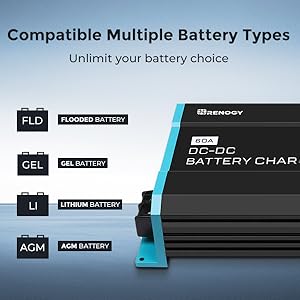
Image: Illustration showing compatibility with Flooded, Gel, Lithium, and AGM battery types.
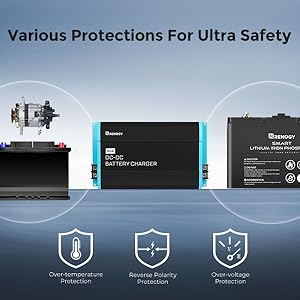
Image: Visual representation of safety features including over-temperature, reverse polarity, and over-voltage protection.
3.2. Product Display and Components
Familiarize yourself with the various ports and indicators on your DC-DC charger:
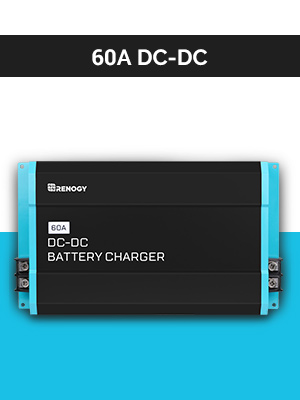
Image: Detailed view of the charger's terminals and indicators.
- Negative DC Input Terminal
- Positive DC Input Terminal
- Ventilation Fans
- Power LED
- Fault LED
- Dip Switches (for settings)
- RJ11 Temperature Sensor Port (RTSDCC, requires separate purchase)
- D+ Ignition Terminal
- LC Terminal – Current Limiting Terminal
- Positive DC Output Terminal
- Negative DC Output Terminal
4. Specifications
| Feature | Specification |
|---|---|
| Brand | RENOGY REGO |
| Model Number | 60A Max Power |
| Product Dimensions (D x W x H) | 2.3" x 9.31" x 5.17" (58.4mm x 236.5mm x 131.3mm) |
| Input Voltage | 16 Volts (DC) |
| Output Voltage | 12 Volts (DC) |
| Current Rating / Amperage | 60 Amps |
| Connector Type | Ring Terminals, Battery Clamps |
| Color | Black |
| Specification Met | UL, CE, FCC, IEC |
| Mfr Part Number | RNG-DCC1212-60 |

Image: Diagram illustrating the physical dimensions and weight of the charger.
5. Setup and Installation
The RENOGY REGO DC-DC charger is designed for straightforward installation. Ensure your vehicle's engine bay or mounting location provides adequate ventilation and is protected from direct exposure to elements, although the unit is waterproof.
5.1. Mounting
Mount the charger securely using the provided brackets in a location that allows for easy access to terminals and sufficient airflow around the ventilation fans.
5.2. Wiring Diagram
Follow the wiring diagram carefully. Incorrect wiring can damage the unit or your batteries. Use appropriate gauge wiring and fuses as recommended by the manufacturer.
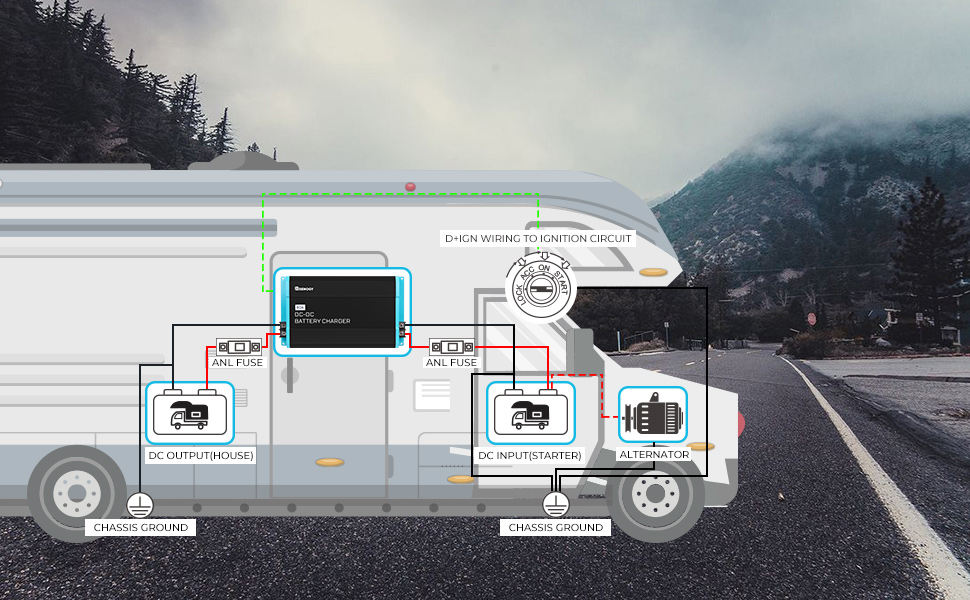
Image: A detailed wiring diagram showing the connection of the DC-DC charger between the starter battery, house battery, and alternator in an RV setup.
5.3. Connecting to Starter Battery (D+ Ignition)
The D+ Ignition Terminal is crucial for protecting your vehicle's starter battery. Connect this terminal to an ignition-switched power source. This ensures the charger only operates when the engine is running, preventing discharge of the starter battery when the vehicle is off.
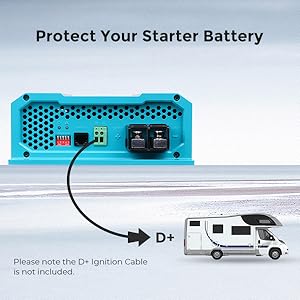
Image: Diagram illustrating the D+ ignition cable connection to protect the starter battery. Note: D+ Ignition Cable is not included.
5.4. Connecting to House Battery (LC+ Current Limiting)
The LC Terminal (Current Limiting) can be used to manage the charging current to your house battery. Refer to the detailed wiring instructions for specific applications and optional current limiting configurations.
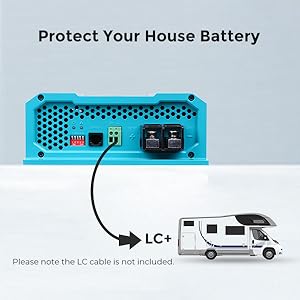
Image: Diagram illustrating the LC+ cable connection for managing the house battery. Note: LC cable is not included.
6. Operating Instructions
Once properly installed, the RENOGY REGO DC-DC Battery Charger operates largely automatically.
6.1. Automatic Battery Type Detection
The charger automatically detects the chemistry of the connected house battery (LiFePO4, AGM, Gel, or Flooded) and adjusts its charging parameters accordingly. No manual selection is typically required for standard operation.
6.2. Smart 3-Stage Charging Process
The charger employs a 3-stage charging algorithm to optimize battery health and lifespan:
- Bulk Charge: Delivers maximum current to rapidly charge the battery to approximately 80% capacity.
- Boost Charge: Provides a constant voltage to bring the battery to 100% charge, ensuring full saturation.
- Float Charge: Maintains the battery at a safe voltage level, compensating for self-discharge and ensuring the battery remains fully charged without overcharging.
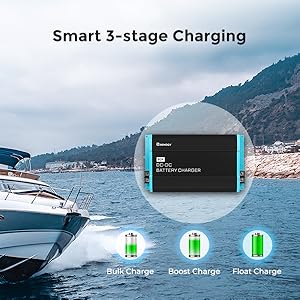
Image: Illustration depicting the Bulk, Boost, and Float charging stages for optimal battery health.
6.3. Engine-On Activation
The charger will only begin charging the house battery when it detects that the vehicle's engine is running, indicated by the D+ ignition signal. This prevents accidental discharge of the starter battery.
7. Maintenance
The RENOGY REGO DC-DC Battery Charger requires minimal maintenance due to its robust design and waterproof rating.
- Regular Inspection: Periodically check all wiring connections for tightness and corrosion.
- Cleaning: Keep the exterior of the charger clean and free of dust or debris. Use a dry cloth for cleaning. Do not use harsh chemicals or abrasive cleaners.
- Ventilation: Ensure the ventilation fans are not obstructed to allow for proper heat dissipation.
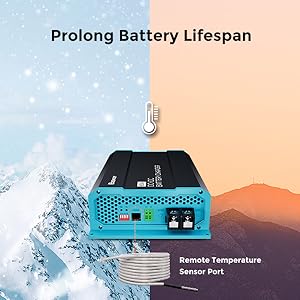
Image: Illustration showing the charger operating in extreme temperatures, highlighting the benefit of a remote temperature sensor for prolonging battery lifespan.
8. Troubleshooting
If you encounter issues with your charger, refer to the following common problems and solutions:
| Problem | Possible Cause | Solution |
|---|---|---|
| Charger not turning on | No input power; D+ signal not detected; Blown fuse. | Check input battery connections; Ensure engine is running and D+ wire is connected; Inspect and replace fuses. |
| Battery not charging | Incorrect battery type setting (if applicable); Faulty battery; Loose connections. | Verify dip switch settings for battery type; Test house battery condition; Secure all connections. |
| Fault LED is on | Over-temperature; Reverse polarity; Over-voltage/Under-voltage. | Allow unit to cool; Check wiring for correct polarity; Verify input/output voltages are within range. |
| Low charging current | LC+ terminal activated; High resistance in wiring. | Check LC+ connection and settings; Inspect wiring for damage or undersizing. |
If the problem persists after attempting these solutions, please contact customer support.
9. Warranty Information
The RENOGY REGO 12V 60A DC-DC Battery Charger comes with a 1-year material and workmanship warranty from the date of purchase. This warranty covers defects in materials and manufacturing under normal use. It does not cover damage caused by misuse, neglect, improper installation, accidents, or unauthorized modifications.
For warranty claims, please retain your proof of purchase and contact RENOGY REGO customer support.
10. Customer Support
For technical assistance, troubleshooting beyond this manual, or warranty inquiries, please visit the official RENOGY REGO website or contact their customer service department. Contact information can typically be found on the product packaging or the official website.
Online resources may include:
- RENOGY Official Website
- Product-specific FAQs and support documents.
Ask a question about this manual
Ask about setup, troubleshooting, compatibility, parts, safety, or missing instructions. Manuals+ will review the question and use this page’s manual context to help answer it.