
1. Introduction
This manual provides guidance for utilizing the MEDI STUDY GO Dental Anatomy and Dental Histology Mind Maps, Edition 1. This resource is designed to facilitate the understanding and retention of complex concepts in dental anatomy and dental histology for dental students and professionals. It features visually structured mind maps and concise notes to support efficient learning and revision.
The booklet includes QR codes that provide instant access to supplementary digital resources available on the App Store, Play Store, and YouTube, enhancing the learning experience.
2. Key Features
- 5-Minute Revision Tool: Designed for rapid review, enabling quick grasp of complex topics.
- Colour-Coded Mind Maps: Visual organization of information to aid comprehension and memory.
- Detailed Illustrations: Clear and accurate diagrams to support textual explanations.
- Concise Notes: Summarized information for focused study.
- Flowcharts & Differential Diagnosis (Diff-Dx) Tables: Structured content for understanding processes and distinguishing conditions.
- NEET Exam Pointers: Highlighted information relevant for competitive examinations.
- Digital Resource Integration: QR codes link to online content for expanded learning.

Image 2.1: Overview of the Mind Maps, highlighting color-coded sections and illustrations.
3. Content Overview
The book is structured into 18 units, comprising 211 colour-coded flowcharts that cover essential topics in Dental Anatomy and Dental Histology. Key areas include:
- Dental Anatomy: Covers topics such as tooth morphology, dentition types, and specific characteristics of individual teeth.
- Dental Histology: Explores the microscopic structure of oral tissues, including enamel, dentin, pulp, cementum, periodontal ligament, and oral mucosa.
- Clinical Considerations: Integrates clinical relevance with anatomical and histological concepts.

Image 3.1: Detailed Table of Contents showing the units and topics covered.
4. Usage and Study Method
This revision tool is designed for efficient learning and recall. Follow these guidelines to maximize your study effectiveness:
- Quick Revision: Utilize the 5-minute revision sections for rapid review of key concepts before exams or clinical sessions.
- Visual Learning: Focus on the color-coded mind maps and flowcharts to understand relationships between concepts and processes.
- Concept Comparison: Use tables, such as those comparing maxillary and mandibular canines, to identify distinguishing features.
- Exam Preparation: Pay attention to highlighted NEET Exam pointers for critical information.
- Digital Integration: Scan QR codes to access supplementary videos and interactive content for deeper understanding.

Image 4.1: Example of a 5-minute revision tool comparing dental features.

Image 4.2: Structured learning example with NEET exam pointers for faster recall.
5. Specifications
| Attribute | Detail |
|---|---|
| ASIN | B0F9SRQQJB |
| Publisher | MEDI STUDY GO |
| Publication Date | 31 July 2024 |
| Print Length | 236 pages |
| Reading Age | 17 years and up |
| Item Weight | 700 g |
| Dimensions | 29.5 x 1.5 x 21 cm |
| Country of Origin | India |
| Generic Name | Dental Revision tool |
6. About the Author
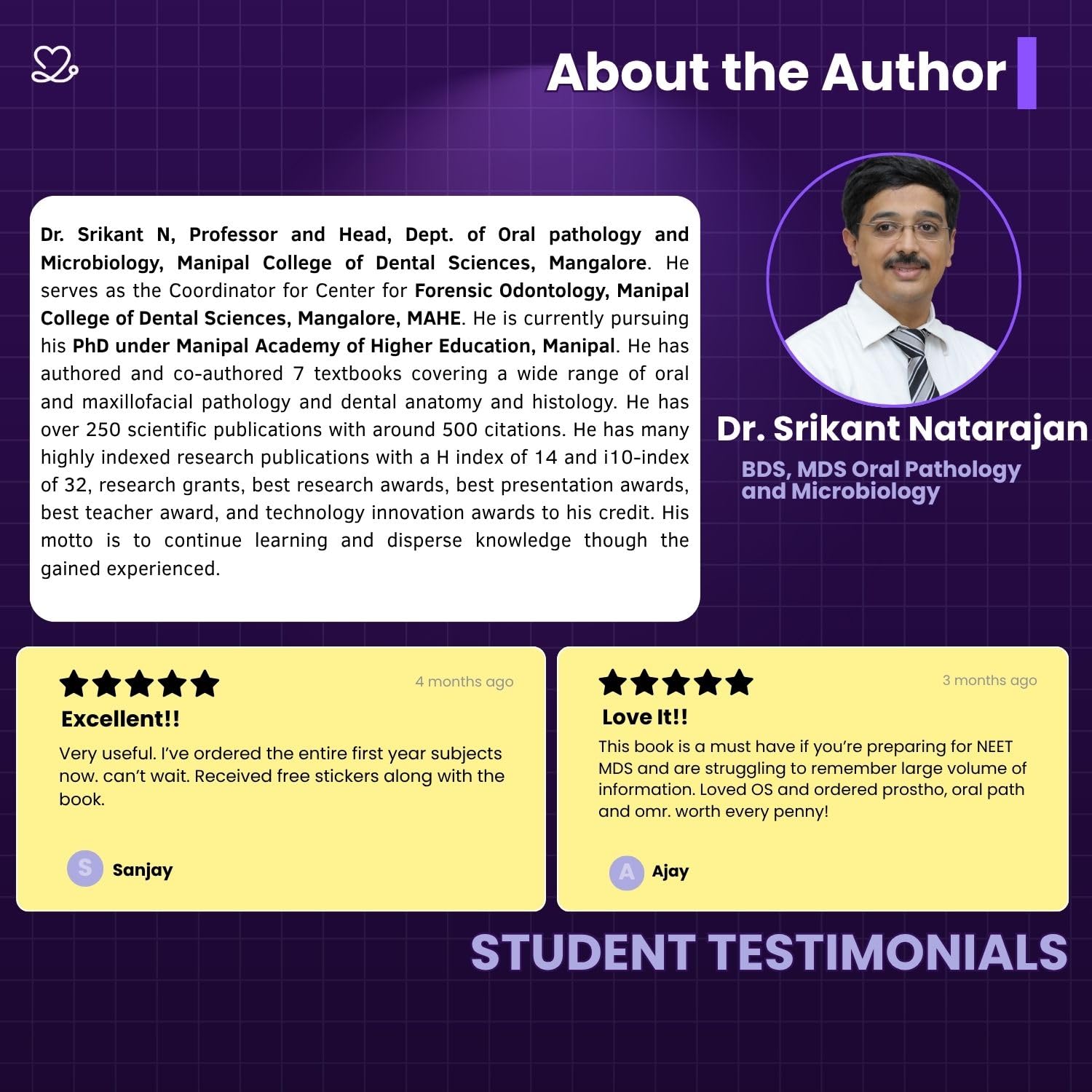
The MEDI STUDY GO series is authored by Dr. Srikant N, Professor and Head, Dept. of Oral Pathology and Microbiology, Manipal College of Dental Sciences, Mangalore. Dr. Srikant N is also the Coordinator for the Center for Forensic Odontology at Manipal College of Dental Sciences, MAHE. He has co-authored 7 textbooks and has over 250 scientific publications. The mission of MEDI STUDY GO is to make learning simple, visual, and effective for medical and dental students.
7. Support and Resources
For additional support and to access digital resources, please utilize the QR codes provided within the book. These codes link to supplementary content on the App Store, Play Store, and YouTube, offering an extended learning experience.
For general inquiries or further assistance, please refer to the publisher's contact information provided in the book.
8. Maximizing Your Learning
To get the most out of your MEDI STUDY GO Mind Maps, consider the following study tips:
- Active Recall: After reviewing a mind map, try to recreate it from memory to reinforce learning.
- Spaced Repetition: Revisit topics periodically to strengthen long-term memory retention.
- Integrate with Lectures: Use the mind maps to consolidate information from your lectures and textbooks.
- Self-Assessment: Use the structured content to test your understanding of key concepts and identify areas needing further study.

Image 8.1: Visual diagrams and flowcharts for rapid pattern recognition.
