
E-ACE DMMRUTXB
E-ACE 4.3-Inch Dual Lens Car DVR Rearview Mirror Dash Cam User Manual
Model: DMMRUTXB
1. Product Overview
The E-ACE 4.3-inch Dual Lens Car DVR Rearview Mirror Dash Cam is designed to enhance driving safety by providing comprehensive video recording of your journeys. This device integrates a front-facing camera and supports an optional rear-facing camera, offering a wide field of view and continuous recording capabilities. Its sleek design replaces your existing rearview mirror, providing a discreet and integrated solution for vehicle surveillance.
Key features include a 4.3-inch high-definition display, dual-lens recording, night vision, loop recording, and a G-sensor for automatic incident detection.

Image: The E-ACE rearview mirror dash cam displaying both front and rear camera feeds on its integrated screen.
2. Package Contents
Please check the package for the following items:
- E-ACE Rearview Mirror Dash Cam Unit
- Car Charger
- Fixed Bandages (for mounting)
- User Manual
- Card Reader
- Optional: Rear View Camera + Cable (6M or 10M, depending on variant)
- Optional: Buck Line (for parking monitoring power)
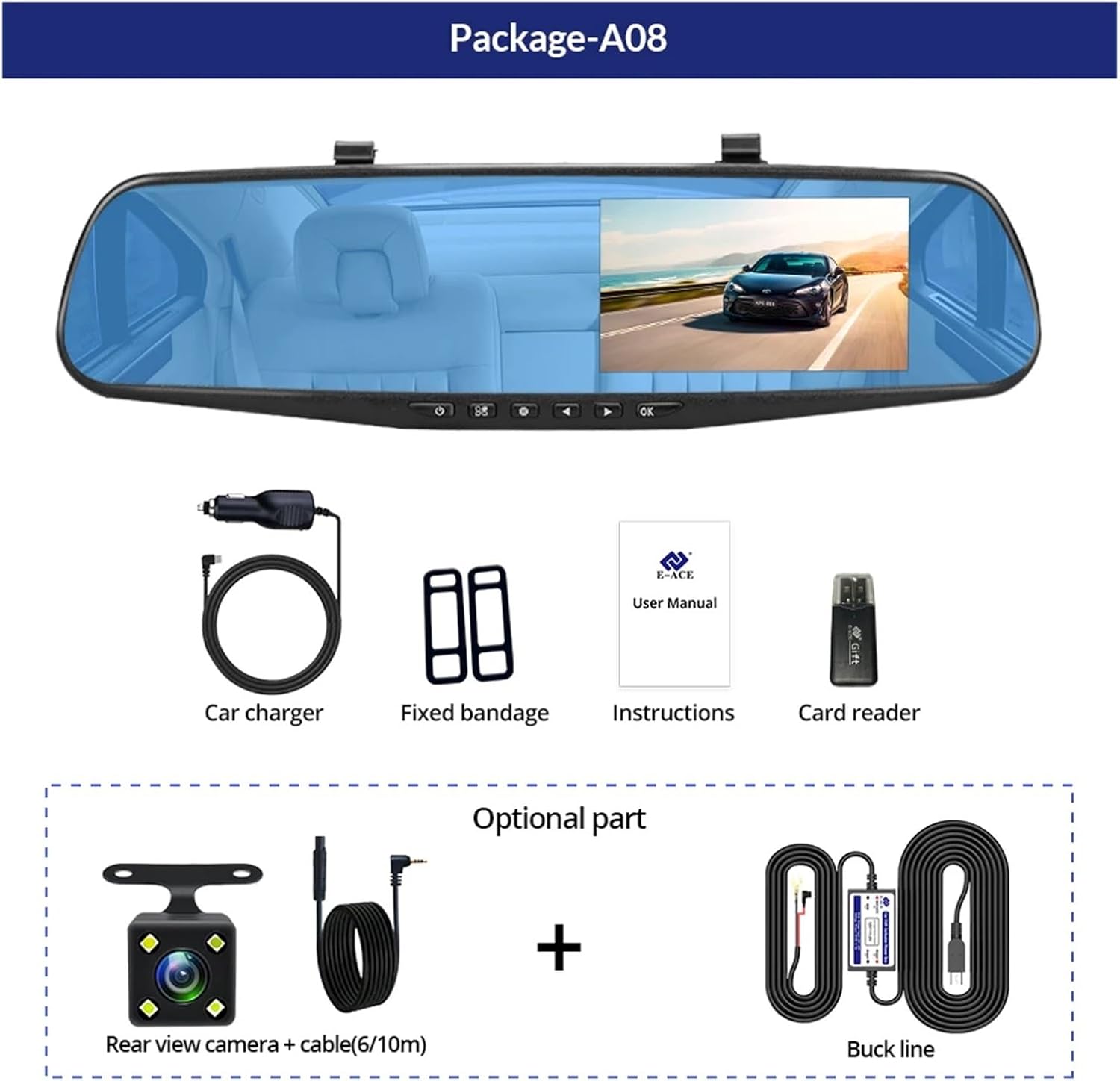
Image: A visual representation of the items included in the E-ACE dash cam package, showing the main unit and accessories.
3. Product Features
- 4.3-inch High-Definition Display: Provides clear visibility for real-time monitoring and playback.
- Dual Lens Design: Captures both front and rear footage simultaneously for comprehensive coverage.
- Built-in Night Vision Technology: Ensures clear recordings in low-light conditions.
- User-Friendly Installation: Sleek rearview mirror design integrates seamlessly into your vehicle.
- Loop Recording: Automatically overwrites the oldest footage when the memory card is full, ensuring continuous recording.
- G-Sensor Feature: Detects sudden movements or impacts and automatically locks the current video file to prevent it from being overwritten.
- Parking Monitoring: Records video when motion or impact is detected while the vehicle is parked (requires buck line connection).
- 170-Degree Wide Angle: Provides a broad view of the road ahead.
- Reverse Image: Displays the rear camera view with parking guidelines when reversing.
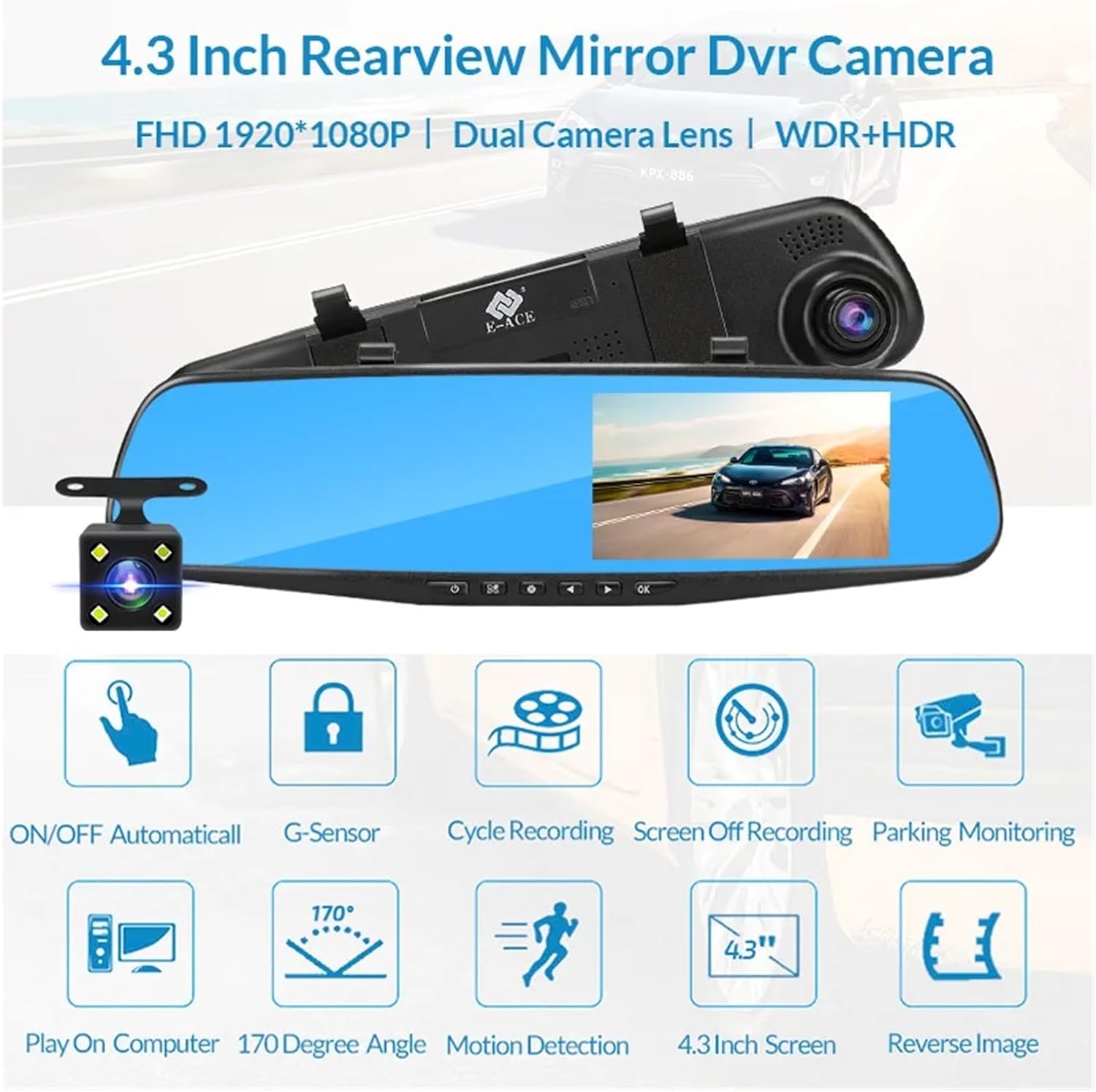
Image: An illustration highlighting the various functional features of the E-ACE dash cam.
4. Component Identification
Familiarize yourself with the various parts and controls of your E-ACE dash cam:

Image: A detailed diagram identifying the buttons, ports, and features on the E-ACE dash cam unit.
- ON/OFF Button: Powers the device on or off.
- Menu Button: Accesses settings and options.
- Mode Button: Switches between video recording, photo, and playback modes.
- UP Button: Navigates up in menus or adjusts settings.
- Down Button: Navigates down in menus or adjusts settings.
- OK Button: Confirms selections or starts/stops recording.
- TF Card Slot: Insert your MicroSD (TF) card here.
- AV-IN Port: Connects the rear camera.
- USB Port: For power supply and data transfer.
- Reset Button: Resets the device to factory settings (use a thin pin).
- Microphone: Records audio inside the vehicle.
5. Setup and Installation
5.1 Inserting the Memory Card
Before installation, insert a high-speed MicroSD (TF) card (Class 10 or higher, up to 64GB recommended) into the TF Card Slot (7) with the contacts facing the screen. Ensure the card is inserted correctly until it clicks into place.
5.2 Mounting the Dash Cam
- Attach the fixed bandages to the back of the dash cam unit.
- Securely strap the dash cam over your vehicle's existing rearview mirror using the fixed bandages. Ensure it is centered and stable.
5.3 Connecting the Power Supply
- Connect the car charger to the USB Port (9) on the dash cam.
- Plug the other end of the car charger into your vehicle's cigarette lighter socket.
- Route the power cable neatly along the windshield trim to avoid obstructing your view.
5.4 Installing the Rear Camera (Optional)
- Connect the rear camera cable to the AV-IN Port (8) on the dash cam.
- Route the rear camera cable from the dash cam to the rear of your vehicle. This typically involves tucking the cable under the headliner and along the side pillars.
- Mount the rear camera on the rear windshield or near the license plate using its adhesive or screws. Ensure it has a clear view of the road behind.
- If using the reverse image function, connect the red wire from the rear camera cable to your vehicle's reverse light power supply.
6. Operating Instructions
6.1 Power On/Off
- Automatic: The dash cam will automatically power on and start recording when your vehicle's ignition is turned on (if connected to a switched power source).
- Manual: Press and hold the ON/OFF Button (1) to manually power the device on or off.
6.2 Basic Operation
- Switch Modes: Press the Mode Button (3) to cycle between Video Recording, Photo, and Playback modes.
- Access Menu: In any mode, press the Menu Button (2) to enter the settings menu. Use the UP (4) and Down (5) buttons to navigate, and OK (6) to select.
- Start/Stop Recording: In Video Recording mode, press the OK Button (6) to manually start or stop recording.
6.3 Display Modes
While recording, you can typically switch between different display views by pressing the UP or Down buttons:
- Front Camera Only
- Rear Camera Only
- Picture-in-Picture (Front main, Rear sub-window)
- Picture-in-Picture (Rear main, Front sub-window)
6.4 Loop Recording
Set the loop recording duration (e.g., 1, 3, or 5 minutes) in the settings menu. When the memory card is full, the oldest unlocked files will be overwritten by new recordings.
6.5 G-Sensor
The G-sensor automatically detects collisions or sudden braking. When triggered, it locks the current video file, preventing it from being overwritten by loop recording. Adjust sensitivity in the settings.
6.6 Parking Monitoring (Optional)
If the buck line is installed, the dash cam can monitor your vehicle while parked. When motion or impact is detected, it will automatically record a short video. Enable this feature in the settings.
6.7 Date and Time Setting
It is important to set the correct date and time in the system settings for accurate timestamps on your recordings.
7. Maintenance
- Cleaning: Use a soft, dry cloth to clean the lens and screen. Avoid abrasive cleaners or solvents.
- Memory Card: Format the MicroSD card regularly (e.g., once a month) within the dash cam's settings to maintain optimal performance and prevent data corruption. Back up important files before formatting.
- Temperature: Avoid exposing the device to extreme temperatures, as this can affect battery life and component integrity.
- Firmware Updates: Check the manufacturer's website periodically for firmware updates that may improve performance or add features.
8. Troubleshooting
| Problem | Possible Cause | Solution |
|---|---|---|
| Dash cam does not power on. | No power supply; faulty charger; loose connection. | Check car charger connection and vehicle's cigarette lighter. Try a different USB cable/charger. |
| Recording stops automatically. | Memory card full; slow memory card; G-sensor sensitivity too high. | Format the memory card. Use a Class 10 or higher MicroSD card. Lower G-sensor sensitivity in settings. |
| Video footage is blurry. | Protective film on lens; dirty lens; incorrect focus. | Remove any protective film. Clean the lens with a soft cloth. |
| Rear camera not displaying. | Loose connection; faulty cable/camera. | Check the AV-IN connection. Ensure the rear camera is properly installed. |
| Device freezes or crashes. | Software issue; memory card error. | Press the Reset Button (10) with a thin pin. Format the memory card. |
9. Specifications
- Model Name: DMMRUTXB
- Display: 4.3 inches
- Camera: Dual Lens (Front & Rear support)
- Video Resolution: FHD 1920x1080P (Front)
- Features: Loop Recording, G-Sensor, Night Vision, Parking Monitoring, 170-degree wide angle
- Storage: Supports MicroSD (TF) card, Class 10 or higher (up to 64GB)
- Connectivity: USB, AV-IN (for rear camera)
- Item Weight: Approximately 1.76 ounces (50 grams)
- Package Dimensions: Approximately 0.39 x 0.39 x 0.39 inches
- Manufacturer: DMMRUTXB
10. Warranty and Support
For warranty information and technical support, please refer to the documentation provided with your purchase or contact the retailer/manufacturer directly. Keep your purchase receipt as proof of purchase.
Related documentsDMMRUTXB


Ask a question about this manual
Ask about setup, troubleshooting, compatibility, parts, safety, or missing instructions. Manuals+ will review the question and use this page’s manual context to help answer it.