
Introduction
This manual provides essential information for the proper use and handling of BARRINS 2W 1% 3.3K Metal Film Resistors. These components are designed for various electronic applications requiring precise resistance and stable performance.
Product Overview
BARRINS Metal Film Resistors are precision electronic components characterized by their stability and reliability. They are constructed with a thin metal film resistive element deposited on a ceramic substrate, offering excellent electrical characteristics.
Key Features:
- Function: Primarily used for current limiting, voltage division, signal conditioning, and power management in electronic circuits.
- Design: Compact size with through-hole package type for easy integration into circuit boards.
- Performance: Offers high stability, reliability, low noise characteristics, and a favorable voltage coefficient.
- Applications: Suitable for a wide range of fields including medical equipment, communication systems, and industrial control applications.
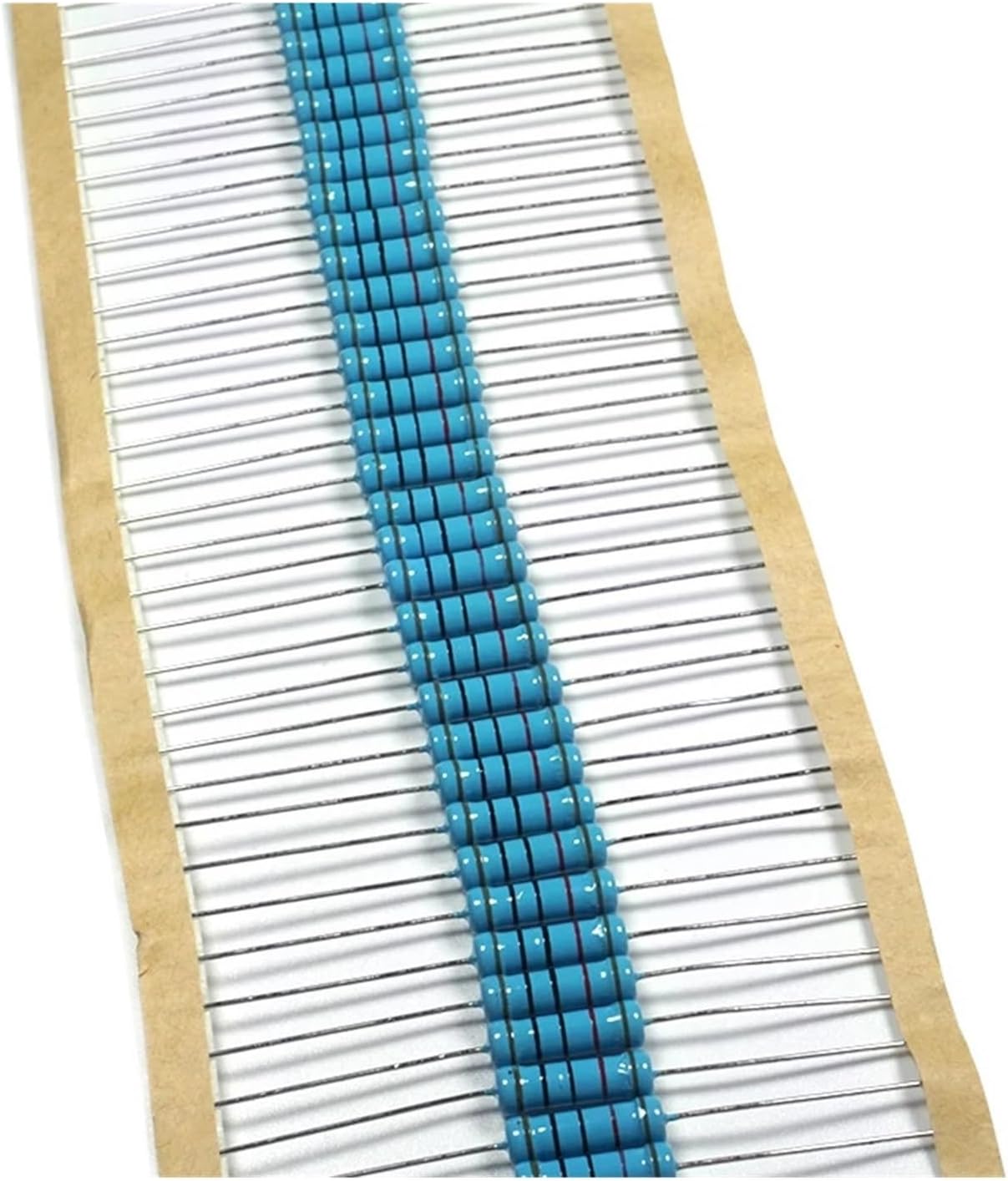
Specifications
| Characteristic | Value |
|---|---|
| Resistance Value | 3.3K Ohm |
| Power Rating | 2W |
| Resistance Tolerance | 1% |
| Technology | Metal Film |
| Package Type | Through Hole |
| Item Weight (approx.) | 50 Grams (for a pack of 20) |
| Number of Pieces | 20 |
Setup and Installation
Handling Precautions:
- Handle resistors by their leads to avoid touching the resistive body, which can transfer oils or contaminants.
- Avoid excessive bending or stressing the leads near the resistor body to prevent internal damage.
- Store resistors in a dry, temperature-controlled environment to maintain their integrity.
Installation Steps:
- Identify Value: Verify the resistor's value (3.3K Ohm) and tolerance (1%) using the color bands or markings on the component body.
- Prepare Leads: Gently bend the leads to fit the spacing of the circuit board holes. Ensure bends are smooth and not too close to the resistor body.
- Insert into Circuit Board: Insert the resistor leads into the designated holes on the Printed Circuit Board (PCB).
- Solder Connections: Securely solder the leads to the PCB pads. Use appropriate soldering techniques to ensure good electrical contact and prevent overheating the component.
- Trim Leads: Trim any excess lead length after soldering to prevent short circuits or interference.

Operating Principles
Metal film resistors operate by opposing the flow of electric current in a circuit. When current passes through the resistive element, a voltage drop occurs across the resistor, proportional to the current and resistance, as described by Ohm's Law (V = I * R).
Power Dissipation:
These 2W resistors are rated to dissipate up to 2 watts of power. Exceeding this rating can lead to overheating and component failure. It is crucial to ensure that the power dissipated in your circuit (calculated as P = V * I, P = I² * R, or P = V² / R) does not exceed 2W.
Temperature Coefficient:
Metal film resistors typically feature a low temperature coefficient, meaning their resistance value changes minimally with fluctuations in ambient temperature. This characteristic contributes to the overall stability and precision of the electronic circuit.
Maintenance
Metal film resistors are passive components and generally require no active maintenance. However, proper circuit design and environmental conditions are crucial for ensuring their long-term reliability and performance.
- Environmental Control: Operate resistors within their specified temperature range and avoid exposure to excessive humidity, corrosive environments, or mechanical stress.
- Visual Inspection: Periodically inspect resistors in critical applications for any signs of physical damage, discoloration (which may indicate overheating), or cracked solder joints.
- Cleaning: If cleaning a circuit board, ensure that cleaning agents are compatible with electronic components and do not leave conductive residues that could affect resistor performance.
Troubleshooting
If a circuit involving a metal film resistor is not functioning as expected, consider the following troubleshooting steps:
- Incorrect Resistance Value: Use a multimeter to measure the actual resistance value. An incorrect value, either due to manufacturing error or damage, can lead to improper circuit operation.
- Open Circuit: A resistor may fail as an open circuit (exhibiting infinite resistance) due to physical damage, excessive current, or a manufacturing defect. Check for continuity with a multimeter.
- Short Circuit: While rare for resistors, a short circuit (exhibiting near-zero resistance) can occur if the resistive element is bypassed or severely damaged.
- Overheating: Discoloration, charring, or a burnt smell emanating from the resistor indicates it has been subjected to excessive power. Re-evaluate circuit calculations for power dissipation and ensure the resistor's power rating is sufficient.
- Poor Solder Joint: Inspect solder connections for cold joints, solder bridges, or insufficient solder, which can lead to intermittent or complete circuit failure.
Warranty Information
BARRINS products are typically covered by a standard manufacturer's warranty against defects in materials and workmanship. For specific warranty terms and conditions, including duration and coverage details, please refer to your original purchase documentation or contact BARRINS customer support directly.
Support
For technical assistance, product inquiries, or customer support, please visit the official BARRINS website or contact your authorized distributor. When contacting support, please be prepared to provide your product details, model number (3.3K), and purchase information to facilitate efficient service.