Introduction
This manual provides detailed instructions for the setup, operation, and maintenance of your M-VAVE SMK-25 II MIDI Keyboard Controller. Please read this manual thoroughly before using the device to ensure proper functionality and to maximize your creative potential.

Image: Front view of the M-VAVE SMK-25 II MIDI Keyboard Controller, showcasing its 25 keys, 16 pads, and 8 knobs.
Product Overview
The M-VAVE SMK-25 II is a versatile 25-key USB MIDI Keyboard Controller designed for music production. It features wireless Bluetooth connectivity, 16 velocity-sensitive MPC drum pads with RGB backlighting, 8 assignable 360-degree rotary encoders, and a dynamic keybed. It offers seamless integration with popular Digital Audio Workstations (DAWs) and supports multiple platforms including PC, Mac, iOS, and Android.

Image: Overview of the SMK-25 II MIDI Keyboard, highlighting its key features such as 8 RGB back-lit pads, 8 360-degree rotary encoders, Smart Chord Function, Octave transform, and DAW control.
Key Features:
- 25 Dynamic Keys: Spring-loaded, force-sensitive keyboard for responsive play.
- 16 RGB Back-lit Pads: Velocity-sensitive with aftertouch for expressive drumming and sample triggering.
- 8 Assignable Rotary Encoders: 360-degree rotation for precise control over parameters.
- Wireless Connectivity: Bluetooth for PC/MAC/IOS/ANDROID mobile terminals, reducing cable clutter.
- Rechargeable Battery: Provides portability and a lightweight operating experience.
- Capacitive Touch Strips: Two strips for sensitive and flexible modulation control.
- Sustain Pedal Port & MIDI Out Port: Enhanced connectivity options.
- Compact and Portable Design: Ideal for musicians on the go.
Component Identification
Familiarize yourself with the different parts of your SMK-25 II MIDI Keyboard Controller:

Image: Labeled diagram of the SMK-25 II MIDI Keyboard, indicating the location of the back of keyboard, Pitch Stripe and Modulation Stripe, Display area, Button area, Oct+ / Oct- buttons, Knobs, Pads, and Keys.
- Back of keyboard: Rear panel connections.
- Pitch Stripe and Modulation Stripe: Capacitive touch strips for pitch bend and modulation control.
- Display area: Shows current settings and modes.
- Button area: Various function buttons (e.g., Mode, Octave, Latch, Gate, Swing, Tempo, Rate, Transpose).
- Oct+ / Oct- buttons: Adjust the octave range of the keyboard.
- Knobs: Eight assignable 360-degree rotary encoders.
- Pads: Sixteen RGB back-lit, velocity-sensitive drum pads.
- Keys: 25 velocity-sensitive mini-keys.
Setup
Setting up your M-VAVE SMK-25 II is a straightforward process. Follow these steps to get started:

Image: Visual representation of the three setup steps: 1. Plug In (connecting the device), 2. Install (software/drivers), 3. Play (begin using the controller).
- Charging the Device:
Before first use, ensure the SMK-25 II is fully charged using the provided USB Type-C cable. Connect the cable to the USB Type-C port on the controller and to a standard USB power adapter or a computer's USB port. The device can be used while charging.
- Wired Connection (USB):
Connect the SMK-25 II to your computer (PC/Mac) or compatible device using the supplied USB Type-C cable. The device is class-compliant and typically does not require additional drivers for basic MIDI functionality. Your operating system should recognize it automatically.
- Wireless Connection (Bluetooth):
To connect wirelessly via Bluetooth to your PC, Mac, iOS, or Android device:
- Ensure Bluetooth is enabled on your host device.
- On the SMK-25 II, activate Bluetooth mode (refer to the display area for indicators).
- Search for available Bluetooth MIDI devices on your host device and select "SMK-25 II" to pair.

Image: Graphic illustrating the M-VAVE SMK-25 II's compatibility with Windows, Mac, iOS, and Android operating systems.
- Software Installation (DAW Integration):
While the device is plug-and-play, for full functionality and seamless integration, open your preferred Digital Audio Workstation (DAW) such as GarageBand, Pro Tools, Studio One, Reason Studios, FL Studio, Ableton, or Cubase. Configure the SMK-25 II as your MIDI input device within the DAW's preferences or settings.

Image: The SMK-25 II MIDI Keyboard Controller shown in a music production environment, with logos of compatible DAWs including GarageBand, Pro Tools, Studio One, Reason Studios, FL Studio, Ableton, and Cubase.
Operating Instructions
Using the Keys:
The 25 velocity-sensitive keys respond to how hard you press them, allowing for dynamic expression in your music. The spring-loaded design ensures rapid rebound and sensitive touch.
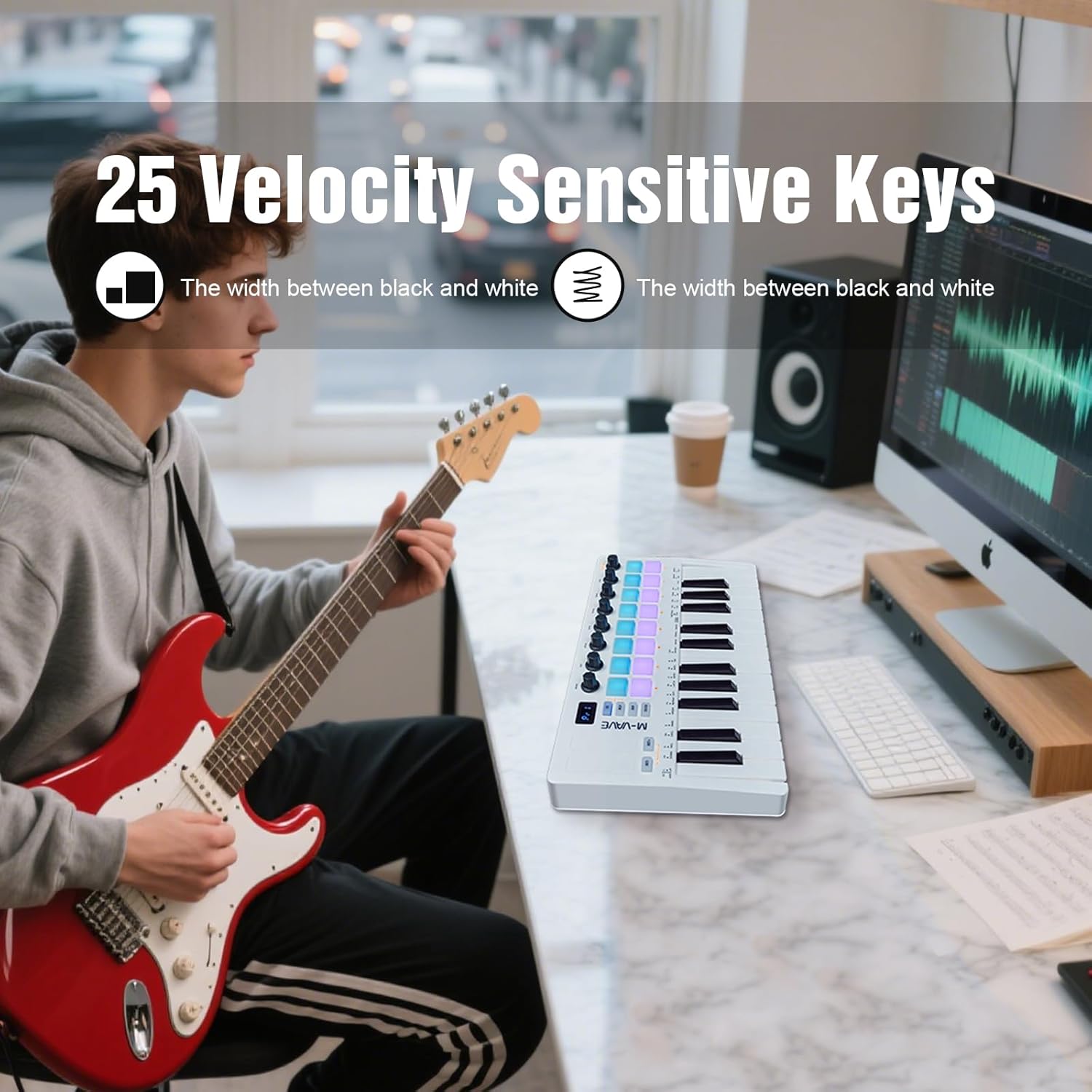
Image: Close-up of the 25 velocity-sensitive keys on the M-VAVE SMK-25 II, emphasizing their responsiveness.
- Octave Adjustment: Use the "Oct+" and "Oct-" buttons to shift the keyboard's octave range up or down, extending your playable note range beyond the physical 25 keys.
- Transpose: The transpose function allows you to shift the pitch of the entire keyboard up or down in semitone increments. Refer to the display for current transpose settings.
Using the Pads:
The 16 RGB back-lit pads are velocity-sensitive and support aftertouch, providing a wide range of expressive possibilities for drumming, triggering samples, or launching clips.
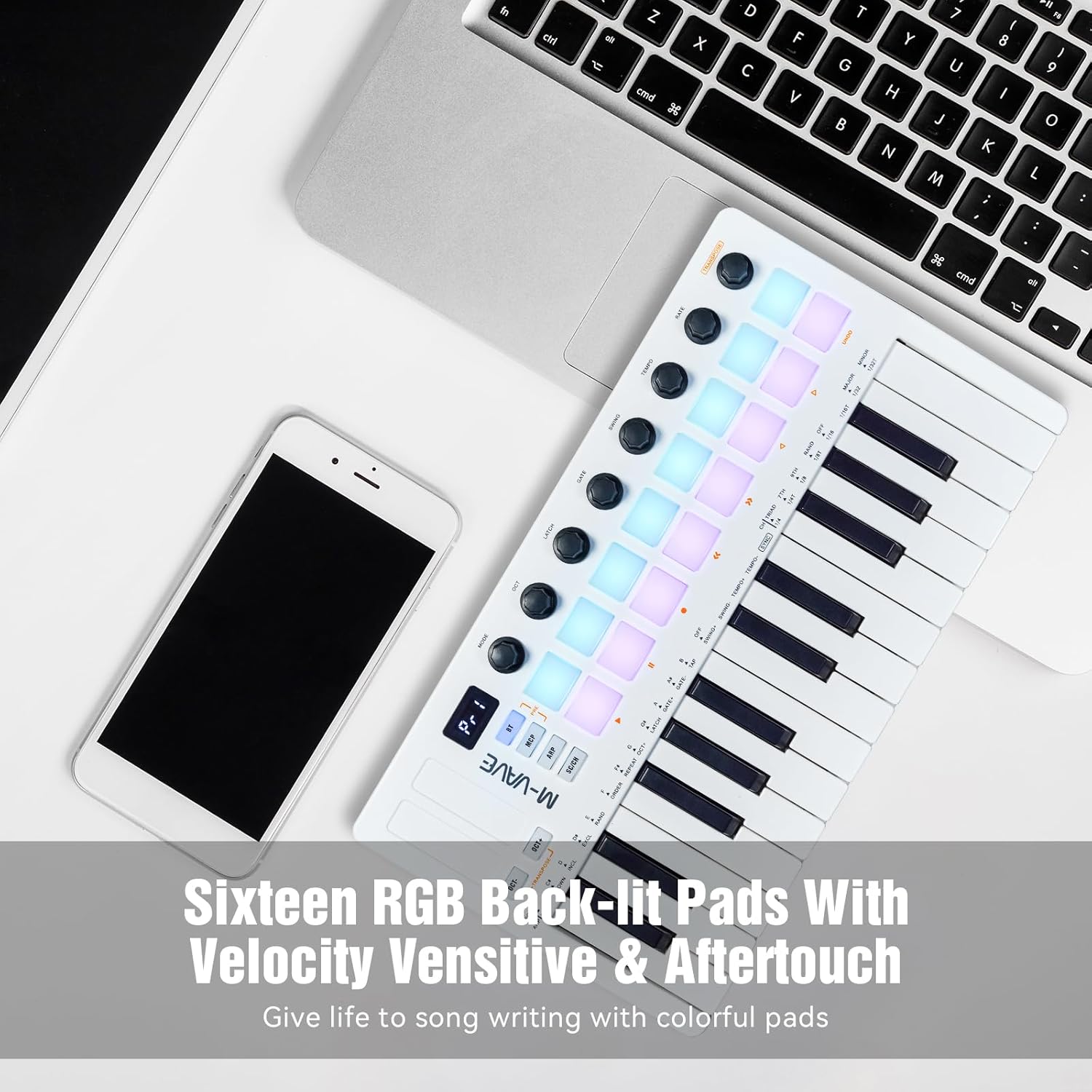
Image: A close-up view of the 16 RGB back-lit pads on the SMK-25 II, demonstrating their vibrant colors and responsiveness.
- Velocity Sensitivity: The harder you strike a pad, the louder or more intense the sound will be.
- Aftertouch: Apply continuous pressure to a pad after the initial strike to control parameters like vibrato, filter cutoff, or volume, depending on your software's mapping.
- RGB Backlighting: The pads' colors can indicate various states, such as active notes, clip status, or assigned functions, depending on the software.
Using the Knobs:
The 8 assignable 360-degree rotary encoders provide precise control over various parameters in your DAW or virtual instruments. These can be mapped to control volume, pan, filter cutoff, resonance, effects sends, and more.
- Assignment: Refer to your DAW's MIDI mapping instructions to assign these knobs to specific functions.
Using the Touch Strips (Pitch Bend & Modulation):
The two capacitive touch strips allow for dynamic control over pitch and modulation.
Image: A detailed view of the Pitch Stripe and Modulation Stripe, illustrating their function as touch-sensitive sliders for expressive control.
- Pitch Bend: Slide your finger up and down the pitch strip to bend the pitch of notes. Releasing your finger will return the pitch to its original value.
- Modulation: Slide your finger up and down the modulation strip to control parameters like vibrato, tremolo, or filter sweeps, depending on your instrument's settings.
Advanced Functions:
- Smart Chord Function: This feature allows you to play complex chords with a single key press. Consult the device's display and accompanying software for configuration.
- Arpeggiator: The built-in arpeggiator can automatically play sequences of notes from held chords. Adjust parameters like tempo, gate, and swing using the dedicated knobs.
- Sequencer: The SMK-25 II includes sequencing capabilities for creating and playing back musical patterns.
Maintenance
Proper care and maintenance will ensure the longevity and optimal performance of your M-VAVE SMK-25 II MIDI Keyboard Controller.
- Cleaning: Use a soft, dry, lint-free cloth to clean the surface of the controller. For stubborn dirt, slightly dampen the cloth with water. Avoid using abrasive cleaners, solvents, or alcohol, as these can damage the finish and components.
- Storage: When not in use, store the controller in a cool, dry place away from direct sunlight, extreme temperatures, and high humidity. If transporting, use a protective case to prevent physical damage.
- Battery Care: To maintain battery health, avoid fully discharging the battery frequently. If storing for extended periods, charge the battery to approximately 50% every few months.
- Connectivity Ports: Keep USB and MIDI ports free of dust and debris. Avoid forcing cables into ports.
Troubleshooting
If you encounter issues with your M-VAVE SMK-25 II, refer to the following common problems and solutions:
| Problem | Possible Cause | Solution |
|---|---|---|
| Device not recognized by computer/DAW. |
|
|
| No sound output. |
|
|
| Pads/Keys not responding or inconsistent. |
|
|
| Bluetooth connection drops frequently. |
|
|
If you continue to experience issues, please contact M-VAVE customer support.
Specifications
| Feature | Detail |
|---|---|
| Model Name | SMK-25 II |
| Number of Keyboard Keys | 25 (Velocity-sensitive) |
| Pads | 16 RGB Back-lit, Velocity-sensitive with Aftertouch |
| Knobs | 8 Assignable 360-degree Rotary Encoders |
| Connectivity Technology | USB Type-C, Bluetooth |
| Hardware Interface | Bluetooth, USB Type C |
| Compatible Devices | Tablet, Smartphone, Laptop, PC |
| Hardware Platform | PC/Mac, iOS, Android |
| Material Type | Polyvinyl Chloride (PVC) |
| Item Weight | 2.09 pounds (approx. 0.95 kg) |
| Package Dimensions | 14.48 x 8.62 x 2.76 inches (approx. 36.78 x 21.89 x 7.01 cm) |

Image: Diagram illustrating the physical dimensions of the M-VAVE SMK-25 II MIDI Keyboard Controller, including length, width, and height.
Warranty and Support
The M-VAVE SMK-25 II MIDI Keyboard Controller comes with a one-year warranty from the date of purchase. This warranty covers manufacturing defects and ensures the product functions as intended under normal use.
For warranty claims, technical support, or any product-related inquiries, please contact M-VAVE customer service. You can typically find contact information on the seller's store page or through the official M-VAVE website.
Note: Amazon return windows typically close after one month. For issues beyond this period, please contact the seller directly via the "ask a question" option on their store page.
For additional resources and software updates, visit the official M-VAVE website: www.m-vave.com


