
WMic-T1
WMic-T1 UHF Wireless Microphone System User Manual
Model: WMic-T1
1. Introduction
Thank you for choosing the WMic-T1 UHF Wireless Microphone System. This manual provides detailed instructions for the proper setup, operation, and maintenance of your new microphone system. Please read this manual thoroughly before using the product to ensure optimal performance and longevity. This system is designed for high-quality audio capture in various applications, including vlogging, live streaming, interviews, and video recording.
2. Package Contents
Please verify that all items listed below are included in your package. If any items are missing or damaged, please contact your retailer.

Image: Overview of the WMic-T1 UHF Wireless Microphone System package contents, including the transmitter, receiver, and accessories.
- 1 x Transmitter
- 1 x Receiver
- 1 x Cold Shoe Adapter
- 1 x Lavalier Microphone
- 1 x 3.5mm TRRS Output Cable (for smartphones)
- 1 x 3.5mm TRS Output Cable (for cameras)
- 2 x Belt Clips
- 1 x Storage Bag
- 1 x User Manual (English)
3. Product Overview
The WMic-T1 system consists of a transmitter and a receiver, both compact and lightweight, designed for portability and ease of use. They feature a clear display for channel and battery status.
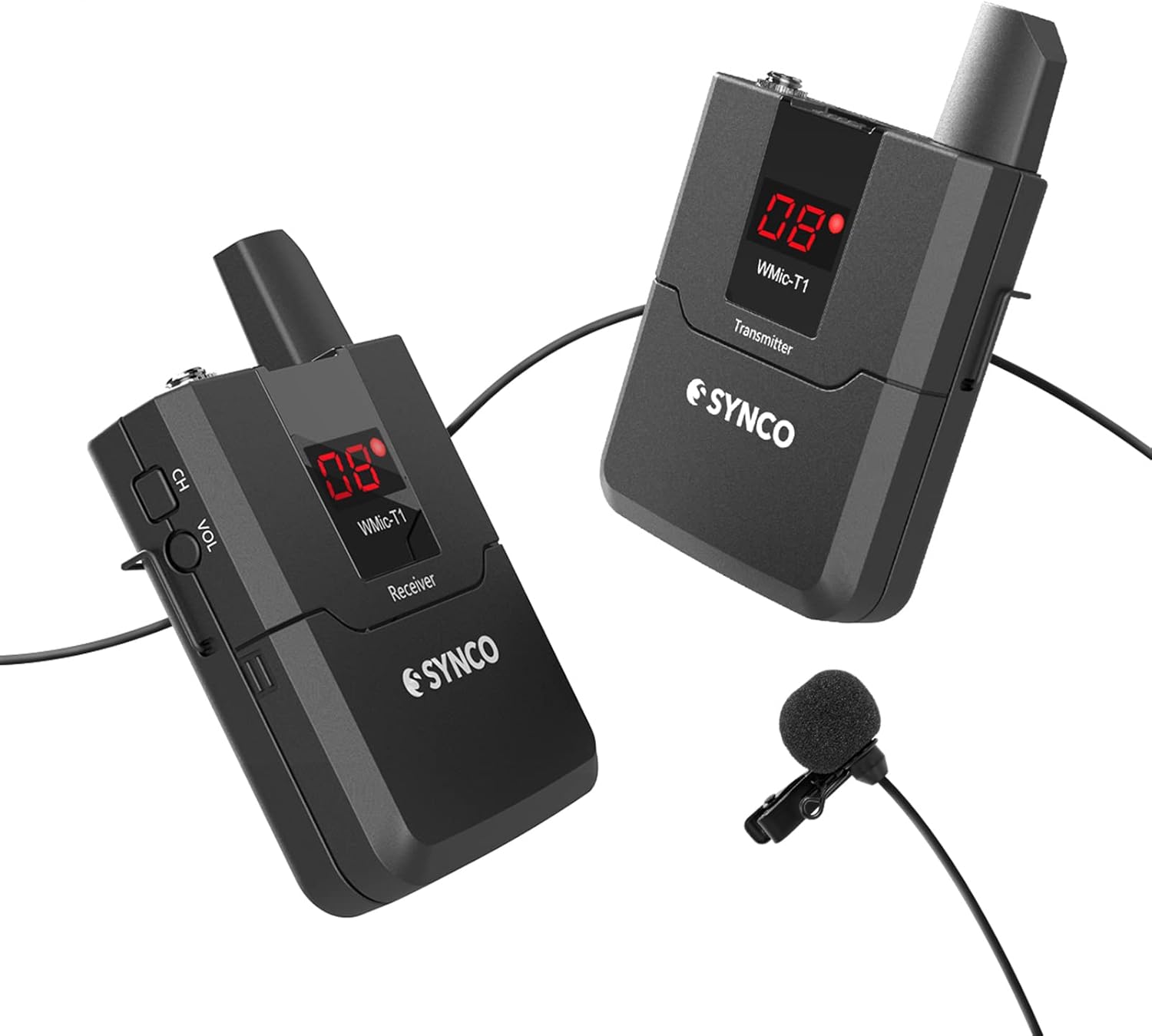
Image: The WMic-T1 wireless microphone system, showing both the transmitter and receiver units along with the lavalier microphone.
3.1 Key Features
- UHF Wireless Transmission: Supports 16 switchable channels for stable and interference-free audio.
- Extended Range: Effective transmission distance of up to 50 meters (164 feet) in open areas.
- Low Noise Performance: Utilizes DSP technology to minimize signal noise, achieving a Signal-to-Noise Ratio (SNR) of 70dB.
- Omnidirectional Lavalier Microphone: Captures sound from all directions with high detail, ideal for hands-free operation.
- Versatile Connectivity: Includes 3.5mm TRRS and TRS output cables for compatibility with smartphones, cameras, camcorders, and audio recorders.
- Compact and Lightweight Design: Easy to carry and mount with included cold shoe adapter and belt clips.
3.2 Components and Controls
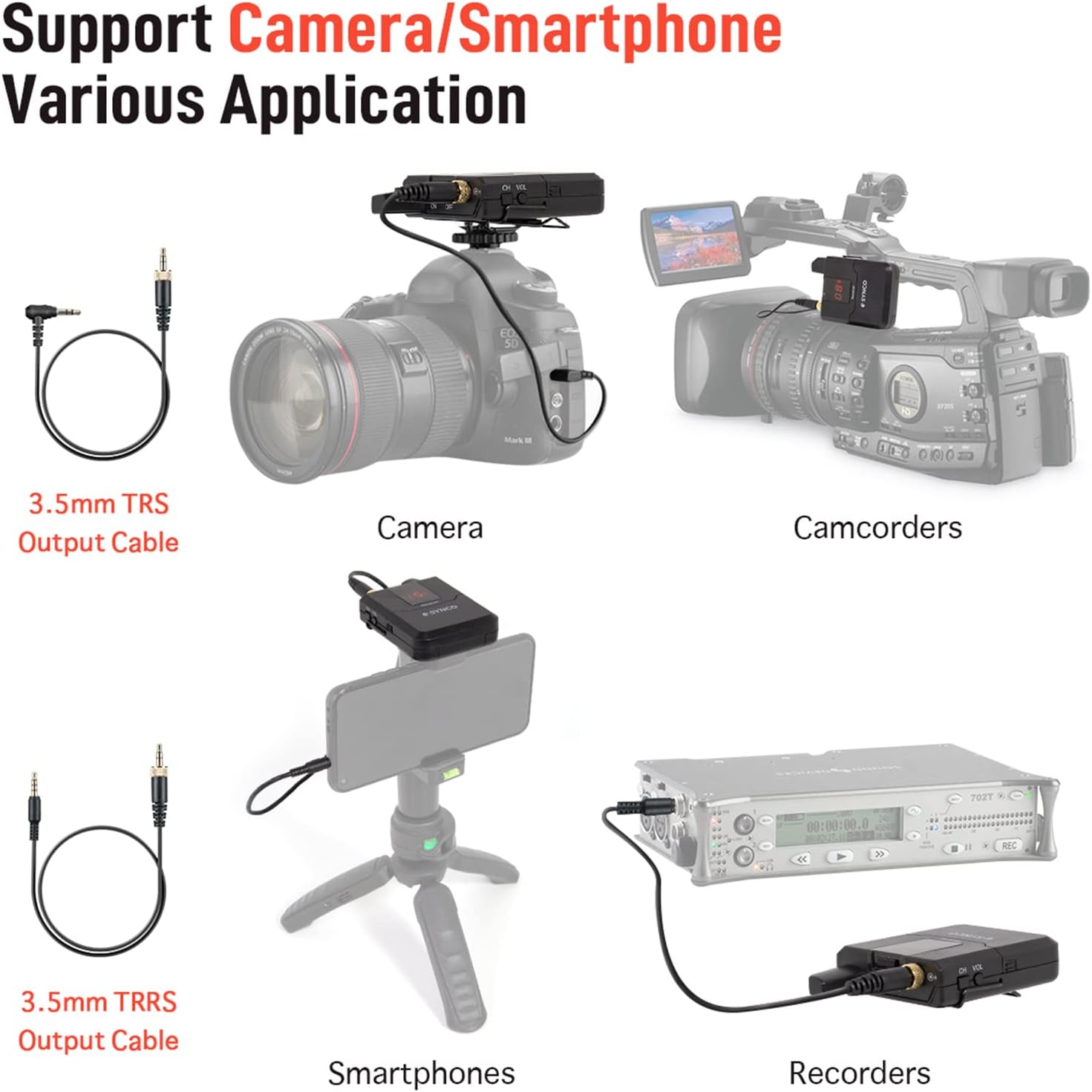
Image: Detailed views of the WMic-T1 units, highlighting the cold shoe mount, display screen, battery compartment, and belt clip attachment points.
- Power Switch: Turns the unit on or off.
- Channel (CH) Button: Used to select and switch between the 16 available UHF channels.
- Volume (VOL) Control: Adjusts the audio output level of the receiver.
- 3.5mm Mic Input (Transmitter): Connects the lavalier microphone.
- 3.5mm Audio Output (Receiver): Connects to your recording device (camera, phone, etc.).
- Display Screen: Shows current channel, battery status, and signal strength.
- Battery Compartment: Houses two AA batteries.
- Belt Clip: For attaching the unit to clothing or a belt.
- Cold Shoe Adapter: For mounting the receiver onto a camera's hot shoe.

Image: Illustrates the compact size of the WMic-T1 units compared to a smartphone, along with explanations of the multiple indicator lights (battery, IR/RF, audio).
3.3 Indicator Lights
- Battery Indicator: Turns red and flickers when power is low.
- IR/RF Light: Stays on when the channel is successfully matched between transmitter and receiver.
- Audio Green Light: Flickers when audio input is detected.
4. Setup
4.1 Battery Installation
Both the transmitter and receiver require two AA batteries (not included). Ensure correct polarity when inserting the batteries.

Image: Diagram showing the battery compartment of the WMic-T1 units and how to correctly insert two AA batteries.
- Open the battery compartment cover on the back of the transmitter/receiver.
- Insert two AA batteries, matching the positive (+) and negative (-) terminals as indicated inside the compartment.
- Close the battery compartment cover securely.
4.2 Connecting the Microphone and Output Cables
Connect the lavalier microphone to the transmitter and the appropriate output cable to the receiver based on your recording device.
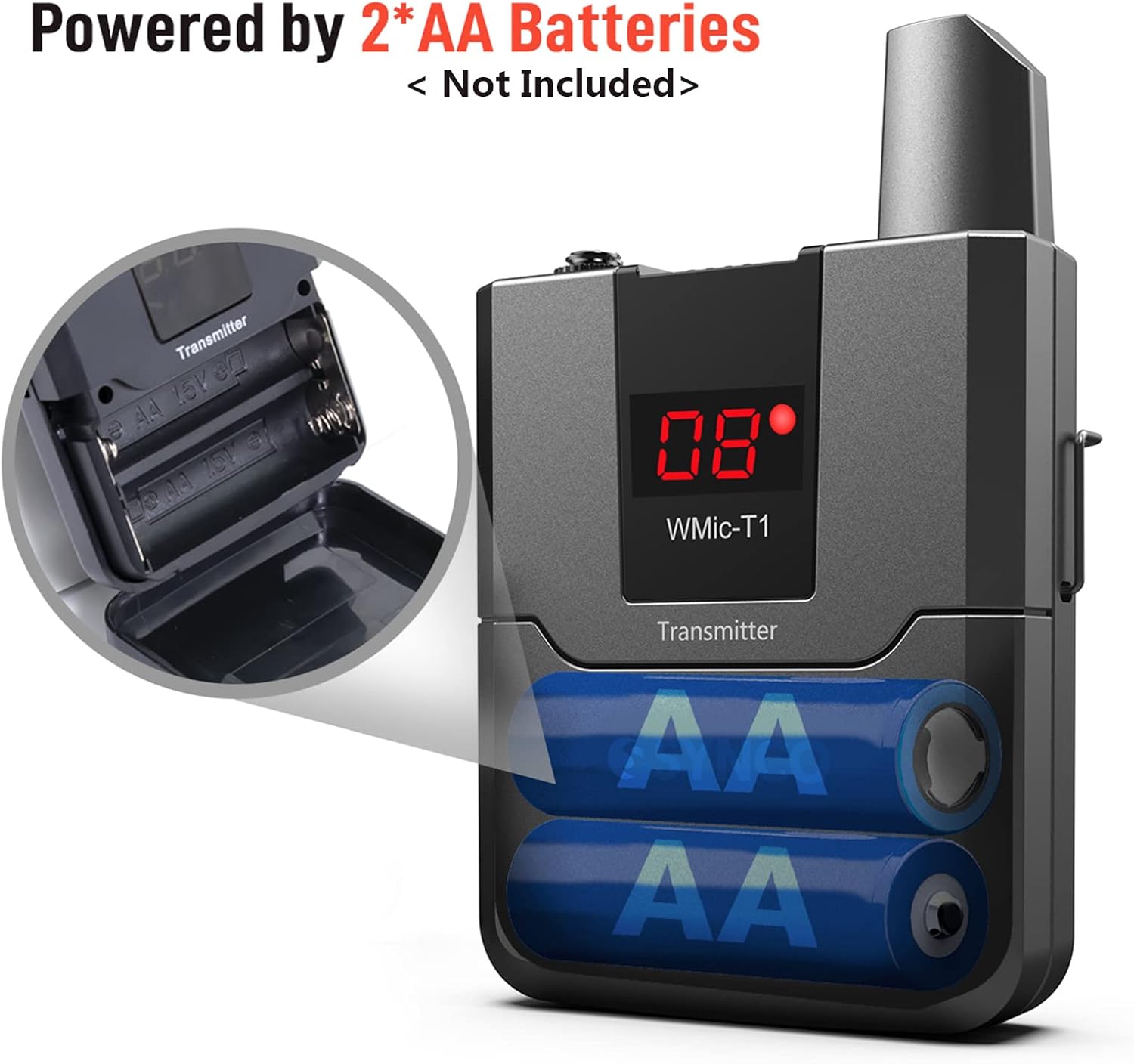
Image: Illustrations demonstrating how to connect the WMic-T1 receiver to various devices like cameras, camcorders, smartphones, and audio recorders using the 3.5mm TRS and TRRS cables.
- Plug the 3.5mm jack of the lavalier microphone into the MIC input port on the transmitter.
- For smartphones, use the 3.5mm TRRS output cable. Connect one end to the receiver's audio output and the other end to your smartphone's 3.5mm audio jack.
- For cameras, camcorders, or audio recorders, use the 3.5mm TRS output cable. Connect one end to the receiver's audio output and the other end to your device's 3.5mm audio input.
4.3 Mounting the Units
Use the provided accessories to conveniently mount the transmitter and receiver.
- Belt Clip: Attach the belt clip to the back of both the transmitter and receiver. This allows you to clip them onto clothing, belts, or pockets for hands-free operation.
- Cold Shoe Adapter: Attach the cold shoe adapter to the receiver. This allows you to slide the receiver onto the hot shoe mount of your camera or camcorder.
5. Operating Instructions
5.1 Powering On/Off
Slide the power switch on both the transmitter and receiver to the 'ON' position to power them on. Slide to 'OFF' to power them off.
5.2 Channel Selection and Pairing
The WMic-T1 system supports 16 switchable channels to avoid interference. The transmitter and receiver must be on the same channel to communicate.

Image: Visual representation of the 50-meter transmission range and the 16 switchable channels feature of the WMic-T1 system.
- Turn on both the transmitter and the receiver.
- Press the 'CH' button on either the transmitter or receiver to cycle through the available channels (01-16).
- Ensure that both units are set to the same channel number. The IR/RF light on the display will remain solid when a successful connection is established.
- If you experience interference, switch to a different channel until a clear signal is found.
5.3 Volume Adjustment
Adjust the output volume of the receiver using the 'VOL' control to match the input level requirements of your recording device. It is recommended to start with a lower volume and gradually increase it to avoid clipping.
5.4 Microphone Usage
The omnidirectional lavalier microphone is designed to pick up sound from all directions, making it versatile for various speaking positions.

Image: Close-up of the omnidirectional lavalier microphone being clipped onto clothing, illustrating its 360-degree sound pickup capability.
- Clip the lavalier microphone to your collar, tie, or other clothing, approximately 15-20 cm (6-8 inches) from your mouth for optimal sound capture.
- Ensure the microphone is not covered by clothing to prevent muffled sound.
5.5 Noise Reduction
The WMic-T1 incorporates DSP technology to effectively reduce background noise, ensuring clear audio recordings.

Image: Graphic illustrating the 70dB Signal-to-Noise Ratio (SNR) and extremely low noise performance of the WMic-T1, highlighting its DSP technology.
While the system is designed for low noise, always try to record in a quiet environment to achieve the best possible audio quality.
6. Maintenance
Proper maintenance will extend the life of your WMic-T1 system.
- Cleaning: Use a soft, dry cloth to clean the units. Do not use liquid cleaners or solvents, as they may damage the components.
- Storage: When not in use, store the system in the provided storage bag in a cool, dry place, away from direct sunlight and extreme temperatures.
- Battery Care: Remove batteries from the units if they will not be used for an extended period to prevent battery leakage and damage.
- Cable Care: Avoid sharp bends or kinks in the cables to prevent internal wire damage.
7. Troubleshooting
If you encounter issues with your WMic-T1 system, refer to the following troubleshooting guide:
| Problem | Possible Cause | Solution |
|---|---|---|
| No sound output | Units not powered on Low batteries Incorrect channel pairing Cables not connected properly Recording device input issue | Ensure both units are ON Replace batteries Verify transmitter and receiver are on the same channel Check all cable connections Test recording device with another audio source |
| Poor sound quality / Interference | Interference from other wireless devices Too far from receiver Obstructions between units Low battery | Switch to a different channel Reduce distance between transmitter and receiver Ensure clear line of sight Replace batteries |
| Lavalier mic not picking up sound | Mic not plugged in correctly Mic damaged Transmitter issue | Ensure mic is fully inserted into transmitter Try another lavalier mic if available Check transmitter's power and channel |
| Battery indicator flickering red | Low battery power | Replace both AA batteries immediately |
8. Specifications
Technical specifications for the WMic-T1 UHF Wireless Microphone System:
- Model: WMic-T1
- Color: Black
- Channels: 16 (UHF)
- Signal-to-Noise Ratio (SNR): 70dB
- Transmission Distance: Up to 50 meters (164 feet)
- Power Supply: 2 x AA batteries (not included) for each unit (Transmitter and Receiver)
- Output Cables: 3.5mm TRRS (for phone), 3.5mm TRS (for camera)
9. Warranty and Support
For warranty information, technical support, or service inquiries, please refer to the documentation provided at the time of purchase or contact your retailer. Keep your proof of purchase for any warranty claims.
Ask a question about this manual
Ask about setup, troubleshooting, compatibility, parts, safety, or missing instructions. Manuals+ will review the question and use this page’s manual context to help answer it.