
1. Introduction
This manual provides essential information for the proper installation, operation, and maintenance of your ZEZEFUFU 2200KV Brushless Motor, 9G Micro Servo, and 40A Electronic Speed Controller (ESC) kit. This kit is designed for use in remote-controlled (RC) aircraft. Please read this manual thoroughly before use to ensure safe and optimal performance.
2. Important Safety Guidelines
Failure to follow these safety instructions may result in injury, damage to the product, or property damage.
- Always connect the battery last and disconnect it first.
- Ensure all connections are secure and correct before applying power. Incorrect polarity can cause severe damage.
- Keep hands, hair, and loose clothing away from rotating propellers and motors. Propellers can cause serious injury.
- Operate RC models in open areas, away from people, animals, and obstacles.
- Never mix old and new batteries, or different types of batteries (e.g., alkaline, standard carbon-zinc, or rechargeable) in the same circuit.
- Always use batteries appropriate for the ESC and motor specifications (2-4S LiPo for this ESC).
- Monitor battery voltage and temperature during operation. Discontinue use if components become excessively hot.
- Store components in a dry, cool place, away from direct sunlight and moisture.
- Adult supervision is recommended for users under 18 years of age.

Image: Product packaging displaying general safety warnings regarding battery usage in multiple languages.
3. Package Contents
Verify that all components listed below are present in your package:
- 1 x 2200KV Brushless Motor
- 1 x 40A Electronic Speed Controller (ESC) with XT60 Plug
- 2 x 9G Micro Servos
- 2 x 6035 Propellers
- Motor mounting accessories (mount, screws)
- Propeller adapters and other fittings

Image: All components included in the ZEZEFUFU kit: 2200KV motor, 40A ESC, two 9G micro servos, and two propellers with accessories.
4. Component Overview
4.1 2200KV Brushless Motor
This is a high-performance 2200KV brushless motor, suitable for various RC aircraft applications. It features a 3.17mm shaft diameter and is designed for 2-3 cell LiPo batteries.

Image: The 2200KV brushless motor, shown with its metal mounting plate and small screws for installation.
4.2 9G Micro Servo
The 9G micro servo is a compact and lightweight servo, providing 1.5-1.7kg/cm of torque at 4.8V-6V. It is ideal for controlling flight surfaces such as ailerons, elevators, or rudders in small RC planes.

Image: Two 9G micro servos, blue in color, with their standard three-wire connectors (signal, power, ground).
4.3 40A Electronic Speed Controller (ESC)
This 40A ESC is designed for brushless motors and supports 2-4 cell LiPo batteries. It features a 5V@3A BEC (Battery Eliminator Circuit) to power your receiver and servos. Key protection features include low voltage cutoff, over-heat protection, and throttle signal loss protection.

Image: The 40A brushless ESC, featuring an XT60 battery connector on one end and three motor phase wires on the other, along with a smaller receiver connection cable.
4.4 Propellers
The kit includes two 6035 propellers, suitable for the 2200KV motor. Ensure propellers are balanced and securely attached for optimal performance and safety.

Image: Two orange 6035 propellers and a set of black propeller adapters/spacers.
5. Setup and Installation
Carefully follow these steps for proper installation of your components.
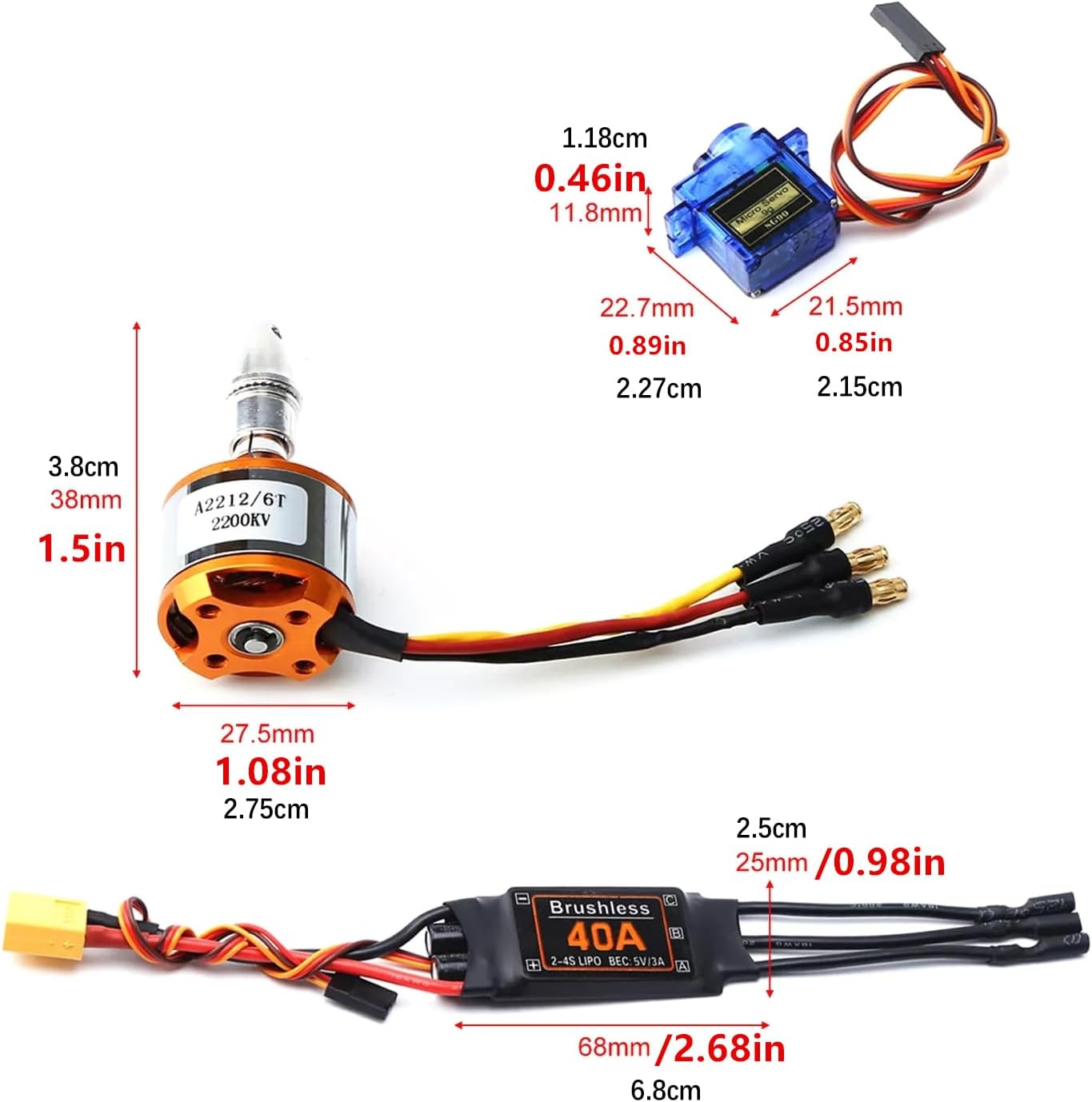
Image: A diagram illustrating the physical dimensions (in cm and inches) of the 2200KV motor, 40A ESC, and 9G micro servo, useful for planning installation space.
5.1 Motor Installation
- Mount the 2200KV brushless motor to your aircraft's motor mount using the provided screws and mounting plate. Ensure it is securely fastened.
- The motor can be mounted in either a front or rear configuration depending on your aircraft design.
5.2 ESC Connection
- Connect the three motor phase wires from the ESC to the three wires of the brushless motor. The order of connection may affect motor rotation direction. If the motor spins in the wrong direction, swap any two of the three wires.
- Connect the XT60 plug of the ESC to your LiPo battery. Ensure correct polarity (red to positive, black to negative).
- Plug the small three-wire connector from the ESC (BEC output) into the throttle channel of your RC receiver. This typically corresponds to channel 3.
5.3 Servo Installation
- Mount the 9G micro servos into their designated positions on your aircraft (e.g., for ailerons, elevator, rudder).
- Connect the servo wires to the appropriate channels on your RC receiver (e.g., channel 1 for aileron, channel 2 for elevator, channel 4 for rudder).
5.4 Propeller Attachment
- Attach the propeller to the motor shaft using the provided propeller adapter and nut.
- Ensure the propeller is oriented correctly for thrust (usually the curved side facing forward).
- Tighten the propeller nut securely, but do not overtighten.
6. Initial Setup and Calibration
6.1 Throttle Range Calibration
Throttle range calibration is crucial for the ESC to recognize the full throttle range of your transmitter. This ensures proper motor control and safety arming.
- Turn on your transmitter and set the throttle stick to its maximum position (full throttle).
- Connect the battery to the ESC. The motor will emit a series of beeps.
- Once the beeps indicate the maximum throttle position has been recognized, immediately move the throttle stick to its minimum position (full brake/off).
- The motor will emit another series of beeps, confirming the minimum throttle position has been recognized.
- The ESC is now calibrated. Disconnect the battery and reconnect it to start normal operation.
6.2 Safety Arming Feature
The ESC includes a safety arming feature. Regardless of the throttle stick position, the motor will not spin immediately after the battery is connected. To arm the ESC, ensure the throttle stick is at its minimum (off) position when connecting the battery. The ESC will then arm, indicated by a specific beep sequence, and the motor will be ready for operation.
7. Operation
Once all components are installed and calibrated, you can begin operating your RC aircraft. Always perform a pre-flight check to ensure all controls are functioning correctly and in the right direction.
- Pre-Flight Check: Verify servo movements correspond to transmitter inputs. Check motor rotation direction and propeller security.
- Takeoff: Apply throttle smoothly and gradually.
- Flight: Maintain control and be aware of your surroundings.
- Landing: Reduce throttle and guide the aircraft to a gentle landing.
- Post-Flight: Disconnect the battery immediately after use. Inspect components for any damage or loose connections.
8. Maintenance
Regular maintenance ensures the longevity and reliability of your RC components.
- Cleaning: Keep the motor, ESC, and servos free from dirt, dust, and moisture. Use a soft brush or compressed air for cleaning.
- Inspection: Periodically check all wires and connectors for signs of wear, fraying, or corrosion. Ensure motor bearings are smooth and free of resistance.
- Storage: Store components in a dry, cool environment. Disconnect batteries when not in use.
- Propellers: Inspect propellers for cracks, nicks, or damage before each flight. Replace damaged propellers immediately.
9. Troubleshooting
Refer to the following table for common issues and their potential solutions.
| Problem | Possible Cause | Solution |
|---|---|---|
| Motor not spinning | ESC not armed; incorrect throttle calibration; loose motor wires; dead battery. | Ensure throttle is at minimum when connecting battery; recalibrate throttle; check all connections; charge/replace battery. |
| Motor spins in wrong direction | Incorrect motor wire connection. | Swap any two of the three motor phase wires between the ESC and motor. |
| Servo not responding | Loose connection; incorrect channel; damaged servo/receiver. | Check servo connection to receiver; verify channel assignment; test with another servo/receiver if possible. |
| ESC beeps continuously | Low battery voltage; throttle signal loss; ESC error. | Check battery voltage; ensure receiver is powered and connected; recalibrate throttle. |
| Loss of control during flight | Radio interference; low receiver battery; range issue. | Ensure clear line of sight; check receiver battery; operate within safe range. |
10. Technical Specifications
10.1 ESC Parameters
- Current: 40A (Continuous), 55A (Short-time, <10s)
- Power Input: 2-4 Lithium Batteries (LiPo)
- BEC Output: 5V@3A (Linear Regulator Mode)
- Maximum Speed: 210,000 rpm (2-pole motor), 70,000 rpm (6-pole motor), 35,000 rpm (12-pole motor)
- Dimensions: Approximately 68 x 25 x 8mm
10.2 9G Servo Parameters
- Size: 21.5 x 11.8 x 22.7mm
- Weight: 9 grams
- No Load Speed: 0.12 sec / 60 deg (4.8V)
- Locked-rotor Torque: 1.5-1.7kg/cm (4.8V-6V)
- Operating Temperature: -30 to +60℃
- Dead Zone Setting: 5 Microseconds
- Working Voltage: 4.8V-6V
10.3 Motor Parameters
- KV: 2200
- Ri(MΩ): 0.033
- Battery: 2-3 Li-Po
- Max Power: 342W
- Test Prop: 7x3/7x4
- Motor Size: 27.5 x 38mm
- Shaft Diameter: 3.17mm
10.4 General Product Specifications
- Product Dimensions: 1 x 1 x 1 inches (Approximate, for entire kit)
- Item Weight: 200 pounds (This value appears to be an error in the source data and is not representative of the actual product weight.)
- Manufacturer Recommended Age: 17 years and up
11. Warranty and Customer Support
ZEZEFUFU products are manufactured to high-quality standards. For specific warranty details, please refer to the product packaging or contact your retailer. If you encounter any issues or require technical assistance, please reach out to the seller or manufacturer's customer support channels.