1. Introduction
This manual provides detailed instructions for the installation, operation, and maintenance of the QUASAR X99 H5 Motherboard. The X99 H5 is a robust solution designed for workstations and servers, supporting LGA 2011-3 socket processors, including Intel Xeon V3/V4 series. It features DDR4 REG ECC memory support in a Dual Channel configuration, ensuring reliable stability and high performance for demanding applications such as rendering, virtualization, and intensive data processing.
Key features include PCIe 16X slots for expansion, an M.2 NVMe slot for high-speed storage, and multiple SATA 3.0 ports for additional drives. High-speed USB 3.0 ports are also integrated for rapid data transfer and peripheral connectivity. Its well-planned layout simplifies system assembly and maintenance, while quality components contribute to operational longevity and stability.
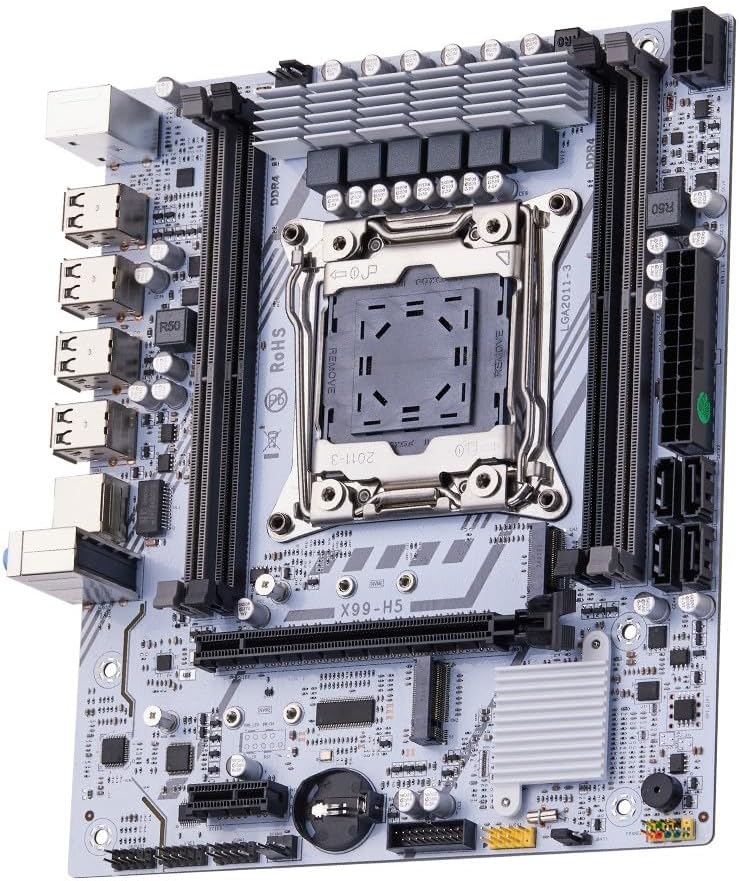
Figure 1.1: Overview of the QUASAR X99 H5 Motherboard. This image displays the full motherboard, highlighting its compact and efficient design, including the CPU socket, memory slots, and various expansion ports.
2. Safety Information
Please read all safety instructions carefully before installing or operating the motherboard. Failure to follow these guidelines may result in personal injury, damage to the product, or damage to other components.
- Always disconnect the power supply from the wall outlet before installing or removing any components.
- Wear an anti-static wrist strap or frequently touch a grounded metal object to discharge static electricity before handling the motherboard or other components.
- Handle the motherboard by its edges to avoid touching sensitive components.
- Ensure proper ventilation within the computer case to prevent overheating.
- Do not expose the motherboard to moisture or extreme temperatures.
- Keep out of reach of children.
3. Setup and Installation
3.1. Component Identification
Familiarize yourself with the various components and connectors on the motherboard before beginning installation.

Figure 3.1: Labeled diagram of the QUASAR X99 H5 Motherboard. This image indicates the location of key components such as the CPU socket, DDR4 memory slots, PCIe slots, M.2 NVMe slot, SATA ports, USB ports, and power connectors.
- LGA 2011-3 CPU Socket: For Intel Xeon V3/V4 processors.
- DDR4 Memory Slots (4x): Supports DDR4 REG ECC memory up to 128GB.
- PCIe 16X Slots: For graphics cards and other expansion cards.
- M.2 NVMe Slot: For high-speed solid-state drives.
- SATA 3.0 Ports: For connecting traditional hard drives and SSDs.
- 24-pin ATX Power Connector: Main power input.
- 8-pin CPU Power Connector: Additional power for the CPU.
- USB 3.0/2.0 Ports: For peripheral connectivity.
- Gigabit Ethernet Port: For network connectivity.
- Audio Jacks: For audio input/output.
- PS/2 Ports: For legacy keyboard and mouse.
3.2. Pre-Installation Checklist
- Compatible CPU (Intel Xeon V3/V4 series, LGA 2011-3 socket).
- Compatible DDR4 REG ECC memory modules.
- ATX power supply unit.
- Computer case with ATX form factor support.
- Storage devices (M.2 NVMe SSD, SATA SSD/HDD).
- Graphics card (if CPU does not have integrated graphics or for dedicated performance).
- Screwdriver set, anti-static wrist strap.
3.3. Installation Steps
- Prepare the Case: Install the I/O shield into the rear opening of your computer case.
- Install the CPU:
- Open the CPU socket retention mechanism.
- Carefully align the CPU with the socket, ensuring the triangular mark on the CPU matches the mark on the socket.
- Gently place the CPU into the socket without forcing it.
- Close the retention mechanism to secure the CPU.
- Install the CPU Cooler: Apply thermal paste (if not pre-applied) and install the CPU cooler according to its manufacturer's instructions. Connect the CPU fan cable to the CPU_FAN header on the motherboard.
- Install Memory Modules:
- Open the clips on the DDR4 memory slots.
- Align the notch on the memory module with the key in the slot.
- Press down firmly on both ends of the module until the clips snap into place. For Dual Channel configuration, refer to the motherboard's silkscreen for recommended slot pairing (e.g., A1 and B1).
- Mount the Motherboard: Carefully place the motherboard into the computer case, aligning it with the standoffs. Secure the motherboard with screws.
- Install Storage Devices:
- For M.2 NVMe SSDs: Insert the M.2 SSD into the M.2 slot and secure it with the provided screw.
- For SATA drives: Connect SATA data cables from the motherboard's SATA ports to your drives. Connect power cables from the PSU to your drives.
- Install Expansion Cards: Insert graphics cards or other PCIe expansion cards into the appropriate PCIe slots and secure them with the case's retention mechanism.
- Connect Power Supply:
- Connect the 24-pin ATX power cable from the PSU to the motherboard.
- Connect the 8-pin CPU power cable from the PSU to the motherboard.
- Connect Front Panel Cables: Connect the power button, reset button, HDD LED, power LED, and front panel USB/audio cables to their respective headers on the motherboard. Refer to the motherboard's silkscreen or a detailed diagram for correct pin assignments.
- Connect Peripherals: Connect your monitor, keyboard, mouse, and other peripherals to the rear I/O ports.

Figure 3.2: Close-up view of the rear I/O panel of the QUASAR X99 H5 Motherboard. This image shows the PS/2 ports for keyboard and mouse, multiple USB ports, the Ethernet port, and the audio jacks.
4. Operating Instructions
4.1. First Boot and BIOS Setup
- After connecting all components and power, press the power button on your computer case.
- During the boot process, repeatedly press the DEL or F2 key (common BIOS entry keys) to enter the BIOS/UEFI setup utility. The exact key may vary; check your screen for prompts.
- In the BIOS, verify that all installed components (CPU, RAM, storage drives) are detected correctly.
- Configure boot order to prioritize your operating system installation media (USB drive or DVD).
- Save changes and exit the BIOS. The system will restart.
4.2. Operating System Installation
Follow the instructions provided with your operating system (e.g., Windows, Linux) to complete the installation process. Ensure you install all necessary drivers for the motherboard's chipsets, network adapter, audio, and any other integrated components. Drivers are typically available on the manufacturer's website or included on a driver disc.
4.3. Driver Installation
For optimal performance and stability, install the latest drivers for your motherboard. These typically include:
- Chipset Drivers
- LAN (Ethernet) Drivers
- Audio Drivers
- USB Drivers (if specific ones are required)
- SATA/NVMe Storage Drivers
Visit the manufacturer's support website for the X99 H5 motherboard to download the most current drivers.
5. Maintenance
Regular maintenance helps ensure the longevity and optimal performance of your motherboard and system.
- Dust Removal: Periodically clean dust from inside your computer case, especially from fans, heatsinks, and the motherboard surface. Use compressed air or a soft brush. Ensure the system is powered off and unplugged before cleaning.
- BIOS/UEFI Updates: Check the manufacturer's website for BIOS/UEFI updates. Updates can improve compatibility, stability, and performance. Follow the update instructions carefully to avoid damaging the motherboard.
- Driver Updates: Keep your system drivers updated to the latest versions.
- Cable Management: Ensure internal cables are neatly routed to improve airflow and prevent interference.
- Environmental Control: Operate the system in a clean, dry, and well-ventilated environment. Avoid extreme temperatures and humidity.
6. Troubleshooting
This section provides solutions to common issues you might encounter.
| Problem | Possible Cause | Solution |
|---|---|---|
| System does not power on. | No power, loose connections, faulty PSU. | Check power cable, 24-pin and 8-pin power connectors. Ensure PSU switch is ON. Test PSU if possible. |
| No display on monitor. | Loose graphics card, faulty RAM, incorrect monitor input. | Reseat graphics card and RAM modules. Check monitor cable and input source. Test with one RAM stick. |
| System reboots unexpectedly. | Overheating, unstable power, faulty components. | Check CPU cooler installation. Ensure adequate case ventilation. Verify PSU stability. Run memory diagnostic. |
| Operating system not found. | Incorrect boot order, unformatted drive, faulty drive. | Check BIOS boot order. Ensure storage drive is properly connected and formatted with an OS. |
| USB devices not recognized. | Missing drivers, faulty port, device issue. | Install/update USB drivers. Try different USB ports. Test device on another system. |
If issues persist, consult the manufacturer's support resources or a qualified technician.
7. Specifications
| Feature | Detail |
|---|---|
| Brand | Generic (Manufactured by Machinist) |
| Model Series | X99 H5 |
| CPU Socket | LGA 2011-3 |
| Compatible Processors | Intel Xeon V3/V4 series |
| Memory Technology | DDR4 REG ECC |
| Memory Slots | 4 x DDR4 DIMM slots (Dual Channel) |
| Max Memory Supported | 128 GB |
| Memory Clock Speed | Up to 3200 MHz (actual speed depends on CPU and memory modules) |
| Storage Interfaces | 1 x M.2 NVMe slot, Multiple SATA 3.0 ports |
| Expansion Slots | PCIe 16X slots (number not specified, but typically at least one) |
| Networking | 1 x Gigabit Ethernet Port |
| USB Ports | USB 3.0 and USB 2.0 ports (number not specified, but typically multiple) |
| Audio | Integrated Audio Jacks |
| Form Factor | ATX (Dimensions: 30.5 x 24.4 cm) |
| Product Weight | 1 Kilogram |
8. Warranty and Support
For warranty information and technical support, please refer to the documentation provided with your purchase or visit the manufacturer's official website. Keep your proof of purchase for warranty claims.
Typical support resources include:
- Online FAQs and Knowledge Base
- Driver and BIOS Download Section
- Customer Service Contact Information (Email/Phone)
When contacting support, please have your motherboard model (X99 H5) and any relevant error messages or system configurations ready.


