
1. Introduction
This manual provides essential instructions for the safe assembly, operation, and maintenance of the Generic Mobile Crane (300kg Rack). This product is a portable, foldable, and detachable frame designed to support a lifting hoist (hand-operated or electric, sold separately or as part of other variants). It is suitable for various lifting tasks, including vehicle-mounted applications and household use.
Please read this manual thoroughly before assembly or use to ensure proper function and safety.
2. Safety Information
WARNING: Failure to follow these safety instructions may result in serious injury or property damage.
- Always ensure the crane rack is on a stable, level surface before attempting any lifting operation.
- Do not exceed the maximum rated load capacity of 300kg for this rack.
- When using the crane in reverse configuration, the load-bearing capacity is halved. Additionally, you must add two times the counterweight to the base to ensure stability.
- Never allow anyone to stand in the counterweight area during lifting operations.
- Regularly inspect all components for wear, damage, or loose connections before each use. Do not use if any part is damaged.
- Ensure the lifting hoist (not included with this rack variant) is securely attached and rated for the intended load.
- Keep hands and feet clear of moving parts during operation.
- Do not operate the crane in adverse weather conditions or in areas with poor visibility.
- Always lower loads slowly and in a controlled manner.
3. Product Components
The Generic Mobile Crane (300kg Rack) includes the following main components:
- Main Column with Retractable Feature
- Lifting Arm with Hook
- Base Frame with Legs
- Wear-Resistant Casters (4 units)
- Operating Handle (for manual adjustment/positioning)
- Mounting Hardware (bolts, nuts, pins)

This image illustrates the Generic Mobile Crane (300kg Rack) in an operational setting, demonstrating its use for loading or unloading items from a vehicle.
4. Setup and Assembly
The crane rack is designed for easy assembly and disassembly. Follow these steps:
- Unpack Components: Carefully remove all parts from the packaging and verify against the component list.
- Attach Casters: Securely attach the four wear-resistant casters to the designated points on the base frame using the provided hardware. Ensure they are tightened to prevent wobbling.
- Assemble Base Frame: If the base legs are detached, connect them to the central column support using the appropriate pins and bolts. Ensure all connections are firm.
- Install Main Column: Insert the main column into the base frame's central support. Secure it with the provided locking pin or bolts.
- Attach Lifting Arm: Connect the lifting arm to the top of the main column. Ensure the pivot points are correctly aligned and secured with pins.
- Secure Hook: Verify that the high-strength hook is securely attached to the lifting arm's cable or chain mechanism (if pre-assembled).
- Final Check: Before first use, double-check all bolts, pins, and connections to ensure they are tight and secure.

This diagram demonstrates the crane's foldable and detachable design for easy transport and storage, along with the adjustable lifting arm that can be set to various heights.

A detailed view of the wear-resistant, silent casters, which allow for 360-degree rotation, improving maneuverability and work efficiency.
5. Operating Instructions
This section outlines the general operation of the crane rack. Note that a separate lifting hoist (hand-operated or electric) is required and must be installed according to its own instructions.
5.1 General Operation
- Positioning: Roll the crane rack to the desired location. Ensure the casters are locked or the crane is otherwise stabilized before lifting.
- Adjusting Lifting Arm: The lifting arm can be adjusted for height and reach. Loosen the locking mechanism, adjust the arm to the desired position, and securely fasten the locking mechanism.
- Attaching Load: Securely attach the load to the crane's hook using appropriate slings or chains. Ensure the load is balanced.
- Lifting: Operate your attached hoist to slowly lift the load. Monitor the crane's stability throughout the lift.
- Lowering: Slowly lower the load to the desired position. Once the load is fully supported, detach it from the hook.
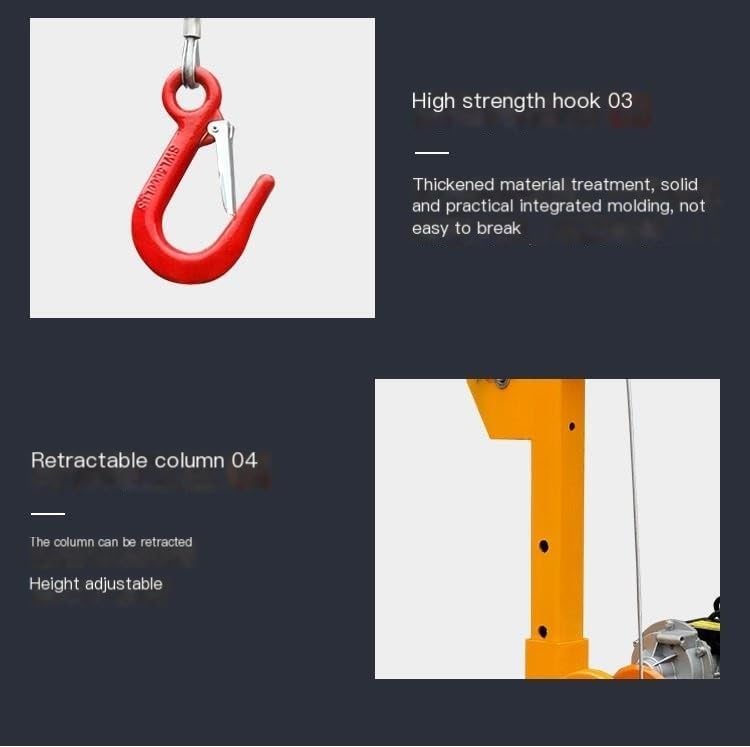
Detail shot showing the thickened, high-strength hook designed for secure lifting and the retractable column feature that allows for height adjustment.
5.2 Reverse Use
The crane rack can be configured for reverse use to avoid obstructions like vehicle legs or wellheads. When installed in reverse:
- The load-bearing capacity is halved. For a 300kg rack, the maximum load in reverse configuration is 150kg.
- You must add two times the counterweight to the base to ensure stability. This counterweight must be securely placed and monitored.
- Ensure no personnel are in the counterweight area during operation.

This schematic explains the procedure for using the crane in reverse, emphasizing the need for double the counterweight to maintain stability and safety. It also warns against standing in the counterweight area.
6. Maintenance
Regular maintenance ensures the longevity and safe operation of your crane rack.
- Cleaning: Keep the crane rack clean and free from dirt, debris, and corrosive substances. Wipe down with a damp cloth as needed.
- Lubrication: Periodically lubricate moving parts, such as the retractable column mechanism and caster axles, with appropriate grease or oil.
- Inspection: Before each use, visually inspect the entire rack for:
- Cracks, bends, or deformation in the alloy steel frame.
- Loose or missing bolts, nuts, and pins.
- Damage to casters or their mounting.
- Wear or damage to the hook.
- Storage: When not in use, store the crane rack in a dry, protected area. Its foldable design allows for compact storage.
7. Troubleshooting
If you encounter issues with your crane rack, refer to the following:
| Problem | Possible Cause | Solution |
|---|---|---|
| Crane feels unstable during lift. | Uneven surface; load exceeding capacity; insufficient counterweight (in reverse use); loose connections. | Move to a level surface; reduce load; add appropriate counterweight; tighten all bolts and pins. |
| Casters not rolling smoothly. | Dirt/debris in casters; lack of lubrication; damaged casters. | Clean casters; apply lubricant; replace damaged casters. |
| Lifting arm difficult to adjust. | Lack of lubrication; debris in mechanism; bent components. | Lubricate sliding parts; clean mechanism; inspect for damage. |
8. Specifications
- Product Name: Mobile Crane Rack
- Model: 300kg Rack
- Maximum Load Capacity: 300 kg (660 lbs)
- Reverse Use Load Capacity: 150 kg (330 lbs) - Requires 2x counterweight
- Hanger Material: Alloy Steel
- Features: Foldable, Detachable, Retractable Column, 360-degree Rotating Casters
- Compatible Hoist Power Types (for other variants/separate purchase): Hand crank, 12V/24V vehicle power, 110V household electricity
- Dimensions: Please refer to the product listing or included diagrams for detailed size specifications.

Detail view highlighting the seamless welding on the crane's bracket for enhanced stability and the comfortable, anti-slip handle designed to reduce user fatigue.
9. Warranty and Support
Information regarding product warranty and customer support is not available in this manual. Please refer to your purchase documentation or contact the seller directly for details on warranty coverage and technical assistance.