
1. Introduction
This manual provides detailed instructions for the installation, operation, and maintenance of your WILAWELS 200W Low Voltage Landscape Transformer, model D11LT06. This device is designed to safely convert 120V AC household current to 12V or 14V AC low voltage, suitable for outdoor LED and halogen landscape lighting systems. Please read this manual thoroughly before installation and use to ensure proper function and safety.
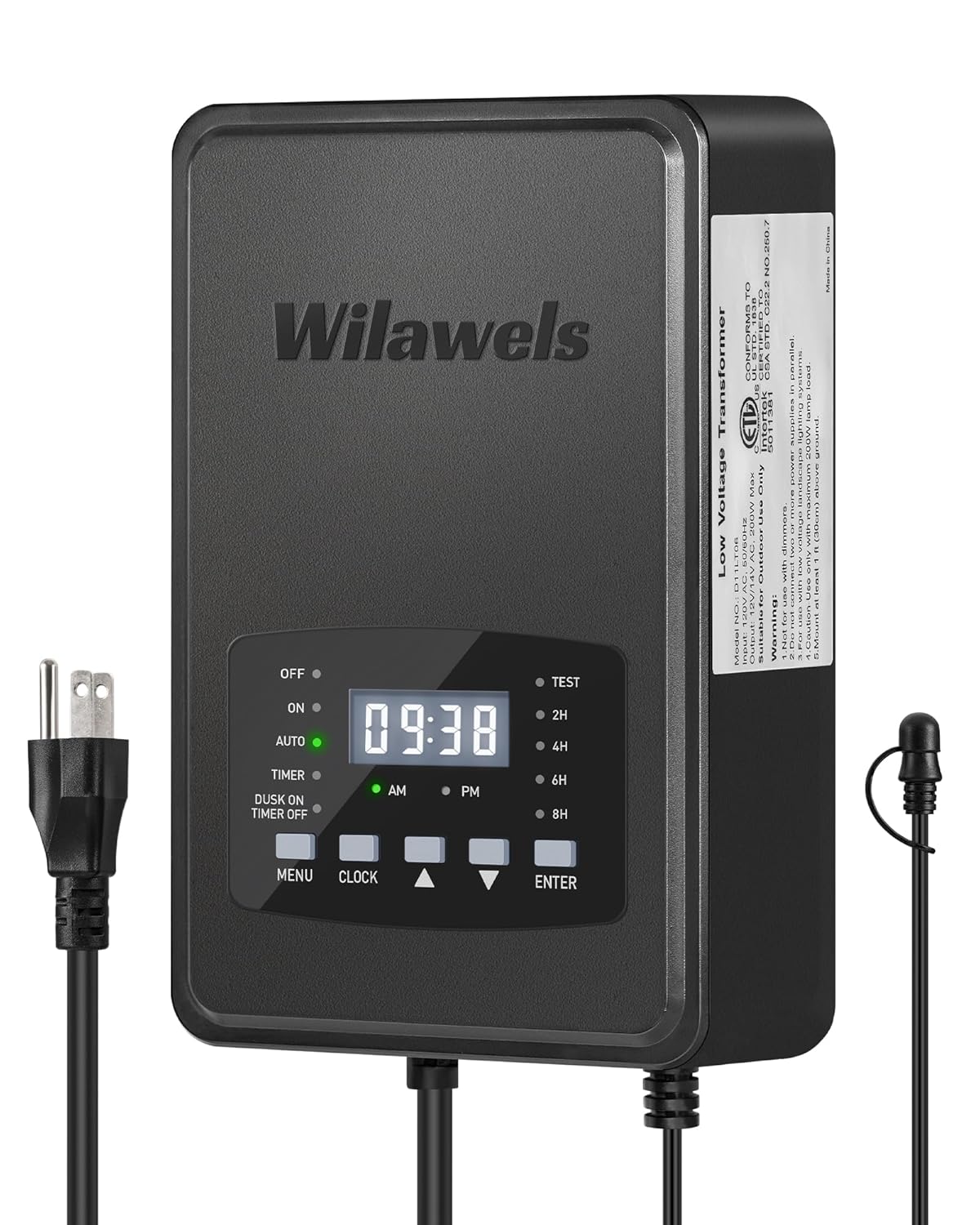
Image 1.1: Front view of the WILAWELS 200W Low Voltage Landscape Transformer D11LT06, showing the digital display and control buttons.
Safety Information
- Ensure the transformer is installed by a qualified electrician or in accordance with local electrical codes.
- Do not immerse the transformer in water. It is designed for outdoor use and is weatherproof, but not submersible.
- Always disconnect power before performing any installation, maintenance, or troubleshooting.
- Do not overload the transformer. The total wattage of connected lights must not exceed 200W.
- Keep children away from the transformer during operation.
2. Package Contents
Verify that all items are present in the package:
- WILAWELS 200W Low Voltage Landscape Transformer (Model D11LT06)
- Detachable Photocell Sensor with 6ft cord
- User Manual
3. Product Features
The WILAWELS D11LT06 transformer offers advanced features for reliable and efficient landscape lighting:
- ETL Certified: Ensures safety and quality standards are met.
- Power Conversion: Safely converts 120V AC to 12V AC or 14V AC for stable power delivery.
- Detachable Photocell Sensor: Automatically turns lights on at dusk and off at dawn.
- Six Operating Modes: Includes Manual On/Off, Auto On/Off (Dusk to Dawn), Countdown (2/4/6/8 hours), Timer (customizable on/off times), DUSK ON TIMER OFF, and TEST mode.
- Built-in Circuit Protection: Automatically disconnects power in case of overload or short circuit, protecting connected equipment.
- Memory Function: Retains programmed settings after a power interruption.
- Weatherproof Construction: Designed to withstand rain, snow, dust, and corrosive environments.

Image 3.1: Diagram illustrating the transformer's function, converting 120V AC input to 12V/14V AC output.

Image 3.2: Illustration of the memory function, showing the transformer retaining settings after power recovery.
4. Specifications
| Specification | Value |
|---|---|
| Model Number | D11LT06 |
| Power Output | 200W Max |
| Input Voltage | 120V AC |
| Output Voltage | 12V AC / 14V AC |
| Product Dimensions | 3.2"D x 5.7"W x 8.9"H (8.2cm D x 14.5cm W x 22.7cm H) |
| Weight | 9.92 Pounds |
| Power Source | Corded Electric |
| Mounting Type | Wall Mount |
| Certifications | ETL Listed |
| Power Cord Length | 3.3 ft (ETL Certified SJTW 18AWG/3C) |
| Sensor Cord Length | 6 ft (ETL Certified 20AWG/2C) |

Image 4.1: Detailed view of the transformer showing its dimensions and specifications for the power and sensor cords.
5. Setup and Installation
5.1 Mounting the Transformer
- Choose a suitable outdoor location for wall mounting. The location should be protected from direct heavy rain and easily accessible.
- Ensure the mounting surface is sturdy enough to support the transformer's weight.
- Use appropriate screws and anchors (not included) to securely mount the transformer to the wall.
5.2 Connecting Low-Voltage Wiring
The transformer features dual terminal outputs (12V and 14V) to accommodate different lighting needs and cable lengths.
- Turn off the main power supply before making any connections.
- Strip approximately 1/2 inch of insulation from the ends of your low-voltage landscape lighting cables.
- Loosen the terminal screws on the transformer's output block.
- Insert the bare wire ends into the desired 12V or 14V terminals. Ensure a secure connection by tightening the screws.
- Connect your landscape lights to the low-voltage cables according to their individual instructions.
5.3 Connecting the Photocell Sensor
The detachable photocell sensor allows for automatic dusk-to-dawn operation.
- Plug the photocell sensor's connector into the designated port on the transformer.
- Position the photocell sensor in a location that receives natural ambient light, free from obstruction or artificial light sources (e.g., porch lights) that could interfere with its operation.

Image 5.1: Rear view of the transformer showing the dual terminal outputs, circuit breaker, and photocell sensor connection port.
6. Operating Instructions
The transformer features a digital display and control buttons for easy programming. The control panel includes MENU, CLOCK, Up/Down arrows, and ENTER buttons.

Image 6.1: Visual representation of the six available operating modes for the transformer.
6.1 Setting the Clock
- Press the CLOCK button. The hour display will flash.
- Use the Up/Down arrows to adjust the hour. Press ENTER to confirm.
- The minute display will flash. Use the Up/Down arrows to adjust the minutes. Press ENTER to confirm.
- Adjust AM/PM as needed and press ENTER.
6.2 Selecting Operating Modes
Press the MENU button to cycle through the available modes. Press ENTER to select a mode and then use the Up/Down arrows to adjust settings.
- OFF Mode: Lights remain off.
- ON Mode: Lights remain on continuously.
- AUTO Mode (Dusk to Dawn): Lights turn on automatically at dusk and turn off at dawn, controlled by the photocell sensor.

Image 6.2: Illustration of the transformer activating lights at dusk and deactivating them at dawn.

Image 6.3: Conceptual image showing smart auto-on at dusk and auto-off at dawn for energy savings.
- COUNTDOWN Mode (2/4/6/8 Hours): Lights turn on at dusk and automatically turn off after a set duration (2, 4, 6, or 8 hours). Use the Up/Down arrows to select the desired duration.

Image 6.4: Example of programmable timers, showing lights turning on at dusk and off after 6 hours.
- TIMER Mode: Allows you to set specific ON and OFF times for your lights. Press ENTER to set the ON time, then repeat for the OFF time using the Up/Down arrows.

Image 6.5: Illustration of setting a custom lighting schedule with specific start and closing times.
- DUSK ON TIMER OFF Mode: Lights turn on at dusk and turn off at a specific programmed time. Set the desired OFF time using the Up/Down arrows.

Image 6.6: Example of lights activating at dusk and shutting down at a customizable time.
- TEST Mode: Activates the lights for a short period (e.g., 30 seconds) to verify connections and light functionality. This mode is useful during installation to check wiring without waiting for dusk.

Image 6.7: Illustration of Test Mode, showing lights turning on briefly to confirm functionality and aid in sensor placement.
7. Maintenance
Regular maintenance ensures optimal performance and longevity of your transformer.
- Cleaning: Periodically wipe the transformer's exterior with a soft, damp cloth to remove dust and debris. Do not use abrasive cleaners or solvents.
- Photocell Sensor: Ensure the photocell sensor remains clean and free from obstructions (e.g., leaves, dirt) that could affect its light detection.
- Connections: Annually inspect all low-voltage wiring connections for corrosion or looseness. Tighten as necessary.
- Environmental Protection: While weatherproof, avoid prolonged exposure to extreme conditions if possible. Ensure the unit is securely mounted to prevent damage from strong winds.

Image 7.1: The transformer demonstrating its weather-resistant properties against rain, snow, dust, and temperature variations.
8. Troubleshooting
If you encounter issues with your transformer, refer to the following troubleshooting guide:
| Problem | Possible Cause | Solution |
|---|---|---|
| Lights do not turn on. | No power to transformer, circuit breaker tripped, incorrect mode selected, faulty wiring, photocell obstructed. | Check power outlet. Reset circuit breaker. Verify mode setting. Inspect low-voltage wiring for breaks or loose connections. Ensure photocell is clear and receiving light. |
| Lights stay on continuously. | ON mode selected, photocell not functioning or receiving too much light. | Change to desired automatic mode. Relocate photocell to a darker area or ensure it's not covered. |
| Lights turn on/off at incorrect times. | Incorrect clock setting, photocell interference, incorrect mode programming. | Adjust the clock. Ensure photocell is not affected by artificial light. Re-program the selected mode (Timer, Countdown, Dusk On Timer Off). |
| Circuit breaker trips repeatedly. | Overload (too many lights), short circuit in wiring or lights. | Reduce the total wattage of connected lights. Inspect all low-voltage wiring and light fixtures for short circuits. Disconnect lights one by one to identify the faulty component. Reset the circuit breaker after troubleshooting. |
If issues persist after following these steps, please contact WILAWELS customer support.
9. Warranty and Support
WILAWELS provides a standard manufacturer's warranty for this product. Please refer to the warranty card included in your package or visit the official WILAWELS website for detailed warranty terms and conditions.
For technical support, troubleshooting assistance, or warranty claims, please contact WILAWELS customer service through the contact information provided on the product packaging or their official website. When contacting support, please have your model number (D11LT06) and purchase date available.