
1. Safety Information
WARNING: Installation, operation, and maintenance of this circuit breaker must be performed by qualified personnel only. Failure to follow these instructions can result in serious injury or death, and property damage. Always disconnect power before working on electrical equipment.
- Ensure all local and national electrical codes are followed.
- Verify that the power supply is completely disconnected and locked out before installation or maintenance.
- Use appropriate personal protective equipment (PPE) when working with electrical systems.
- Do not operate the circuit breaker if it appears damaged.
2. Product Overview
The HZVEKCRI XT1C160 TMD100-1000 FF 3P is a molded case circuit breaker designed for reliable protection of electrical circuits. It features a thermal-magnetic trip unit (TMD100-1000) and is a 3-pole device, suitable for various industrial and commercial applications. This circuit breaker is engineered to interrupt fault currents and protect equipment from overloads and short circuits.
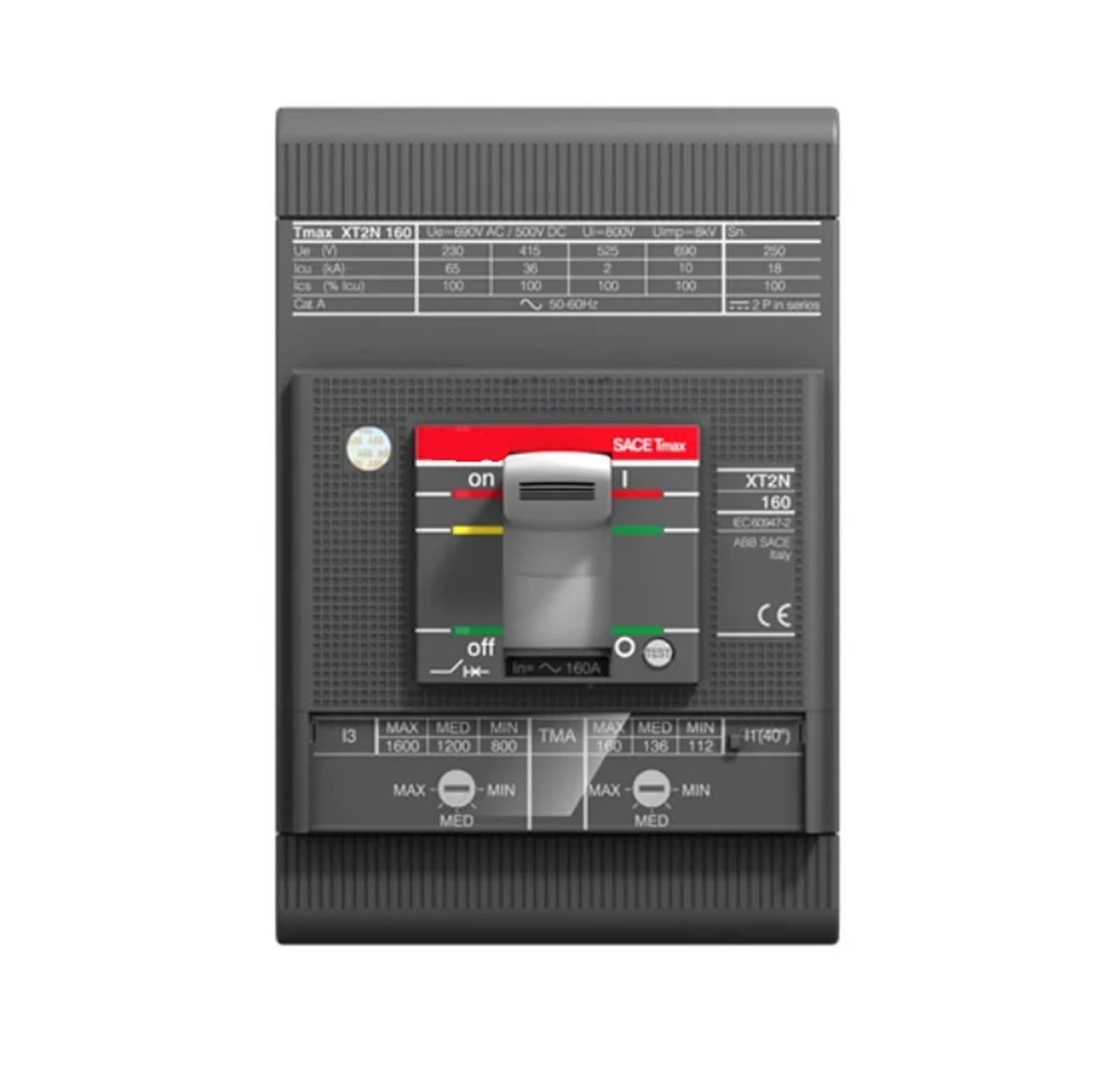
Figure 1: Front view of the HZVEKCRI XT1C160 TMD100-1000 FF 3P Molded Case Circuit Breaker. Visible components include the main ON/OFF toggle switch, a label indicating 'SACE Tmax XT2N 160', and various technical specifications and adjustment dials for current settings (MAX, MED, MIN) and trip unit (TMA).
3. Installation
Installation should only be performed by a certified electrician or qualified personnel.
- Power Disconnection: Ensure all power to the installation area is completely disconnected and verified using appropriate testing equipment. Apply lockout/tagout procedures.
- Mounting: Securely mount the circuit breaker in an appropriate enclosure or panel according to manufacturer guidelines and local electrical codes. Ensure adequate ventilation.
- Wiring: Connect the incoming and outgoing electrical conductors to the designated terminals. Ensure proper torque is applied to all terminal screws as specified by the manufacturer to prevent loose connections and overheating. Observe correct polarity and phase connections for 3-phase systems.
- Grounding: Ensure the circuit breaker and its enclosure are properly grounded.
- Verification: After wiring, double-check all connections for tightness and correctness. Verify there are no loose wires or debris.
- Power Restoration: Once installation is complete and verified, carefully restore power to the system.
4. Operation
The circuit breaker is designed for simple operation, providing protection against overcurrents.
- Turning ON: To energize the circuit, move the toggle handle to the 'ON' position. The handle will typically be in the upward position.
- Turning OFF: To de-energize the circuit, move the toggle handle to the 'OFF' position. The handle will typically be in the downward position.
- Trip Indication: If an overload or short circuit occurs, the circuit breaker will automatically trip. The handle will move to a central, tripped position (often indicated by a red or yellow marker).
- Resetting After a Trip: Before resetting, identify and rectify the cause of the trip. To reset, first push the handle fully to the 'OFF' position, then move it to the 'ON' position. If the breaker immediately trips again, do not force it; investigate further.
5. Maintenance
Regular maintenance ensures the longevity and reliable operation of your circuit breaker. Always disconnect power before performing any maintenance.
- Visual Inspection: Periodically inspect the circuit breaker for any signs of physical damage, discoloration, loose connections, or excessive dust accumulation.
- Cleaning: Keep the circuit breaker and its enclosure clean and free from dust and debris. Use a dry, non-abrasive cloth. Do not use liquids or solvents.
- Connection Checks: Annually, or as recommended by a qualified electrician, verify the tightness of all electrical connections.
- Functional Test: If equipped with a test button, periodically press it to ensure the trip mechanism is functional. This should only be done by qualified personnel.
6. Troubleshooting
If the circuit breaker is not functioning as expected, consider the following common issues:
- Breaker Trips Frequently:
- Overload: The circuit may be drawing too much current. Reduce the load on the circuit.
- Short Circuit: A direct connection between live wires or a live wire and ground. This requires immediate investigation by a qualified electrician.
- Ground Fault: Current leaking to ground.
- Faulty Appliance/Wiring: Disconnect appliances one by one to identify the faulty one, or inspect wiring for damage.
- Breaker Does Not Reset:
- Ensure the handle is pushed fully to the 'OFF' position before attempting to move it to 'ON'.
- If it still does not reset, there might be a persistent fault or internal damage to the breaker. Do not force it; consult a qualified electrician.
- Breaker Feels Hot: This could indicate an overload, loose connection, or internal fault. Immediately disconnect power and have it inspected by a qualified electrician.
7. Specifications
Below are the key specifications for the HZVEKCRI XT1C160 TMD100-1000 FF 3P Molded Case Circuit Breaker:
| Feature | Specification |
|---|---|
| Model Number | XT1C160 TMD100-1000 FF 3P |
| Brand | HZVEKCRI |
| Type | Molded Case Circuit Breaker |
| Poles | 3P |
| Trip Unit | Thermal-Magnetic (TMD100-1000) |
| Package Dimensions | 1.18 x 0.79 x 0.39 inches |
| Item Weight | 3.6 ounces |
| Manufacturer | HZVEKCRI |
| Assembly Required | No |
| Number of Pieces | 1 |
8. Warranty and Support
For warranty information and technical support, please refer to the documentation provided with your purchase or contact HZVEKCRI customer service directly. Ensure you have your product model number and purchase details available when seeking support.